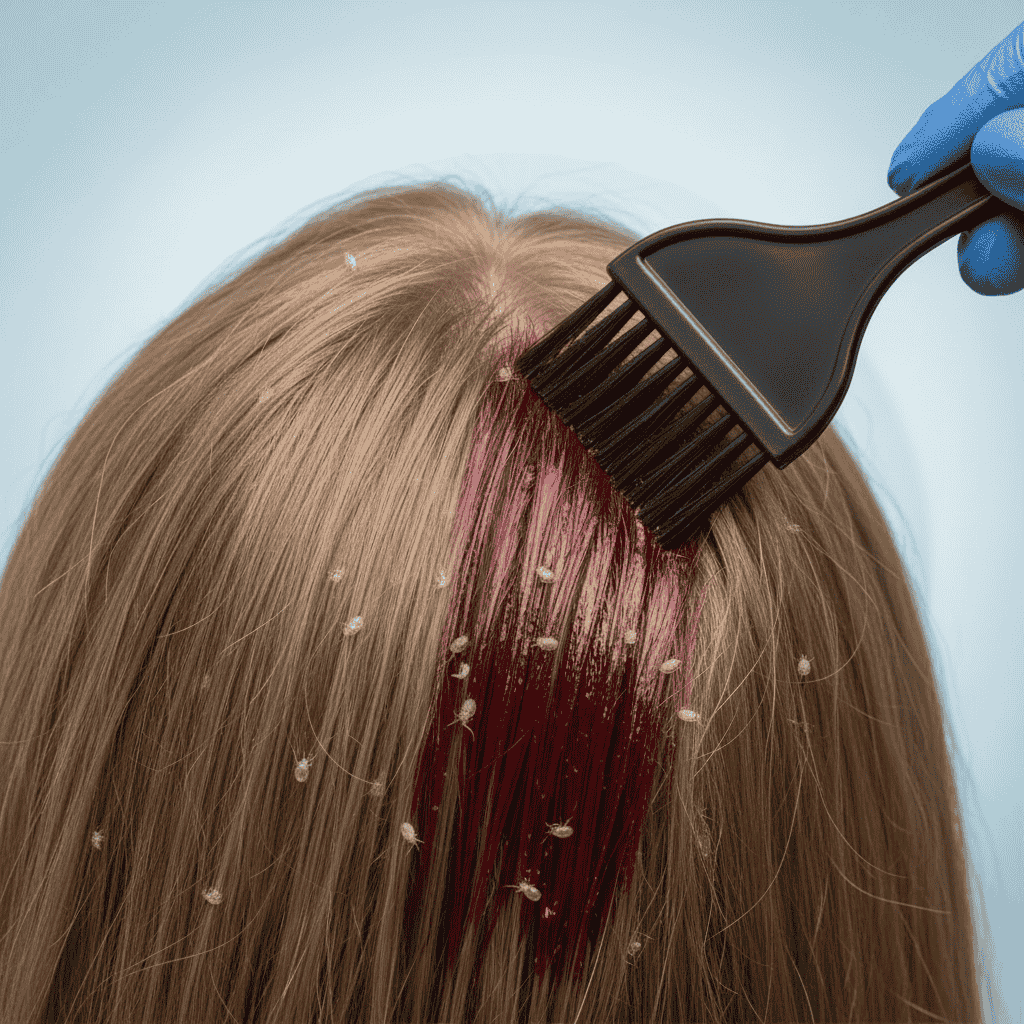
If you’ve ever looked at a bottle of hair dye and thought, “Could this be a lice killer?” you are not alone. When lice are in the house, that is one of the most common questions parents whisper to each other. At first glance, it seems to make sense. Dye is full of harsh chemicals. Surely those chemicals must wipe out tiny bugs, too, right?
The truth is, hair dye may kill a few live lice, but it’s not a reliable treatment and does next to nothing for eggs. You can rely on it, but it can leave you frustrated with an infestation that keeps coming back.
In the last five years I’ve been digging into hair and scalp research, reading clinical guidelines and filtering real evidence from marketing fluff. This article examines the myth of dye killing lice, what happens when dye contacts lice, and the real ways to get rid of an infestation. No hype, no hyperbole, only the science.
Short answer: There is no scientific evidence at all that hair dye kills head lice or their eggs (nits). The chemical exposure may kill some adult lice, but the eggs are encased in a protective shell and hatch later. To get rid of lice for good, you need targeted treatment and careful combing over a number of weeks.
What Are Head Lice and How Do They Spread?
Before we answer the dye question, it helps to understand what you’re actually fighting. If you understand how lice live and move, you understand why dye doesn’t work.
Understanding Head Lice Biology
Head lice are small, wingless insects that live on the human scalp. They are parasites. That means they live by drinking your blood. The louse bites the scalp several times a day and gets a small meal, and it’s the reaction to their saliva that causes that maddening itch, according to Cleveland Clinic.
Adult lice are tiny, about 2 to 3 mm in length and roughly the size of a sesame seed. They are usually tan to grayish white and have six tiny claw-like legs that grip the strands of hair. The live bug is fast and avoids light, so most people see the eggs before they see the live bug.
It’s good to know the three stages:
- Nits (eggs): small oval eggs, attached to the hair shaft near the scalp. They’re often mistaken for dandruff, but they don’t brush off.
- Nymphs: Baby lice hatch from eggs and develop for about 9 to 12 days.
- Adults: Fully grown lice that can lay more eggs and keep the cycle going.
Up to ten eggs can be laid by a female louse each day, and the eggs are adhered to the base of the hair using a material that resembles glue. The eggs sit within roughly 4 mm of the scalp because they need body heat to develop, and they usually hatch in 8 to 9 days, as detailed in the American Academy of Pediatrics clinical report. That need for warmth is a big clue to why eggs are so hard to kill, as we’ll get back to.
How Head Lice Are Transmitted
The easiest way for head lice to spread is through head-to-head contact. Lice crawl directly across children who are reading, playing, or taking selfies while leaning their heads together. That’s also why lice are so prevalent among children in preschool and elementary school.
Less commonly, lice can be spread by sharing such items as:
- Hats and headgear
- Hairbrushes & combs
- Pillows and pillow cases
- Hair bands and ribbons
That said, this indirect way is much more infrequent than most people think. One study cited by the AAP found live lice on only 4 percent of pillowcases used by infested volunteers, and examinations of classroom carpet found no lice even when hundreds of children in those rooms had them.
Let’s go ahead and dispel two myths:
- Lice can not jump or fly. They have no wings and no jumping legs. They only walk.
- Lice do not indicate unclean hair. NHS and Cleveland Clinic are both adamant that hygiene has nothing to do with it. Actually, lice happily move across clean and dirty hair.
Does Hair Dye Actually Kill Lice?
And the question you came here to ask. What’s really going on in the chemistry? Let’s see what so many people believe in the dye trick.
Why People Think Dyeing Your Hair Works Against Lice
Hair dye, especially permanent color, has some pretty potent ingredients. The two that receive the most attention are:
- Hydrogen peroxide lightens and lifts existing hair colour.
- Ammonia (in most permanent formulas) to open the hair cuticle for color penetration
And if you get that sharp chemical smell and a little sting on your scalp, it’s hard not to think that anything growing up there is in trouble, too. There’s a point in that. Some adult lice die in the hostile environment.
So the myth isn’t built on nothing. It grew because a few bugs do die and people saw that as evidence the whole problem was solved. Unfortunately, killing a few adults won’t eliminate an infestation.
The Science Behind Hair Dye and Lice Survival
This is where the concept falls apart. Dye isn’t going to do that. To get rid of lice for good, you have to get every stage of their life cycle.
There are a few issues to contend with:
- Coverage varies. Dye is supposed to coat the hair strands, not soak the scalp and every hidden louse. Often not fully exposed: bugs under the roots, behind ears, or at the nape.
- Time is running. You wash out the dye after a certain time ( minutes ). In terms of the proven lice treatments, the amount of time it needs to be in contact, and how often it needs to be reapplied are studied. Dye was never timed or tested to kill head lice.
- Eggs are good. This is the deal killer. Even if dye kills some adults, the nits stay glued to the hair, protected and waiting.
Because the eggs live on, newly hatched nymphs restart the whole cycle within days. You might feel like the problem’s gone for a week, then the itching returns and you’re back to square one. The F.D.A. has not approved any hair dye for the treatment of lice, and no clinical guidelines recommend it. That gap in the evidence matters.
Can Hair Dye Kill Lice Eggs (Nits)?
Short answer: almost never. Nits are the real reason why quick fixes don’t work, and deserve their own section.
Why Nits Are Harder to Remove Than Adult Lice
Nits are tough little buggers. The louse glues each egg to the hair shaft with a substance so strong researchers have compared its composition to human hair itself — which is exactly why products that try to dissolve it often damage the hair as well, the AAP report said.
It also has a hard outer shell and a small lid, called an operculum, that lets air in but keeps most liquids out. So even a potent chemical such as dye finds it difficult to penetrate deeply enough to kill the developing nymph within. The egg is basically wearing armor.
Why Hair Coloring Alone Cannot Stop a Lice Infestation
Take those two facts and combine them, and the outcome is predictable:
- Dye may kill some adults, but many eggs will remain intact.
- Those eggs hatch within days.
- The new lice mature, mate, and lay more eggs.
- The infestation is right back to the beginning.
Even the treatments specifically designed for lice aren’t 100% effective against eggs, hence the schedule of repeat treatments. The AAP’s research found that standard products can allow about 20% to 30% of eggs to survive one application. If purpose-built pediculicides need a second round, a bottle of color that was never designed for the job stands little chance on its own.
Potential Risks of Using Hair Dye as a Lice Treatment
It doesn’t work very well at all, and treating lice with dye can in fact be dangerous. It’s worth a look.
Scalp Sensitivity and Allergy Reactions
Hair dye is a known cause of skin reactions. The scalp is usually already scratched and raw and inflamed from itching when you’re fighting lice. Dye is absorbed into broken skin, and you are more likely to:
- Burning / tingling sensation
- Redness and itching that gets worse
- Dryness and brittle, damaged hair
- Allergic contact dermatitis in sensitive individuals
A common component of dyes, PPD (para-phenylenediamine) can cause allergic reactions in certain persons that range from minor discomfort to severe swelling. Repeatedly chasing lice with dye only increases such exposure.
Why Hair Dye Is Not Recommended for Children With Lice
It is kids that you will most often find lice on, and it is kids that you should never treat with dye. Children have thinner and more sensitive scalps, meaning they absorb and respond to chemicals more quickly than adults.
Additionally, the majority of box colors are not designed or tested for young children and come with age warnings. In the meanwhile, there are safe, gentle, and well-researched choices for kids, such as wet combing. When safer, tried-and-true techniques are readily available on the pharmacy shelf, why take a chance?
Effective Treatments That Actually Get Rid of Head Lice
Now, the good news. Lice are a pain, but knowing how to treat lice makes you a winner. Here’s what the evidence really supports.
Lice – Over-the-Counter Treatments
1. Permethrin applications
Permethrin 1% is the most researched and the preferred lice treatment. It is a synthetic compound, toxic to lice but very low toxicity to humans. Mayo Clinic says permethrin is available over the counter and is safe for anyone 2 months and older.
Apply to towel-dried hair, leave on for the time specified on the package (about 10 minutes), rinse. It does not kill all eggs, so a repeat treatment is usually recommended around day 9 to kill newly hatched nymphs. The #1 thing that makes it work is to do exactly what it says to do.
One caveat: in some areas lice have become resistant to permethrin, so it doesn’t always work. If it fails after correct use, that’s a signal to move on to another option rather than repeating it endlessly.
2. Other medicated lice treatments
According to Mayo Clinic, another OTC option is pyrethrin-based products (with piperonyl butoxide), which are safe for those 2 years and older. There are other options too, for example, ivermectin lotion. Pick whatever you like, but read the age recommendations carefully, as many of the items are not safe for babies or very young children.
Manual Removal Using a Lice Comb
The method I like to recommend is wet-combing. It is inexpensive, safe for everyone, and can be used with or without medication. The NHS has a well-defined routine:
- Wash hair with a regular shampoo.
- Use plenty of conditioner. Any conditioner works, and it slows the lice down so they are easier to catch.
- Clip hair into sections.
- Comb each section from root to tip slowly with a fine-toothed detection comb.
- After each pass, wipe the comb with a tissue to remove lice and nits.
- Comb it all through again, and run through the whole head.
Timing is important. The NHS recommends wet combing on day 1, 5, 9 and 13 to break the life cycle and a final check on day 17. Short hair will take around 10 minutes. Long/curly hair can take 20-30 minutes. I won’t lie, it’s boring, but it works really well if you do it consistently.
Prescription Treatments for Resistant Lice
Sometimes lice just won’t quit, usually due to resistance or missed applications. If OTC options do not work, despite being used correctly, then a doctor can intervene. Mayo Clinic lists a number of prescription treatments:
- For use in adults and children 6 months of age and older. Apply to dry hair for 10 minutes.
- Malathion. 6 years & up. Highly flammable, so keep away from hair dryers, curling irons, and open flame.
- Oral option for harder cases (usually for children over 33 lbs (~ 15 kg) Ivermectin
If you did all the steps and the lice keep coming back, then it’s time to call in a healthcare provider, not experiment on your own.
Natural Home Remedies for Head Lice: What Works and What Doesn’t

There are plenty of home remedies on the internet, so let’s take a hard look at them — where the evidence is thin.
Home Remedies Commonly Used by People
The usual suspects are:
- Coconut oil.
- Olive oil
- Tea tree oil (melaleuca oil)
- Vinegar
- Mayonnaise
Most of these work by coating the lice and “suffocating” them so that they cannot breathe.
Are Natural Remedies Scientifically Proven?
The fair summary is this. The evidence is mixed, and generally weak.
Thick, oily substances such as mayonnaise or olive oil may suffocate some lice. The AAP cited one study that found that petroleum jelly allowed only about 6% of eggs to hatch. But these are all muddled and inconsistent and not supported by good controlled trials. “You’ll find little or no evidence that home products, such as olive oil, actually work,” Mayo Clinic reports.
Vinegar is sometimes suggested as a way of softening the glue that holds the nits in place, but there is no real evidence of benefit here either.
Essential oils such as tea tree oil require a special word of caution. They can irritate skin, trigger allergic reactions, and aren’t regulated for safety or strength like medicines are. I’d be careful with children especially. If you want a non-chemical approach, thorough wet combing has far more support behind it than any oil.
How to Remove Lice From Your Home and Prevent Reinfection
Good news here as well: you don’t have to deep-clean your entire house. Lice don’t live long away from a human scalp.
Items that may have lice on them
Adult lice usually die within a day or two off the head, and eggs need the warmth of the scalp for them to hatch. So focus only on things that touched the head of the infested person in the last day or two. According to Mayo Clinic:
- Wash bedding, clothing, hats, and towels in hot water at least 130°F (54°C), then dry on high heat for at least 20 minutes.
- Make sure to soak your combs and hairbrushes in rubbing alcohol for an hour or clean them in hot, soapy water at 130 degrees Fahrenheit.
- Vacuum floors and furniture the person’s head rested on.
- For two weeks, keep non-washable things sealed in a plastic bag.
No need to scrub every surface to a frenzy. “Don’t go overboard on cleaning,” the AAP says. Sprays for furniture to kill lice aren’t recommended.
Preventing Future Lice Problems
You can’t completely prevent lice, but you can reduce the odds and catch them early:
- Teach children not to play head-to-head.
- Don’t share hair brushes, combs, hats, or hair ties.
- Check the heads of family members regularly, especially after sleepovers or an outbreak at school.
- Treat close contacts and bed sharers if infested with lice.
The best early warning is to comb for it regularly.
Hair Dye After Lice Treatment: Is It Safe?
A lot of people rephrase the question to dying their hair after the lice are gone. Food for thought.
How soon can you dye your hair after getting rid of lice?
Let your scalp heal first. Lice treatments, not to mention all that combing, can leave the skin tender, and dyeing an irritated scalp is inviting trouble. Wait for a couple of weeks or until the itching, redness, and any scratching have completely healed.
Always follow the dye’s safety instructions, and if you have had sensitive skin, do a patch test. If your scalp is still tender, wait some more.
Can Colored Hair Still Get Lice?
Yes, it sure can. This is the myth in reverse. Dye will not create a coating to repel the lice. Lice attach to the hair shaft near the scalp, natural or colored, and they feed on the scalp, not the hair.
So coloring your hair will not save you from future infestation. It’s far more useful to prevent problems with habits like avoiding head-to-head contact and regular comb checks than it is to use any bottle of dye.
Common Questions About Hair Dye and Lice (FAQ)
Does hair dye kill lice?
It may kill some adult lice by exposure to chemicals but is not a reliable treatment. Most of the eggs survive and hatch in days to restart the infestation. Use of dye for lice is not recommended.
Does bleach kill nits and lice?
Bleach is not safe and not recommended. If you are talking about the peroxide in hair bleach or household bleach, neither has been studied as a treatment for lice. Hair bleach has the same problems as dye: uneven coverage and protected eggs. Household bleach is bad for skin and hair. Just ignore.
Can lice live in dyed hair?
Yes. Lice do just fine on colored hair. They stick to the hair shaft and eat away at the scalp. Dye doesn’t affect that. Colored hair does not give protection.
How long do lice survive without a host?
Not long. Adult lice typically only live for one to two days off the scalp (Cleveland Clinic) as they need regular blood meals and body heat. They will not hatch away from the heat of the scalp. That way you don’t have to do any heavy-duty house cleaning.
How do you get rid of lice the fastest?
The best way is to combine treatments. Use an approved treatment, such as OTC permethrin or pyrethrin, and comb thoroughly with a fine-toothed comb. Repeat the treatment on schedule to catch newly hatched lice. All three together trump any one of them.
Hair Dye vs Proper Lice Treatment: Quick Comparison
|
Method |
Kills Adult Lice |
Kills Nits |
Recommended |
|---|---|---|---|
|
Hair Dye |
Sometimes |
Usually no |
No |
|
Lice Medication |
Yes |
Depends on product |
Yes |
|
Lice Comb |
Yes |
Removes nits |
Yes |
|
Professional Treatment |
Yes |
Often effective |
Yes |
You get my drift. The methods created for lice handle both the bugs and the eggs. Neither dye is reliable.
Final Verdict: Should You Use Hair Dye to Kill Lice?
No, don’t hold your breath. Hair dye is a myth-based fix that keeps going because it occasionally kills off a few adult lice and fools people into thinking it worked. But it keeps the eggs alive, it only covers certain areas, and it can irritate an already-sore scalp, especially on kids.
Always proven treatments and careful combing. They’re safer, they’re studied, they actually go through the entire life cycle. For kids and families, use techniques that have real evidence behind them.
Conclusion: The Best Way to Deal With Head Lice
Lice come? Take a breath. This is one of the most common parts of childhood and says nothing about your cleanliness or your parenting. Yeah, it’s a pain, but you can get this.
Don’t take the shortcuts and do what works – an approved treatment, good wet combing on a schedule, and a quick check of everyone in the house. Hang in there for the two-to-three week cycle, and you’ll purge it.
The conclusion is simple: Hair dye can change the color of your hair, but should never be used in place of proven lice treatments.
Are you ready to secure your family with smart security? Discover more science-based scalp and hair care guides at Hair Care Growth. We cut through the hype and stick to what the science really says. Bookmark this page, share it with another parent battling lice, and comb with confidence.
Medical Disclaimer: This article is intended just for general informational reasons and should not be used in place of professional medical advice, diagnosis, or treatment. Always be sure to follow the directions on the product and talk with a doctor, pharmacist, or dermatologist about your particular situation, especially if treating young children or if an infestation does not clear up.