Hairspray is made to do one thing: hold a hairstyle in the position it’s supposed to be in. But those who have experienced hard curls, sticky roots, or an unnatural stiffness to the finish will know that this is not always easy to get.
The good news is that hairspray doesn’t have to leave a stiff, crunchy result. For most people, the trick is to find a hold level that works for your daily hairdo, select a flexible or brushable formula, and apply the product in light, even layers, rather than saturating the hair.
Follow this guide to learn how to use hairspray for a natural-looking finish that lasts. You can keep movement and softness while holding blowouts, waves, curls, or updos.
How does hair spray work?
Hair spray is mainly categorised as a styling and finishing product. Most formulations are based on film-forming ingredients, which are usually polymers, distributed over the hair. As the liquid part of the formula evaporates, these ingredients form a thin film that helps to hold neighbouring hair fibres in place.
Cosmetic research suggests that hairsprays work by spreading droplets of polymers over the surface of the hair to provide hold. The strength and behaviour of this film can be influenced by the polymer used, its concentration, the humidity of the environment, the other components of the formula and the condition of the hair.
This variability indicates one important consideration: not all hairsprays provide the same amount of hold. Some are designed to keep movement and touchable softness, while others provide a firmer structure for updos, sleek looks, or situations where you need extra hold.
Hairspray is one of the various products, ranging from mousse, gel, texture spray, and hair serum. Mousse adds volume and styling support, gel adds more structured definition, and serum is usually for adding smoothness or shine. Hair spray works best when you’re trying to lock in a style you’ve already created.
Why Hair Spray Can Make Hair Stiff or Crunchy
Often, the product itself is the only thing that gets credit for the crunchiness. But the way you apply it is just as important.
A flexible formula necessarily has less structure than a strong-hold one does. That said, even a light-hold spray may produce an undesirable texture when product builds up in one area. Applying product too close to the scalp, leaving the nozzle stationary over one section for a long time, or applying multiple layers before the previous application has settled can cause excess product to concentrate on individual strands. This produces a thick layer that prevents natural motion rather than a thin and breathable layer.
Another problem is that consumers tend to go with the strongest formula available on the market. Maximum hold may be called for with a complicatedly pinned formal updo, but is rarely needed with a soft blowout or loose, everyday waves.
Hair spray is one of those products that you want to use in small doses, not all at once.
Choosing the Right Hold Level: Flexible, Medium or Strong
While manufacturers don’t have a one-size-fits-all hold classification system, it’s a good rule of thumb to use when trying to decide on a product to get a certain style goal.
|
Hold Level |
Suitable for |
Expected Result |
|---|---|---|
|
Light or Flexible hold |
Blowouts. Loose waves. Natural curls. Daily style. |
Touchable movement and easy restyling |
|
Medium Hold |
Defined curls, ponytails, half-up styles, extended wear |
Little movement for more control |
|
Extra Strong or Strong Hold |
Formal hairstyles Sleek hairstyles Intricate hairstyles |
Maximum structure, minimum flexibility |
If you’re looking for a hair spray that doesn’t compromise softness, a flexible or brushable hold is the best place to start.
Look for descriptors like flexible, workable, brushable, touchable, lightweight, or buildable on product packaging. These terms are generally used to describe a formulation that can help support a hairstyle while allowing for more movement than a traditional firm-hold spray.
A better hold is not always a stronger hold. The best option is usually the lightest hold level that reliably supports your hairstyle.
How to Choose a Hair Spray That Won’t Make Hair Stiff
Start the selection process with the desired outcome, not by looking at one ingredient in isolation.
If you are after soft, natural-looking waves that move, opt for a flexible or brushable hold. If a style regularly loses shape or develops frizz in humidity, consider a formula labelled for humidity resistance. For fine hair, a light mist will distribute more evenly and not weigh down each strand.
Another consideration is spray pattern. The fine mist spreads the product around a larger area, reducing the likelihood of wet spots in one area. If you’re just looking to control around an updo or some flyaway strands, then you’ll want a more targeted spray pattern.
Aerosols vs. Non-aerosol Formulations
Most aerosol sprays produce a fine spray that is evenly distributed, but pump or non-aerosol products may be more concentrated or slightly wetter. Neither option is necessarily better, and the choice should be made according to personal styling preferences and the amount of control desired over placement.
Always follow product-specific directions, regardless of format. Standard safety precautions also apply to aerosol products. Spray cosmetics should be used in well-ventilated places, and aerosol containers should be kept away from smoking materials and open flames, according to the U.S. Food and Drug Administration. Labels on aerosol products also caution against spraying near the eyes.
How to Apply for a Long-Lasting, Soft Result
The application technique often makes the difference between a style that stays beautifully put and one that feels stiff or glued. A suggested approach is detailed in the steps below:
- Complete most of your styling before applying a finishing spray. If the product is specifically labelled as a working or styling spray, follow its directions for use during curling, straightening, or blow-drying.
- Use primarily on dry hair. Most finishing sprays are for dry, fully styled hair, but always follow the product-specific instructions as the formulations vary.
- Hold the container at the distance recommended on the label. Spraying from the appropriate distance helps distribute the mist more evenly instead of concentrating the product in one spot.
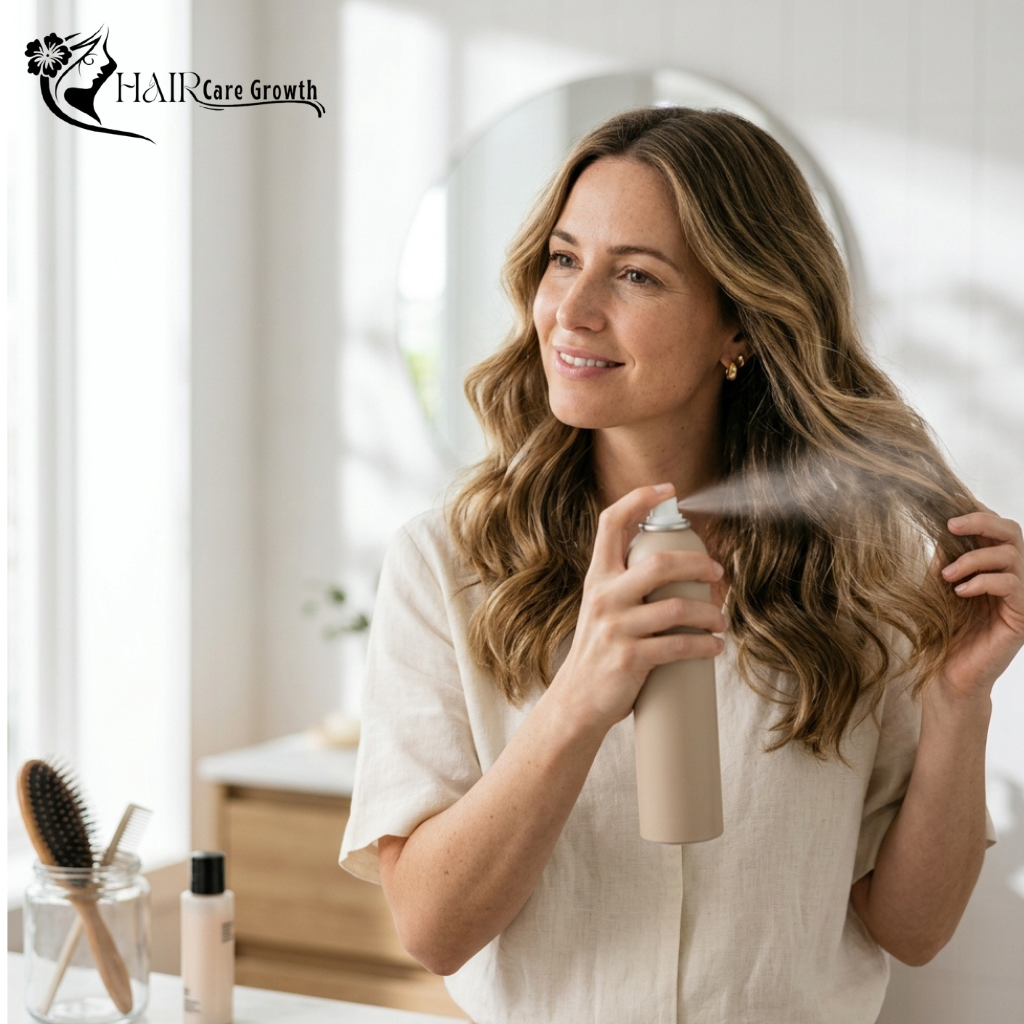
- Keep moving. Rather than keeping the nozzle stationary, sweep the spray across the hairstyle.
- Start with a light application. Let the product sit for a little while before deciding if another application is needed.
- Selectively reinforce hold. The rest of the hair usually doesn’t need support, but some areas may need some extra help, such as a curl that is likely to fall, the crown of a voluminous style, or the edge of an updo.
- When the style is secure, stop application. Anything past this point is just adding residue and not really anything of styling benefit.
This step-by-step method is especially effective when you are after a concrete finish and not for the ultimate stiffness.
Recommendations for Applying to Hair Types

Your hair type will influence how much product you need and how well you can see any build-up.
Thin or Fine Hair
Overloaded with styling product, fine strands quickly lose volume. Opt for a light fine mist spray, using as little as possible to keep the style in place. To build more volume, concentrate the product strategically on the styled sections rather than applying it uniformly along the entire length.
Thick or Coarse Hair
More structured styles often need more support, especially if you have thicker hair. Instead of going straight for the strongest formula you’ve got, build up a medium-hold product by layering it lightly. It’s a way to have staying power without getting a hard outer shell.
Curly hair
A flexible hold is especially good to keep the natural movement in the curls. The wave pattern should be allowed to set before a light misting is applied, and excess handling should be avoided thereafter.
Coily & Kinky Hair
Generally, the best way to present the curls is shaped but not stiffened with bounce. Individual curl clusters can become rigid if product is over-applied, so it should only be concentrated in the areas that need extra control. Curl patterns and dryness levels are so varied that no single formulation works for everyone.
Hair That is Dry or Damaged
Don’t use more product to make a style hold, because this doesn’t treat the underlying condition of the hair. A styling spray can improve the appearance or hold of the hair, but it cannot repair structural damage. If you’re struggling with chronic dryness, the best way to combat it is to change how you wash, condition, and heat-style your hair.
How to Make a Hairstyle Last Longer Without Adding More Product
When a hairstyle falls out of shape prematurely, adding more hair spray can seem like the answer, but the problem is often rooted earlier in the styling process.
Allow each section to cool and set when heat-styling curls before touching or separating. If volume is the main goal, you should avoid heavy oils or creams beforehand for blowouts.
Humidity is another factor that contributes. Laboratory tests have shown that the performance of hair spray, including its resistance to stiffness, can be affected by humid conditions. In situations where humidity is a regular problem, an anti-humidity or humidity-resistant formula will probably be more effective than adding more of a standard product.
Finally, once a hairstyle is done, it should not be touched again and again, as it can ruin the shape.
Does Hair Spray Damage Your Hair?
Hair spray is a cosmetic styling product and not a hair treatment. When used as directed, it is meant to give you a temporary hold.
However, the hair and scalp may accumulate styling products over time. Products like gels, hair sprays, lotions, and serums can build up, which can irritate your scalp and leave your hair feeling greasy or coated, according to the Cleveland Clinic.
The correct answer is not to stop the use of hair spray altogether, but to use an appropriate quantity and to clean hair and scalp thoroughly according to individual needs. If your hair starts to feel rough, dull, or coated from regular styling-product use, a periodic clarifying treatment may help remove the residue. There is no set schedule for all hair types, although users may need occasional clarifiers for styling products.
If your hair is firm, be careful when you brush it through; forcing a brush through stiff hair can add to the mechanical stress on fragile hair.
How to Treat Scalp Irritation From Hair Spray

Some people can be irritated by hair-care products and develop contact dermatitis. Shampoos, conditioners, and styling products can all cause scalp irritation in sensitive individuals, according to the Cleveland Clinic.
If you notice recurring itching, burning, redness, bumps, or flaking after using a particular spray, discontinue use and observe for improvement. However, there are a variety of scalp conditions that have similar characteristics and symptoms and should not be automatically assumed to be dry scalp. See a dermatologist or other skilled healthcare professional if your symptoms are severe, ongoing, or inexplicable.
Medical Disclaimer: This material is not meant to diagnose or treat any problem of the scalp or hair; rather, it is provided for general educational reasons only.
Keeping a Soft, Healthy-Looking Finish
Healthy hair is usually seen to have movement, separation, and dimension. Everywhere, too much stiffness makes a hairstyle look false, which would otherwise be well done.
A finishing spray can also change the way the light reflects off the surface of the hair. The effects of hair spray deposits on the visible shine and other optical properties of hair have been studied. However, cosmetic shine should not be interpreted as an indicator of improved hair health, as the two are different.
When you have the support you need for a softer finish, stop using the product. You don’t have to wear one hairstyle to look polished.
Common Myths About Hair spray
If the hair isn’t stiff, the spray isn’t working.
Not necessarily. Flexible-hold formulas are specifically designed to provide support while allowing movement.
For the longest-lasting hold, use the strongest spray.
That is not necessarily true. Results will vary depending on formula, hair type, hair style, environmental conditions, and application technique. Strong hold can also be more than you need for an everyday style.
More product means a longer-lasting hairstyle.
Beyond a certain point, additional product is mostly just buildup and stiffness. Usually, if you prepare hair properly and layer it lightly, you get better results.
Hair spray makes hair healthier as it adds shine.
Hair spray alters the surface appearance of the hair, but it is not a repair treatment.
All alcohol-containing hair sprays are bad for hair.
That is an oversimplification of a complex issue. The performance of a hair spray is a function of the entire formulation and not one ingredient. If a particular product is consistently causing dryness or discomfort, opt for a different formulation instead of making a blanket statement about all products containing the ingredient.
FAQs (Frequently Asked Questions)
Can you have hold without the stiffness of hair spray?
Yes. Light-hold formulas are flexible and brushable, holding a hairstyle in place while still allowing for natural movement. The probability of stiffness is further reduced when the product is applied in thin layers.
What causes hair spray to be crunchy sometimes?
Typical causes include overusing the product, spraying too close to the hair, concentrating the product in one area, or picking a hold level that is too strong for the style.
How much hair spray is enough?
There is no universal quantity that applies to everyone. The appropriate amount depends on hair density, length, style, spray pattern, and formulation. We suggest a light initial application and add more product only as needed.
Do You Use Hair Spray on Wet or Dry Hair
Most traditional finishing sprays are meant for dry, fully styled hair. Some products are formulated differently, and manufacturer directions should always be followed.
Can you brush your hair after hair spray?
Flexible or brushable formulations are often best if reshaping or brushing is anticipated. Very strong hold formulas may be more difficult to brush through easily.
Why does hair spray sometimes come out in chunks?
Visible residue is usually the result of excessive product build-up, or disturbing dried product while brushing or handling. Regular cleaning and reducing the amount of product can help to reduce this issue.
Can hair spray control frizz?
Some formulas have smoothing or humidity-controlling properties that help a finished style hold back frizz. However, hair spray is primarily a hold product. If your hair is always dry or frizzy, you might be better off with conditioners, leave-in treatments, serums, and a full hair care regimen.
The Bottom Line
Hair spray is designed to prolong the life of a hairstyle without interfering with the natural feel. Choose a flexible or brushable formula for a soft, natural hold; mist lightly from the distance indicated on the product label; keep the spray moving constantly while applying; and reinforce the hold only where needed. Fine hair generally requires less product; thick or more structured styles may require more layering. The best product is the one that’s right for the individual hairstyle, not assuming that stronger is always better.
So, with that in mind, it is much easier to effectively use hair spray: enough hold to keep the style in place and enough flexibility to maintain natural movement and appearance.
For more tips on how to create a hair-care routine that’s specific to your unique hair type, texture, and styling goals, browse Hair Care Growth’s complete collection of product guides.
Written by Mian Hussain.