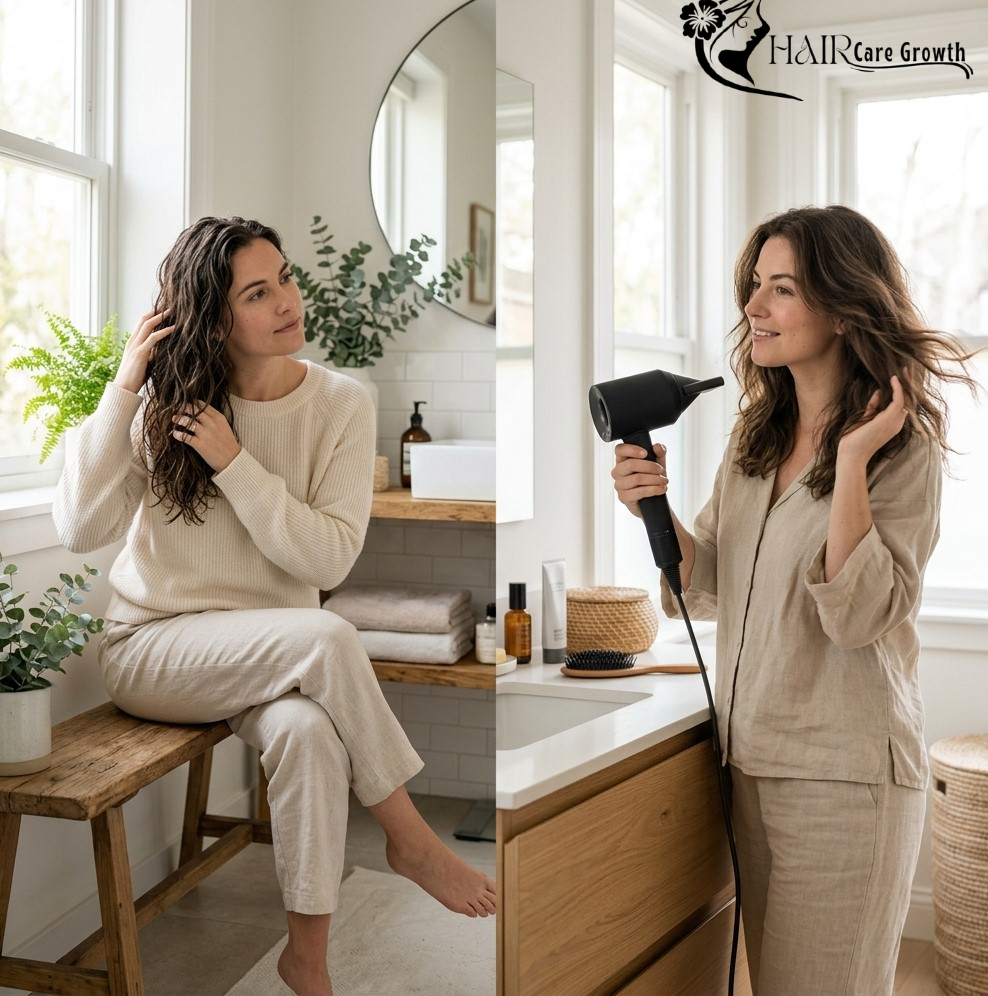
Let your hair dry naturally, or is the blow-dryer a better option? The honest answer surprises many people: neither method is inherently healthier for everyone. Air-drying avoids direct heat, whereas blow-drying dries the hair faster and offers greater control over volume, frizz, and shape. The best option will depend on your hair type and current condition, as well as how much time you have to work with and how gently you treat wet strands.
Excessive heat can damage the surface of the hair. But prolonged exposure to wet hair and rough handling can also stress the strands. This guide compares both procedures with an evidence-informed approach, so you can make an informed decision confidently.
In this guide, you will find:
- How hair behaves as it dries
- Pros and cons of air-drying and blow-drying
- Which drying method suits your hair type best?
- How to Prevent Frizz and Damage from Heat
- Frequently asked questions about hair drying answered
Air-Drying vs. Blow-Drying – At a Glance
|
Factor |
Air-Drying |
Blow-Drying |
|---|---|---|
|
Direct heat |
Nil |
Depends on heat setting |
|
Time to dry |
Slower |
Faster |
|
Control of Styling |
Limited |
High |
|
Root volume |
Often less |
Simpler to build |
|
Organic quality |
Usually kept |
Preserved or re-formed |
|
Manage Frizz |
Depends on products and handling |
Depends on airflow, heat, and technique |
|
Risk of heat damage |
Extremely low |
More with excessive heat |
|
Duration of wet hair |
Longer |
Shorter |
|
Ideal for |
Natural texture, low heat routines |
Speed, volume, smoothing, styling |
Air drying works well if you have time to spare and want to minimise heat. If you’re in a hurry to dry your hair, or want a professional finish, careful blow-drying is more practical. For lots of people, the answer is somewhere in between.
What’s Happening When Hair Dries?
Hair behaves differently when wet. The fibre absorbs water and swells. Wet hair stretches more easily and is more prone to damage from aggressive brushing, rubbing, twisting, or tension.
The American Academy of Dermatology (AAD) suggests that wet hair is more likely to break, so take care. The AAD recommends gently wrapping your hair in a towel or T-shirt to absorb moisture, rather than rubbing it vigorously to dry it. People with curly or textured hair often benefit from detangling when the hair is wet and conditioned.
Heat introduces a third variable. In a laboratory study published in the Annals of Dermatology, they compared natural drying with blow-drying at different temperatures and distances. As the temperature of the dryer increased, the surface damage increased. In that experiment, hair dried with a dryer that was continuously moving and held at a moderate distance of about 15 cm was found to be less damaged than naturally dried hair.
This isn’t proof that blow-drying is always healthier. It demonstrates that the pertinent question is not so much ‘heat or no heat?‘ but rather: how much heat, how long, how far, and how much handling?
Advantages and Disadvantages of Air Drying
Air drying allows most or all of the water to evaporate without heated airflow. The main advantage is obvious: no direct heat exposure. That helps if your routine already includes curling irons, flat irons, bleaching, colouring, or chemical processing.
Air drying avoids brushing the natural waves, curls or coils into a different shape. It doesn’t take much gear, and it makes your routine easier.
Time is the trade-off. Thick, dense, long, or slow-drying hair can stay damp for hours. Hair can also dry flatter at the roots, and the final shape can be less predictable. Rough towel drying or touching your hair all the time while it’s drying can cause frizz.
You don’t want to make a habit of sleeping with very wet hair. Wet hair is more vulnerable to stretching and breakage, and mechanical stress is added by friction against a pillow.
Advantages and Disadvantages of Blow-Drying
Blow-drying is much faster and gives you a lot more control over the result. For volume, you can lift the roots; smooth straight hair with a concentrator nozzle; or use a diffuser to define curls and waves. If your hair is thick and takes hours to dry, a dryer also reduces the time your strands remain wet.
It’s not so much that a hair dryer is the problem, but bad technique and too much heat. Surface damage increases with increasing drying temperature, studies have shown. The AAD suggests steering clear of frequent exposure to high heat, instead opting for low to medium heat.
Too close to a dryer, standing still, pulling hard with a brush, or burning dry hair all add stress.
What Is The Best Way To Dry Your Hair?

Choose based on your texture, density, condition, and styling goals.
Fine/Thin Hair
Fine hair tends to dry quickly in the air, so natural drying is convenient. The downside is that it might dry flat against the scalp. For volume, a light blow-dry at the roots will give you lift without high heat. Fine strands are better suited to lightweight mousse or volumising products than heavy creams and oils.
Dense or Thick Hair
Air-drying dense hair takes a long time to dry, especially near the roots and underneath sections. Partially air-dry first, then finish with a dryer on a lower setting instead of having to choose between hours of air-drying and maximum heat.
Curly hair
I let my hair air-dry because it helps the waves form naturally. For more volume at the roots or to speed up the drying process, use a diffuser on low or medium airflow. Excess uncontrolled airflow separates wave clumps and leads to frizz.
Hair That’s Curly and Coily
There is no one right way to do curls and coils. Air-drying reduces direct heat and promotes natural curl formation but may also increase shrinkage and take longer. A diffuser will speed the drying and add volume but is less disruptive to the curl pattern than free airflow. Keep the temperature comfortable and don’t touch the curls over and over until they set.
Bleached, Damaged or Color-Treated Hair
Take extra care with processed hair because it can be more porous and fragile. Blow-dry with a combination of air and low heat, avoiding excessive high heat. Keep brush tension light. Heat protectants and conditioning products help with styling.
What Method Is Better For Frizz?
Both techniques can cause frizz if performed improperly. Air-drying can also result in frizz from rough towel rubbing, touching too much, brushing the developing curl pattern, or using the wrong products. Frizz can be worsened by blow-drying if the airflow is too strong, the temperature is too hot, or the dryer is pointed the wrong way for how you want your hair to lie.
Gently remove excess water by squeezing or patting dry, without twisting or rubbing the hair. A microfibre towel or a soft cotton T-shirt absorbs moisture, not rough friction. Then, select products based on your hair type – don’t layer everything at once. A light leave-in is okay for straight or wavy hair, but drier curls and coils will require richer conditioning and hold.
A little serum or hair oil will smooth down the ends once you’ve dried. However, oils are the final products. Don’t assume that you can use regular hair oil in place of a heat protectant, unless the label specifically states that it offers heat protection.
Blow-Drying vs. Air-Drying for Volume and Texture
Blow-drying gives you more control for maximum root volume. When drying, lifting sections away from the scalp prevents the hair from settling flat. Air-drying is often a winner for natural texture because you’re doing less to reshape the hair. Diffusing is a middle ground for waves and curls when you want natural definition with more volume.
A controlled blow dry is usually easier to get a smooth, polished finish. The concentrator nozzle guides the airflow precisely. Brushing and downward airflow help the strands lie uniformly. You want a result, so you should be as concerned about heat as you are about wanting a result.
How to Blow-Dry Your Hair Without Frizz
- Gently squeeze excess water out; do not twist or scrub.
- While your hair is still damp, apply leave-in or styling products.
- Detangle according to your texture. Do not aggressively brush soaking wet hair, but detangle tightly curled hair when it’s wet to minimise breakage.
- Style your part, curls or waves, and leave the hair alone.
- When it is completely dry, gently lift the roots or apply a little serum or oil to the ends.
How to Use a Hair Dryer With Less Heat Damage
- Blot up as much excess water as possible without rubbing.
- Use a heat protectant as per product instructions before using heated tools.
- Use the lowest effective temperature setting, rather than the maximum temperature.
- Keep moving the dryer so that the same area isn’t getting exposed all the time.
- A helpful principle, but not a guaranteed rule, is to keep the dryer about 15 cm from the hair.
- Use attachments wisely: concentrator for smooth airflow, diffuser for curls and waves.
- Stop as soon as the hair is dry, because heating dry strands only adds exposure without benefit.
The hybrid method: A feasible compromise
You don’t have to be stuck one way forever. One practical option is to let the hair dry partway naturally, then finish with a controlled blow-dry. This cuts down dryer exposure and gives you styling control, as well as preventing damp, slow-drying hair from staying damp for hours.
The AAD recommends air-drying hair 80 percent before styling to limit damage caused by blow-drying. This is a great technique for thick hair, curls that need a quick blast of diffusing, or anyone who wants volume at the roots and doesn’t want to have to dry every inch from soaking wet.
Two Popular Hair-Drying Myths
Myth: Air drying is always the healthiest option
Avoiding direct heat has obvious benefits, but “no heat” does not mean “no damage“. But abuse, long contact with water, friction, and sleeping with wet hair put strain on the strands.
Myth: Blow-drying is a guaranteed way to destroy your hair
Hair can be damaged by excessive heat. It is dependent on temperature and technique. Moderate heat, reasonable distance, continual movement, and less exposure are not the same as applying maximum heat to one section.
When Hair Damage Calls for More Than a Change of Routine
Often, cutting back on damaging styling habits can help with dryness, rough ends, and mild breakage. But don’t blame your hair dryer for every hair problem.
If you notice sudden or significant shedding, bald patches, scalp pain, persistent itching, sores, inflammation, or thinning that continues even with gentler care, it may be time to see a board-certified dermatologist. These symptoms may be related to the scalp or to the hair-growth cycle rather than to the condition of the hair shaft. This article is for general hair-care education purposes and is not intended as a diagnosis or a substitute for individual medical advice.
Frequently Asked Questions
Air-drying or blow-drying your hair – which is healthier?
No one way is healthier across the board. Air-drying is not directly heated, and careful blow-drying can reduce the drying time. The mildest option depends on temperature, technique, texture, condition, and how long your hair normally stays wet.
Is air drying hair bad?
Air-drying is not necessarily bad. Hair that is rubbed, brushed, twisted, or subjected to friction while wet, or that stays wet for a long time, is more prone to develop problems.
Is it bad to blow-dry your hair daily?
High heat drying daily can add up and cause cumulative stress to the hair. If you do need blow-drying, use the lowest heat setting that does the job, keep the dryer moving, reduce tension on brushes, and think about partial air drying first.
Is blow-drying hair loss a thing?
A blow-dryer can be damaging and breakage-causing if used improperly, but broken hair shafts are not the same as actual hair loss at the follicle. If you have thinning that won’t go away or unusual shedding, it’s worth getting a medical evaluation.
Air-drying or diffusing curly hair?
Both will work. Air-drying keeps the heat down and generally makes less root volume. Diffusing on low to medium heat and a gentle airflow helps to dry curls faster while adding volume and definition.
Do you air dry your hair before blow drying?
Yes, often. Drying your hair partially before the dryer reduces the time under heated airflow. But don’t tie down delicate wet hair or rub it while you wait.
Is it better to use cool air on a hair dryer?
Cool airflow avoids the high temperatures that cause heat damage, but it may take longer to dry. This is useful if your main goal is to reduce exposure to heat.
Should I use hair oil before or after blow-drying?
It is contingent upon the product, so be sure to read the directions. Finishing oil can smooth dry ends after styling, but a regular hair oil shouldn’t be considered a substitute for a proper heat protectant.
The Bottom Line
The air-dry vs blow-dry debate doesn’t need a winner. If you want to minimise direct heat and have time to let your natural texture come through, air-dry. Be careful when blow-drying if speed, volume, smoothing, or styling control is important. Or, combine the two methods, air-drying partially and then completing with controlled airflow.
Whatever you decide, the same rules will protect your hair: no extra heat, less friction, treat wet strands with care, get products that work for your texture, and stop styling when your hair is dry. Looking good isn’t so much about finding the “right” way and more about creating a kinder routine and keeping to it.
Ready to polish off the rest of your routine? More evidence-informed guides to help you select products for your hair type, manage frizz, correctly use hair oils, and protect your strands from everyday damage.