
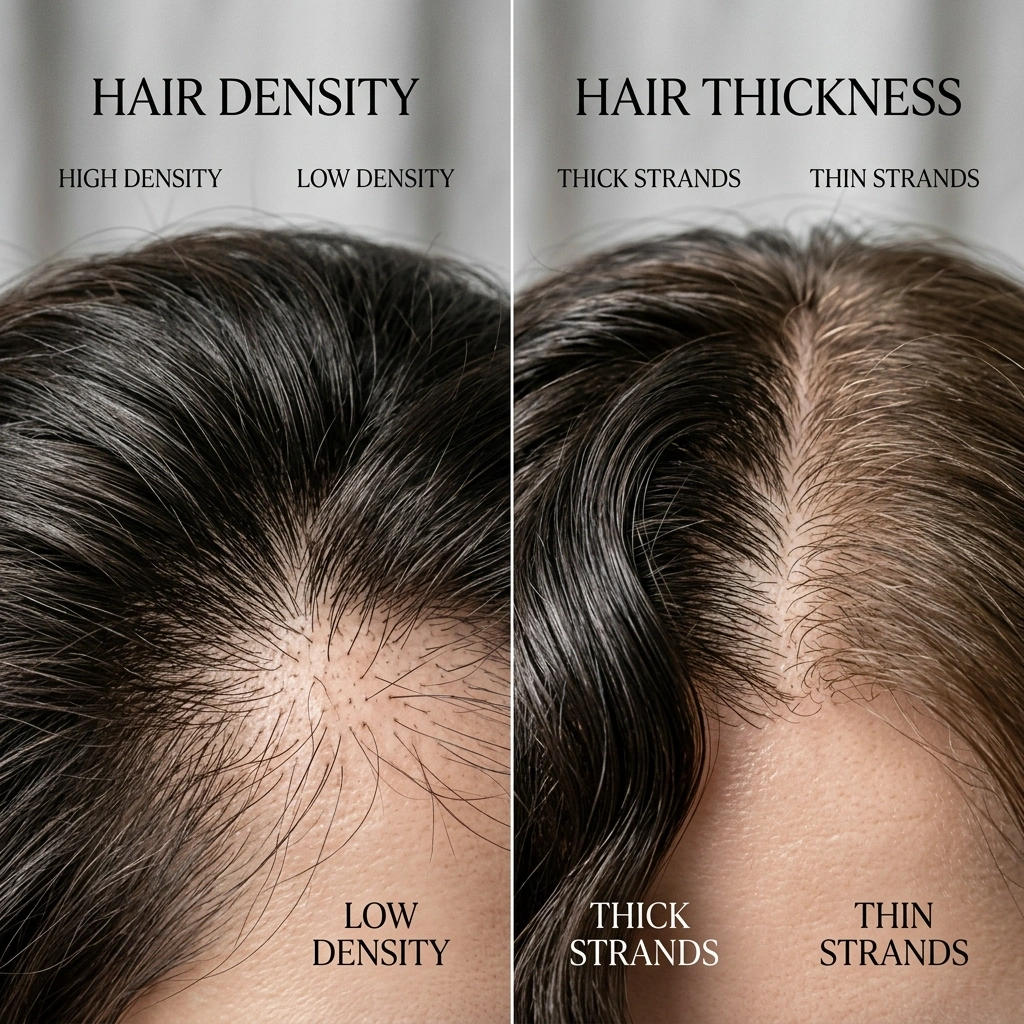
Years ago, I had a client in my chair who said, “My hair feels thinner, but I don’t know if I’m losing it or if the strands are just getting weaker.” I hear that line all the time. Although they refer to different aspects of hair, “hair thickness” and “hair density” are frequently used interchangeably. They do not. And once you know the difference between the two, your entire hair care routine starts to make a lot more sense.
You pay the price for mixing them up. You buy the wrong shampoo, listen to advice intended for someone else, and feel stuck when nothing changes. I’ve worked in the trenches with people of various hair kinds, and I’ve witnessed this small error cost a significant amount of money and time.
Let’s resolve this, friend to friend. Here’s what you’ll walk away with:
- What hair density and hair thickness really mean
- How to check both in minutes at home
- Why do each of them change over time
- What works: Advice from experts, errors, and useful tips
At the conclusion, you will have a clear picture of what you are dealing with and what to do next.
What Is Hair Density?
The number of hairs you have is known as your hair density. It’s like a head count for your head. It measures the number of hairs growing over a defined patch of skin.
Usually, researchers report density as follicle count per square centimetre. The density is higher with the more densely packed follicles. The less dense it is, the fewer follicles you have, the more scalp you see.
This is what people don’t get. Strand has no bearing on density. You can have healthy, strong hair and low density. You can have lots of density with soft and delicate strands, too. Density is heads, not quality.
The total volume of hair is measured by density (covering is half of what creates the illusion of fullness).
What Is Hair Thickness?
The thickness of hair is a matter of strands. Particularly, the diameter of the strand. That is, how wide is one hair?
Here are two familiar words that come into play:
- Fine hair is considered to have a small diameter. Feels silky to touch, but often falls flat.
- Coarse hair is thick. Feels more stable and holds the body better.
Thickness is the width of each strand of hair, not how many strands you have on your head. So,
I’ve worked with clients who have a lot of really fine hair that looks gorgeous and full. And I’ve seen people with thick, coarse hair; they’re sparse, so you can see the scalp very easily. These two terms need to have different meanings because of this.
Key Differences Between Density and Thickness
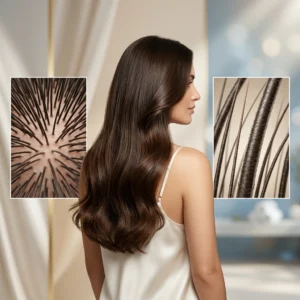
Let me get this straight now.
- Density is equal to the number of hair follicles.
- Each hair strand’s diameter determines its thickness.
They both give your hair more volume, but they do it in different ways. Density provides coverage all the way to the scalp. Each strand is given more substance by the thickness.
I like this analogy. Picture a lawn. The number of grass blades per square foot is known as density. The thickness is the width of each blade. A healthy, full lawn may be many thin blades or fewer thick blades. Your hair is the same logic.
From here on, every choice of product is determined by which one you have.
In short, the density is the number of strands, and the thickness is the width of the strands.
How to Check Yours at Home
These quick checks will send you in the correct direction. You don’t need to go to a clinic to learn a lot.
Density Test
- Find a good, well-lit mirror and stand in front of it.
- Comb your hair down the middle.
- Look at all the scalp you can see through the part.
Very little scalp showing suggests a higher density. Visible scalp line indicates lower density. Another option is to measure the circumference while wearing your hair in a ponytail. Usually, a fuller ponytail is a denser one.
Measure your waist
Roll a single hair that has been shed between your fingers.
- You most likely have fine hair if you are unable to feel it at all.
- If it feels very noticeable, almost wiry, you probably have coarse hair.
Another simple trick is comparing a strand to a piece of sewing thread. The points thinner than the thread indicate fine hair. Coarse Hair- Equal or Thicker Tips.
These tests won’t hand you exact numbers, but they give you a solid starting point.
What Causes Changes in Each
This is where it gets interesting, because the two are moving for different reasons.
Why density changes
Much of this is driven by your hair growth cycle. Hairs follow a regular cycle of growth, rest, and shedding. The American Academy of Dermatology says that shedding between 50 and 100 hairs a day is normal. That daily shedding doesn’t mean your density is going down.
Real density can be lost from:
- Ageing
- Hormonal alterations
- Stress, illness, or operation
- Nutritional deficiency
- Androgenetic Alopecia, Genetic Pattern Thinning
Thickness why different
Follicle miniaturization is one process by which the width of strands can be reduced. In androgenetic alopecia, every follicle cycle is slower with thinner and shorter strands. This miniaturization is the histological hallmark of pattern hair loss, whereby thick terminal hairs are progressively converted into fine, wispy hairs, according to research hosted by the NIH.
Other factors include age, diet, and health of the scalp. Heat and chemical damage won’t shrink the follicle, but they can strip away a strand’s outer layer, making hair feel thinner than it really is.
Practical Tips to Support Both
I’ll be honest with you. You can’t alter your genetic density or magically broaden every strand. What you can do is protect what you have and help your hair look and feel its best.
Support your density
- Healthy follicles need a healthy home. Maintain a clean and balanced scalp.
- Wet hair is more delicate, so treat it with care.
- Eat plenty of foods rich in iron and protein.
- If you see real hair thinning, see a dermatologist early. The faster you act, the more options you have.
Add Thickness & Volume
- Volumizing products at the root for fine hair.
- Avoid heavy oils and rich serums that pull the strands down.
- Minimize high-heat styling as much as possible to prevent breakage.
- Ask your stylist for this cut, get the look of body with a layered cut.
On supplements. Don’t take them unless a blood test shows you’re really deficient in a particular nutrient. Too much iron or zinc can do real harm. Prior to making any judgements or acting, always seek advice from an expert.
Best Practices for Long-Term Hair Health

Good habits add up. Mix these into your routine:
- Wash when necessary, don’t wash on a schedule.
- Helps protect hair from the sun, chlorine, and rough friction.
- Do not rub vigorously. Pat dry with a soft towel.
- Trim regularly to prevent fraying and thin ends.
They won’t alter your follicle count, but they will keep the hair you do have strong and appearing fuller.
Common Mistakes to Avoid
These bloopers happen all the time and are easy to fix:
- Fine strands – density problem. Growth products won’t open each strand overnight.
- Normal shedding and freak out. Usually, a few strands in the drain are nothing.
- Choosing the wrong products. Heavy creams weigh down fine hair, while light mists may not be enough for coarse hair.
- Forget the head. Your strands grow from hair follicles, so ignoring the health of your scalp is working against you.
- Too long waiting. If you suspect that you might have pattern thinning, don’t be afraid to seek help.
Expert Tips From Real Experience
This is where the real difference lies:
- Progress photos. Take them every couple of months in the same lighting. Memory plays tricks, but pictures tell the truth.
- Buy for the hair you have. Match products to the type of strand, not the wish list.
- Stay strong. It takes months to see any real change, and hair grows at about a centimeter a month.
- Be wary of grand promises. Anything promising to double your density in weeks is worth a look.
- Get an actual diagnosis. Only a board-certified dermatologist can tell you whether it is density, thickness, or both.
Frequently Asked Questions
How to increase hair density naturally?
You can’t grow brand new follicles, but you can take care of the ones you have with good scalp care, balanced nutrition, and gentle handling. If hair thinning runs in your family, speak with a dermatologist about proven options.
Is Thinning Hair the Same as Fine Hair?
No Fine hair is about the diameter of the hair strand. Thinning hair is generally about falling density. You can have fine hair your whole life and not thin.
What does the volume of hair matter?
Both are important. Coverage. Coarse strands. High-density body. Or one might make the illusion of fullness for oneself.
Does a haircut make my hair thicker?
Cutting does not alter the strand diameter or the follicle number. But it will make hair look thicker because blunt ends look thicker than tapered ends.
Can You Get Thickening Back To Follicle Miniaturization
sometimes, in part, with early treatment? Once the follicles are fully miniaturized, it is much harder for the hair to regrow, and this is why early intervention is so important.
How worried should I be about hair in the drain?
It’s common to lose up to 100 hairs every day. But a sudden heavy increase or a newly visible scalp should be checked out by a professional.
Do density and thickness vary with hormones?
They can affect either. Hormonal changes can be a driver of androgenetic alopecia, leading to shedding or miniaturization.
Bringing It All Together
Density and thickness are not the same thing, and the difference should now be clear. Your hair is a measure of you. The other measures the width of each thread. Together, they dictate the fullness and feel of your hair on a daily basis.
The first step before you go out and buy another product is to figure out which one you have. Once you know if you have fine or coarse hair, high or low density, your options are determined.
Here’s your next step. Do the mirror and strand checks today, then work your routine around what you find. Treat your scalp kindly, be patient, and ignore any claims that seem too good to be true. If you feel your hair shedding or strand quality is off, see a dermatologist. Your hair deserves the good stuff.