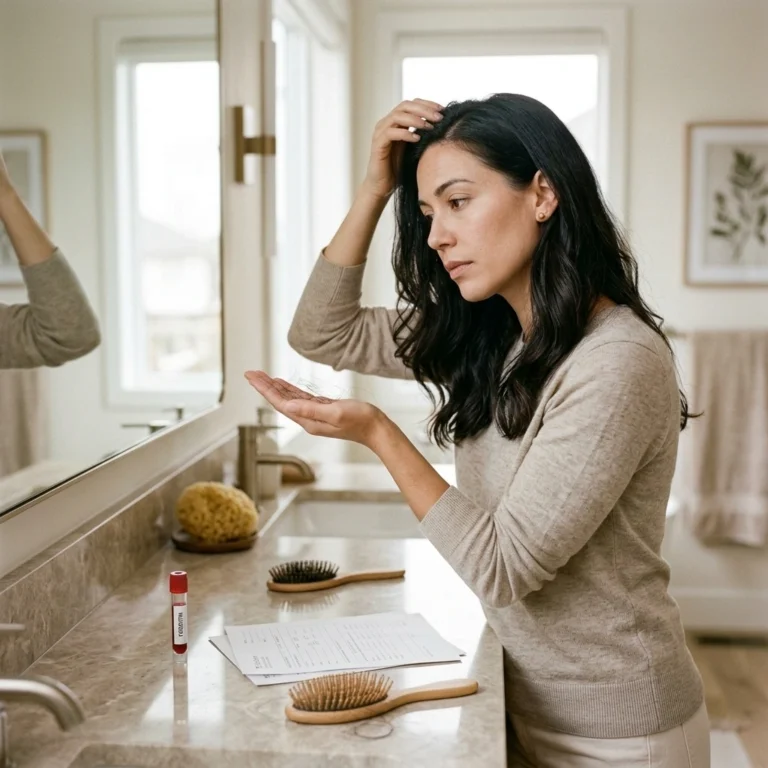
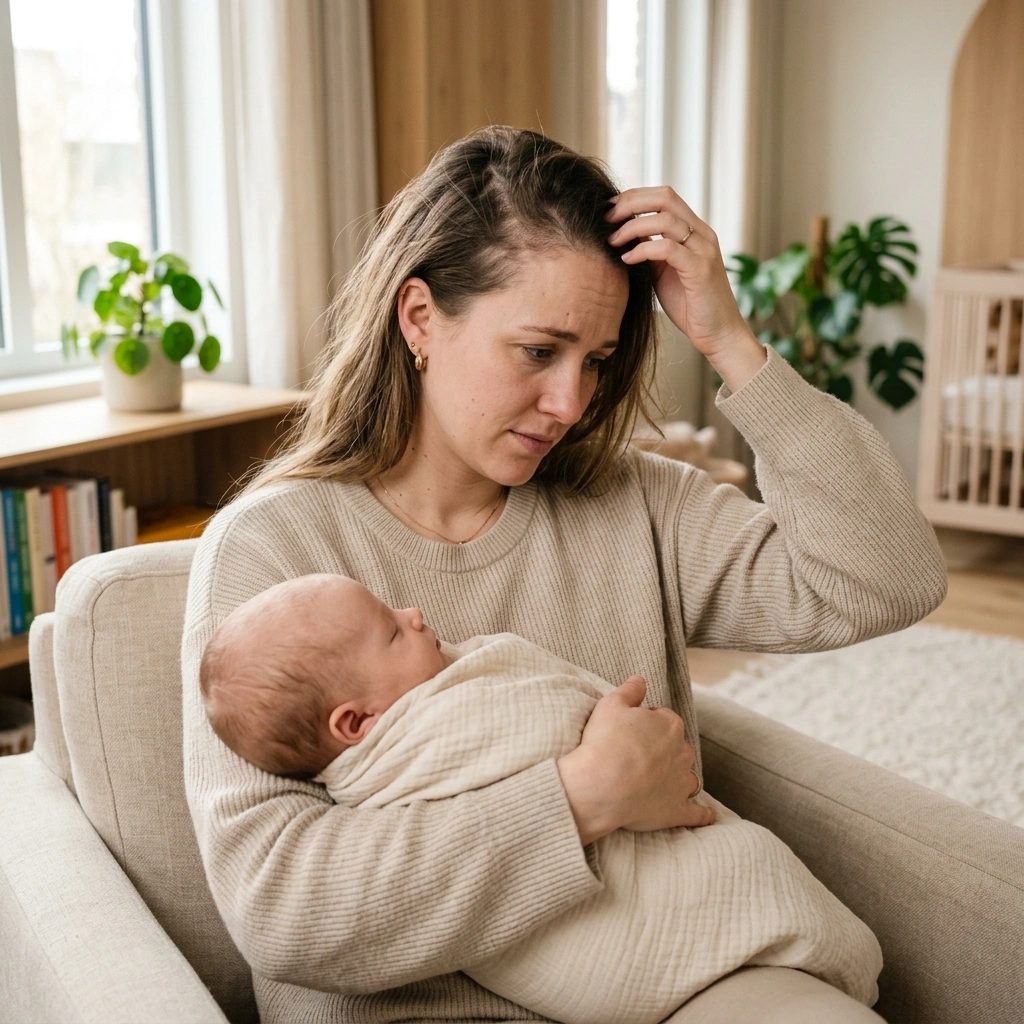
You run your fingers through your hair, and a startling clump comes away in your hand. You notice strands on your baby’s onesie, in the shower drain, and on your pillow. Breathe if you just gave birth. Your hair will come back; this is natural.
I’ve spent years helping new parents with this exact concern. It’s a straightforward question that I hear most frequently. “Is there a serious problem with me?” Almost invariably, the answer is no. What you’re experiencing is a very common way for your body to reset after pregnancy.
Let’s examine what’s going on, why it’s happening, and some useful things you can do to help your hair heal. You don’t have to accept this, and you have more control over the day-to-day than you may realise.
What Postpartum Hair Loss Really Is

Postpartum hair loss is the intense shedding many new parents notice a few months after giving birth. It usually appears about three months after delivery and can last as long as six months.
Here’s the part that people are surprised about: it’s not real hair loss. Dermatologists refer to it as telogen effluvium, which simply means excessive shedding. Your follicles are not damaged. They are not going down.
During your pregnancy, the hair you are losing was essentially “on loan.” You are discharging them all at once now – hence the dramatic change in the mirror.
The Science Behind Telogen Effluvium
Hair grows in a cycle, and knowing that cycle takes a lot of the fear out of shedding. When you see the pattern, the clumps in your brush begin to make sense.
The 3 Stages of Hair Growth
The Cleveland Clinic states that each strand goes through three stages:
- Anagen (growing phase): The phase of active growth, which can last two to six years. At any given time, about 85 to 90 percent of your hair is in this area.
- Catagen (transitional phase): A short period in which the follicle shrinks and growth slows.
- Telogen (resting phase): A resting period of about three months. After it is over, the follicle releases the hair, and it falls out.
You can lose up to 100 hairs in a typical day. That’s completely normal. With postpartum shedding, you lose more than that daily total for a period because many strands enter the resting phase at the same time.
The Hormone Behind It All
The key is oestrogen here. Your oestrogen levels rise in the last trimester of pregnancy and keep many hairs in the growing phase.
So that’s why your hair probably felt thick, full, and glossy when you were pregnant. You just weren’t shedding on the normal schedule.
Oestrogen levels drop sharply after delivery. That signal switches a huge batch of hairs into the resting phase all at once. They are released together a few months later, and that is the shedding you see. According to the American Academy of Dermatology, the reason is a decline in oestrogen, and the shedding is temporary.
Your Recovery Timeline
This is the part I want you to hold to heart: the shedding stops on its own. You don’t have to do anything to make your hair come back.
Most new parents find that their hair is back to normal fullness by the time their child is a year old. Many of them show definite improvement long before then.
Here’s a broad outline of what to anticipate:
- Months 1-2: Typically, very little shedding. Your hair may still feel lush.
- Months 3-4: Shedding usually peaks. That’s when most people start to panic.
- 5-6 Months Most parents see shedding slow down.
- In about 12 months, your hair should be back to its pre-pregnancy volume.
Some people find their hair is still a little thinner than before. Additionally, this is typical and does not indicate a problem.
Practical Hair Care Tips While You Recover

You can’t stop the shedding, and you don’t need to. In the meantime, though, you can work on keeping your hair looking and feeling fuller. These steps are easy, simple, and realistic for a newborn carer.
Try Volumising Products
Pick up a volumising shampoo. These tend to have the proteins that cover each strand, making hair look fuller.
Choose a conditioner meant for fine hair and apply it mostly to the ends. Don’t apply to your scalp, or your hair will look flat and weighed down.
Be Kind to Your Hair
Be gentle with your hair when it’s shedding. Use a wide-tooth comb to work through tangles, wash and comb gently.
Turn down the heat on your blow dryer and styling tools. Less heat means less breakage to add to the shedding you already deal with.
Stimulate internal regrowth
Good nutrition gives your follicles what they need to get the job done. Try to eat a balanced diet with enough protein, iron, and whole foods.
If you’re thinking of taking a supplement, talk to your healthcare provider first. They can tell you things like low iron and recommend what really fits your needs.
Get a Fresh Cut
A shorter cut can add volume to hair instantly. It’s also a lot easier to manage with a baby in your arms, and any time you can save is a huge win at the moment.
Common Mistakes to Avoid
A few routine behaviours can exacerbate shedding symptoms or increase breaking. Avoid these while you’re recovering.
- Pigtails and tight ponytails. Continuous tension can pull on hair that is already fragile and can even lead to traction alopecia in the long run. Lighten up your style.
- Heavy, thick conditioners. These drag down hair and make it look limp. Right now, you do better with lighter formulas.
- High heat styling, hot tools, cause breakage to strands you’d rather keep. When you can, use lower settings or air-dry.
- Panic-buying “miracle” products. Hormonal causes mean there is no product that reverses postpartum shedding. “Save your money for effective, gentle basics.”
And one more safety note to be aware of: Shed strands of hair can sometimes get wrapped tightly around a baby’s finger or toe. This is called a hair tourniquet and is not common. If you see one, carefully remove or cut the hair. If you can’t remove it, call your baby’s provider.
Expert Tips Worth Remembering
Here are some things I frequently tell new moms after working in the hair care industry for years:
- Follow the timeline, not the threads. Counting the hairs in the sink only makes you more anxious. Looking at the calendar makes you feel better that you’re getting better.
- Use dry shampoo. It boosts texture and lift between washes to help thinning areas look thicker.
- Guard your part & edges. First thinning is done in these places. Part your hair on the side and distribute the visual weight.
- The texture of regrowth needs patience. Sometimes, new hairs are shorter and stick up around your hairline. That’s a sign of healthy regrowth, not a problem.
Frequently Asked Questions
Will postpartum hair loss last forever?
No, not at all. It is not long-term hair loss, but rather transient shedding. By the time their child is one, the majority of parents have returned to their typical level of fullness.
When does postpartum shedding usually begin?
It usually starts about three months after the baby is born and often peaks around the fourth month.
Can postpartum hair loss be prevented?
This is due to the natural fall in oestrogen, and there is nothing that can be done to stop it. Knowing it is coming makes you feel less alarmed.
Will breastfeeding make it worse?
Breastfeeding does not cause or increase this kind of shedding. What really sets it off is the hormonal change after birth.
Do Postpartum Hair Loss Vitamins Work?
Supplements are not going to counteract the hormonal cause. A balanced diet promotes overall hair health, but check with your provider before adding any supplement.
How much shedding is too much?
You can expect a lot of shedding for months. If it lasts longer than six months, it’s worth talking to your doctor about.
When should I consult a physician?
If the shedding continues for more than six months, causes bald patches, or is accompanied by fatigue and other symptoms, see your provider. Both of these can be an indication of an iron deficiency or a thyroid problem, both of which can be treated.
Is it normal for the regrowth to be different?
Yes, new hairs often appear shorter and finer at first and then blend in as they grow.
You Are on the Path Back to Full Hair
It can be distressing to have postpartum shedding, particularly if you’re already adjusting to life with a newborn. But this is your body resetting its normal rhythm, not something that’s broken.
Give the procedure time, eat healthily, and treat your hair gently. Your follicles are still healthy, and already regrowth is on its way.
If you’ve been losing hair for longer than six months or if you’re experiencing patchy thinning, you should see a board-certified dermatologist. A proper diagnosis means you’ll get the right help, and most causes of ongoing hair loss are easily treatable.
This article should not be used as a replacement for expert medical advice; it is merely intended for general informational purposes. Discuss any concerns you may have with your healthcare provider.