Buying hair products shouldn’t require solving complex puzzles like the rest of the drugstore aisle.
The right products depend on many balanced factors. For example, your current scalp condition, the thickness and texture of your strands, your porosity, and the condition of your hair, as well as your personal problems and concerns, must all be taken into account.
If you’re asking “What hair products do I use for my hair type?” you should separate your scalp concerns from your hair length concerns when establishing a routine. An oily scalp can coexist with dry ends. Fine hair can also have damage. Curly hair can be low or high porosity. Because of that, two people with the same curl pattern could require two completely different routines.
This guide will assist you in choosing the best hair products and making your hair care routine easier.
Start With Your Scalp, Hair Type, and Primary Concern
Determine your concern, and then you can determine the components of interest so you can review the ingredient lists.
Consider the following five characteristics.
1. Scalp Type
Consider the condition of the scalp about 2 days after washing:
- Oily: Within a short time, roots look greasy.
- Dry-feeling: The scalp is usually tight or uncomfortable.
- Sensitive: The use of new products will likely result in burning, itching, or redness.
- Flaky: Flakes are always present; itching may be present.
Not all itching and flaking means you have a dry scalp. Dandruff, as well as seborrheic dermatitis, can cause itching and flaking too. Also, the American Academy of Dermatology (AAD) has said that itchy rashes can be caused by a reaction to various components of a shampoo, conditioner, dye, or other products.
Our guide to seborrheic dermatitis scalp will be more helpful for flaking and other related concerns.
2. Strand Thickness
The thickness of hair refers to the diameter of the strand, while density refers to the number of hairs in a specific region.
This distinction is significant.
Fine hair is generally more prone to being weighed down, so lightweight products are often more effective. Thick hair generally handles richer conditioners, creams, and oils better.
Density has several implications for both the quantity of product required and the application method.
For more understanding, please refer to our hair density versus hair thickness guide.
3. Texture
Hair texture is generally classified as follows:
- Straight
- Wavy
- Curly
- Coily
Texture defines how much support natural scalp oils need to travel down the strand and how much conditioning or styling support is needed.
Curly and coily hair types need extra conditioning and slip, whereas fine straight hair loses volume with rich formulas.
4. Hair Porosity
Porosity refers to the hair’s ability to absorb and retain water.
Hair porosity increases after damage from chemical treatments used to bleach or dye hair; the cuticle structure is altered. Hair fiber research correlates chemical damage with increased hair porosity.
In practical terms:
- Hair with fewer pores tends to attract more rich product, leading to coated, weighed-down hair.
- Hair with more pores and/or damaged hair will feel rough, dry quickly, and tangle. They will also require more conditioner.
Does choosing a product depend on hair porosity? Having knowledge of hair porosity is useful, as there are many other factors that must be taken into account, such as the thickness of your strands, the condition of your scalp, the state of your hair, your daily routine, and the formulation of the products.
5. Primary Concern
Rather than trying to fix everything all at once, focus on one or two priorities.
Examples include:
- Greasy roots
- Dry ends
- Frizz
- Breakage
- Lack of volume
- Tangling
- Heat or bleach damage
- Poor curl definition
- Product buildup
Having a well-defined priority makes it much easier to select a product.
How to Choose Shampoo for Your Scalp and Hair Type

A useful guiding principle is as follows:
Select shampoo according to scalp and cleaning needs mainly. Pick conditioner primarily according to the needs of your lengths and ends.
Shampoo removes oils, sweat, environmental debris, and product residue. The AAD suggests shampooing mainly the scalp and not aggressively washing the entire length, so you can clean the roots without drying the ends unnecessarily.
For oily roots
Choose a shampoo that cleanses thoroughly but doesn’t leave the scalp feeling uncomfortable.
Fine, oily hair types might find heavy conditioning shampoos flatten the roots. Something lighter to clean and conditioner only where you need it is usually a better option.
For dry or sensitive scalps
A milder cleanser might be more comfortable. If you are sensitive to fragrance, you may also want to look for fragrance-free products.
“Sulfate-free” does not automatically mean gentle. Shampoos are mixtures of surfactants, and the total cleaning power depends on the whole formulation.
Sulfate vs. Sulfate-Free Shampoo
Sulphates are good cleansing surface-active agents. They are not bad per se, but harsher cleansing formulas can make some hair types feel rough or dry, especially if the hair is already damaged or the shampoo is not right for the user.
A dermatologic review of shampoos shows that different surfactants have different cleansing qualities, and that too much sebum removal can make hair rougher where the formula does not contain enough conditioning agents.
The more pertinent question, therefore, is not “Are sulfate-free shampoos better?” but rather:
“Does this shampoo clean the scalp properly without making it uncomfortable or too harsh time after time?”
Addressing an Oily Scalp with Dry Ends
This is a common pairing, and it shows why you don’t need to make a shampoo and conditioner for the same hair characteristics.
For those with oily roots, dry ends:
- Thoroughly shampoo the scalp.
- Let the rinse water wash the lengths, rather than scrubbing them hard.
- Focus the conditioner on the mid-lengths and beyond.
- Use the richer leave-ins or serums only on dry areas.
- If you find that heavy oils and creams make your hair greasy, avoid the roots.
For example, someone with an oily scalp and bleached ends may need a cleansing shampoo and a richer conditioner, as each product has a different job.
How to Choose Conditioner for Your Hair Type
Conditioner Softens, reduces friction, helps detangle, and improves manageability. Conditioning ingredients can also improve the look and feel of damaged hair.
Select a lightweight conditioner for:
- Fine hair
- Hair prone to flattening
- Oily roots
- Low tolerance to oil and cream
Apply mainly to the ends, using the least amount necessary to attain sufficient softness.
Select a richer conditioner for:
- Coarse hair
- Curly or coily hair
- Dry lengths
- Bleached or chemically processed hair
- Frequent tangling
Conditioning can improve the smoothness, lubrication, flexibility, and manageability of damaged hair, although it cannot restore the hair to its original, untreated condition.
For more help and advice on bleaching, check out our full guide to hair care after bleaching.
Matching Products to Hair Needs
Use this framework rather than searching for one universal “best hair product.”
Fine hair
Prioritize:
- Lightweight shampoo
- Light rinse-out conditioner
- Volumizing mousse or spray, if desired
- Lightweight leave-in products
- Minimal use of heavy butters or oils
If products are weighing down your fine hair, cut back on the amount and number of products you use before you swap out the whole routine.
Thick or coarse hair
Consider:
- A more substantial conditioner
- Leave-in conditioner
- Smoothing cream
- Hair mask, as needed
- Oil or serum applied to the lengths
Curly and coily hair
Focus on:
- Adequate conditioning
- Slip for detangling
- Leave-in moisture, when necessary
- Curl cream or lotion
- Gel or mousse for hold and definition
Curl pattern alone does not dictate proper product weight; too-rich products can still flatten curls.
Dry or damaged hair
Prioritize conditioning and protection:
- Gentle cleansing
- Conditioner with every wash
- If it helps, leave-in conditioner
- Heat protection
- Less chemical and heat stress. Less waste
“Leave-in conditioners are particularly useful for dry, brittle, curly, heat-styled, color-treated, tangled or frizzy hair,” says the AAD.
For prevention tips, see our tips on how to stop hair damage before it occurs.
How to Read Hair Product Ingredients

Ingredient lists are helpful, but they do not allow you to predict with accuracy how the product will perform.
Ingredients are listed generally in order of predominance in accordance with U.S. cosmetic-labeling regulations. But some ingredients at 1% or less can be listed in a different order, so you can’t reliably determine the exact concentrations from the label alone.
Several categories of ingredients deserve attention.
Cleansing agents
Surfactants help to lift oil and residue. Different surfactants have different cleaning power.
Conditioning agents
Emollients such as behentrimonium compounds, fatty alcohols such as cetyl or stearyl alcohol, silicones, oils and other emollients can help to improve softness and manageability.
Short-chain alcohols are not to be confused with fatty alcohols such as cetyl alcohol, though the term “alcohol” is common to both. They have different functions in formulations.
Silicones
Are silicones bad for hair? Not necessarily.
Commonly used silicones, such as dimethicone, are used to improve slip, shine, smoothness, and manageability. Reviews of hair cosmetics have shown silicones to be effective conditioning agents.
Some want to use only silicone-free formulations, and others have great success using products with silicones. It’s all about how well the hair responds and how well the cleansing routine removes the styling residue that has built up.
Oils and butters
Oils are great for reducing friction, adding shine, and softening dry lengths, but heavier oils aren’t suitable for all hair types.
For more information, read our comparison of natural oils and commercial hair oil.
Recognizing When Hair Products Are Too Heavy
Common indicators include:
- Hair appears flat shortly after styling.
- The roots get oily surprisingly fast.
- Curls or waves lose definition.
- Strands appear coated, not soft.
- Hair separates into oily-looking sections.
- Increasing amounts of shampoo are required to achieve a clean feeling.
Before pointing fingers at a particular ingredient, simplify the routine. For fine hair, the answer is often to decrease the amount of conditioner, cream, oil, or leave-in product you use over a few washes.
Signs a Shampoo May Be Too Harsh
Consider the following indicators:
- Rough or straw-like lengths
- Difficulty detangling
- Excessive tightness
- Burning or irritation
- Noticeable scalp discomfort
An itchy scalp after using a new shampoo can be indicative of irritation or allergic reaction. AAD also recommends discontinuing use of a product suspected to be the cause of an itchy rash and seeking dermatologic evaluation when the cause is unclear.
If symptoms are persistent, they need to be evaluated by a professional, not more product experimentation.
Understanding Hair Product Buildup
Buildup can be caused by styling products, conditioner, oils, leave-ins, or simply using too much product.
Indicators include:
- Greasy roots after washing
- Dull-looking strands
- A coated feeling
- Flattened curls
- Reduced volume
- Increasing heaviness
If a regular shampoo just isn’t doing the trick and you’re left with buildup, a clarifying shampoo can be a good solution. However, there’s no need for everyone to do weekly or monthly clarifying treatments. Frequency depends on how much product you use, how quickly your hair builds up residue, and how your hair responds to cleansing.
Building a Simple, Personalized Hair Care Routine
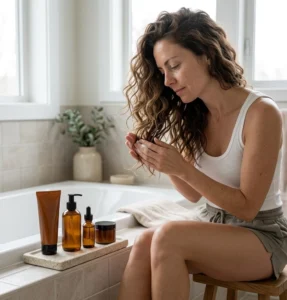
You don’t need a huge collection of products to keep hair manageable.
Start with three vital steps.
Step 1: Shampoo
Cleanse the scalp as needed.
Step 2: Conditioner
Use enough product to help detangle and manage.
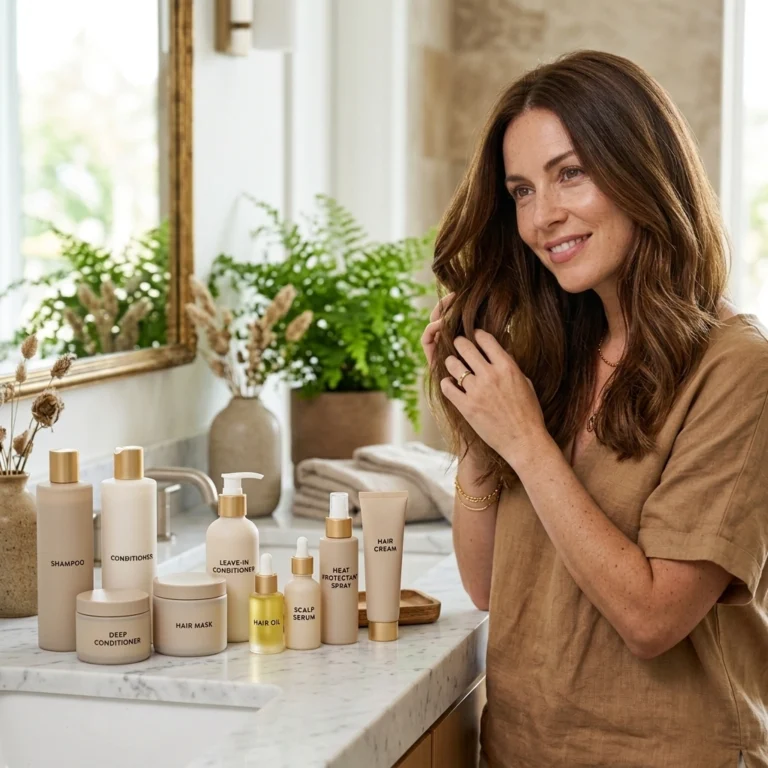
Step 3: One Targeted Product
Select according to the primary concern:
- Dryness: leave-in conditioner
- Heat styling: heat protectant
- Frizz: serum or smoothing product
- Curls: gel, mousse, or curl cream
- Flat, fine hair: volumizing product
Introduce additional products only when you are clear about the purpose of those products.
This approach also helps with troubleshooting. When you replace several products at the same time, it’s hard to know which change led to a certain outcome.
Determining Whether a Hair Product Is Suitable
You don’t need to see dramatic results immediately with a good product.
Evaluate performance over a number of applications.
A suitable routine should generally result in hair that is:
- Clean enough for the type of scalp
- Comfortable at the root
- Easy to untangle
- Manageable
- Appropriately conditioned without unnecessary heaviness
The goal is not to follow another person’s schedule. Someone may have fine, oily, straight hair and need to wash often and use very little conditioning, and someone may have coarse, high porosity, chemically processed curls and need a lot more conditioning. Neither one is better than the other.
Frequently Asked Questions
Should shampoo be chosen on the basis of hair type or scalp type?
The choice of a shampoo should be based mainly on the cleansing needs of the scalp, and also on the dryness, damage, or chemical treatment of the lengths.
Do you want shampoo and conditioner for the same hair type?
Not necessarily so. If you have an oily scalp but dry ends, use a clarifying shampoo and a moisturizing conditioner.
Does hair porosity affect product selection?
Yes, though only one of many relevant factors. Porosity is especially important when hair is chemically damaged. Strand thickness, texture, styling habits, and scalp condition also influence the choice of product.
Do costly hair care products do a better job?
Not always. Price is less significant than formula suitability. Sometimes an inexpensive product that cleans or conditions the hair properly may be better than a high-end product that is too heavy or harsh for a particular hair type.
What about a leave-in conditioner?
Not always. Leave-in conditioners are helpful for dry, curly, damaged, color-treated, tangled, or heat-styled hair, although fine hair may only require a small amount or a lightweight spray formulation.
When should use of a hair product be discontinued?
If significant burning, rash, swelling, or persistent irritation develops, use should be discontinued. Also, a product should be reconsidered when repeated use leads to consistent greasiness, coating, excessive roughness, or reduced manageability.
Summary
The challenge of choosing the right hair care products for a particular hair type becomes a lot easier when the goal is not to find that one perfect product, but to know exactly what the product is supposed to do.
Start with a scalp condition analysis, then consider strand thickness, texture, porosity, damage, and, most importantly, hair concern.
Choose a shampoo that cleans the scalp well and does not cause dryness, irritation, or discomfort. Select a conditioner that gives the lengths sufficient softness and slip but without the undesirable weight. Only add leave-ins, oils, styling products, and treatments as needed for a specific, identified need.
Above all, attention should be paid to how the hair reacts over time. What works great for one person may be too rich, too light, or just not right for another. In general, a simple regimen that leaves you with a comfortable scalp and clean, conditioned, manageable hair works better than constantly jumping on the latest hair-care bandwagon.
To update a routine, start by checking out the three most used products: shampoo, conditioner, and your main styling or leave-in product. What is each product really doing, and is the hair really getting any benefit from it? See the Hair Care Growth guides mentioned throughout this article for more refinement.
Medical note: This article offers general hair-care education and is not a replacement for diagnosis or medical treatment. If the itching, redness, scaling, sudden hair loss, sores, or pain on the scalp persist, consult a dermatologist or other qualified healthcare professional.
Written by Mian Hussain.