
Your hair is on your pillowcase for hours every night. You can’t control how fast hair grows, but its surface can determine how much your strands rub, snag, tangle, and flatten while you sleep. For hair that is curly, long, fine, bleached, chemically treated, or prone to breaking, the fabric selection is crucial.
Quick Answer: Does Pillowcase Fabric Affect Hair?
Yes, mainly friction. Silk and satin pillowcases are smooth and allow the hair to glide along with less friction than many rougher fabrics. This can mean fewer tangles, less frizz in the morning, and better protection of curls or styled hair.
But a pillowcase doesn’t stimulate follicles, cure hair loss, repair split ends, or take the place of a good hair-care routine. It is a protective, not medical, device.
How a Pillowcase Can Affect the Hair Shaft
The visible part of each strand is called the hair shaft. The outer layer, the cuticle, consists of overlapping cells, like roof shingles overlap. When these cells are flat, the hair may feel softer and have more shine. This surface is prone to erosion by heat, bleaching, chemical treatments, sunlight, rough grooming, and repeated mechanical stress.
A scientific review published via the National Institutes of Health found that “damage to the cuticle makes it more likely that friction occurs between hair fibers, which makes it more likely that breakage occurs.” More recent work on friction of hair also shows that mechanical contact can gradually weaken damaged layers of the cuticle.
Friction, frizz and tangles
You turn your head and strands slide across the pillow and into each other. More drag, more hairs are likely to catch, tangle and form knots. The next morning, that can appear as flyaways, rough ends or curls that have lost their shape.
The American Academy of Dermatology suggests silk or satin bonnets and pillowcases to reduce friction and preserve curly hairstyles.
Does Pillowcase Suck Moisture Out of Hair?
The notion that cotton “steals” moisture, and that silk keeps hair fully hydrated, is too simple. Moisture movement depends on fiber, weave, fabric weight, finish, humidity, sweat, and hair products. Silk is absorbent to moisture, and textile studies show that fabric construction affects absorbency and wicking.
The advantage is a smoother finish. Silk or satin may disturb oils and leave-in products less than a rough surface, but it cannot correct dryness caused by over-washing, heat damage, or poor conditioning.
Silk vs. Satin vs. Cotton for Hair
| Fabric | Potential benefit | Possible drawback |
|---|---|---|
| Silk | Smooth, low-friction feel | Higher price and careful washing |
| Satin | Good glide at a lower cost | Quality and breathability vary |
| Cotton | Affordable, breathable, and easy to clean | Some finishes create more drag |
| Linen | Breathable and durable | Usually less smooth |
| Bamboo-derived fabric | Can feel soft | Labeling and processing vary |
Is Silk Always Better Than Satin?
No. Silk is a fiber; satin is a type of weave. A good polyester satin pillowcase can feel softer even than a rough silk one.
If you want natural fiber and are willing to give it special care, silk is a good choice. Satin is practical for families, students, children, or anyone looking for an affordable case that can be washed frequently.
Who May Benefit Most?
You might especially want a smoother pillowcase if you:
- Curly hair, Coily hair or Tight Textured Hair
- Long hair around the neck
- Fine, filmy threads
- Bleached, relaxed, permed or coloured hair
- Dry hair, chronic/high porosity
- Bantu knots, braids, twists, blowouts or heat styled
Because of their shape and cuticle characteristics, curly and tightly coiled strands can be more susceptible to breakage. A good curly-hair routine, along with a silky pillowcase, usually works better than just switching pillowcases.
Can Silk or Satin Make Hair Grow?

There’s no scientific evidence that a pillowcase can increase the biological growth rate of the hair. Within the follicle, growth occurs and is affected by genetics, age, hormones, nutrition, health conditions, medications, and the hair growth cycle.
A smoother fabric may hold on to length by preventing breakage. Less breakage = fuller-looking hair that can grow to longer lengths before ends break off. That is conservation, not more rapid growth.
Breakage and shedding are different also. Broken hairs tend to be shorter and end unevenly. Shed hairs are from the root and may have a small bulb attached. If your part is widening or your scalp is becoming more visible, a pillowcase is not an adequate treatment.
Try a Simple 14-Night Pillowcase Test.
You don’t have to begin with a high-priced product. Try testing out if a smoother fabric makes a difference to your hair:
- Take a few photos of your hair on three different mornings before you make the change.
- Note tangles, frizz, curl shape, and restyling time.
- Apply a clean silk or satin case for 14 nights.
- Stick to the same hairstyle and products.
- Compare the photos and the feeling of your hair.
Two weeks won’t prove a medical benefit, but it can tell you if you get less snagging, easier detangling, or better style retention.
How to Choose a Hair-Friendly Pillowcase
Prioritize Surface
The fabric should feel smooth in all directions. Avoid scratchy embroidery, stiff piping, exposed zippers, or rough seams that will rub your hair.
Often a smooth, moderately priced pillowcase is more useful than an expensive product with decorative seams or textured designs.
Select Realistic Care
Before purchase, check the care label. Many silk products should be hand washed in cool water with a mild detergent and air dried. The polyester satin is the easier one to work with.
A pillowcase that fits into your regular laundry routine will more likely stay clean and be used regularly.
Select Your Fabric Wisely
Choose glide for tangles and frizz, breathability for night sweats, and easy laundering for children or oily hair products.
The fiber label, care instructions, seam quality, and surface feel matter more than vague marketing claims such as “beauty silk,” “anti-aging fabric,” or “hair-growth pillowcase.”
How Often Should You Wash Your Pillowcase?
Bedding collects hair oils, sweat, styling products, skin cells, and allergens. Washing weekly is a good start. If you sweat a lot, use oily products, have allergies, or sleep with pets, you may need to wash your pillow more frequently.
Cleveland Clinic and Mayo Clinic recommend washing pillowcases and bedding weekly or regularly. Always follow the care label and do not use very hot water on delicate silk.
Make washing easier by rotating washing two or three pillowcases at a time.
Better Overnight Habits for Healthier-Looking Hair
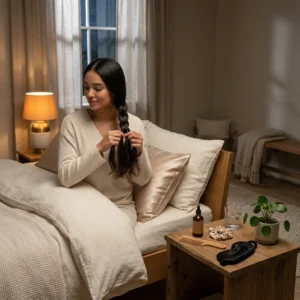
Soft pillowcase best suited to a gentle nighttime routine:
- Your hair should be dry or nearly dry when you go to sleep.
- Try a loose braid or twist instead of a tight ponytail.
- Wrap your hair with a soft scrunchie.
- Right down to the tips.
- Apply a small amount of leave-in and conditioner.
- If your hair still rubs against the pillow, try a silk or satin bonnet.
- Avoid hairstyles that hurt or pull at your scalp.
According to the AAD, damaged hair is brittle, wet hair is more prone to breaking if handled violently, and traction alopecia can develop over time from tight haircuts.
These habits are particularly important for bleached, relaxed, fine, and tightly coiled hair.
Common Myths About Pillowcases and Hair
“Silk Pillowcases Prevent Hair Loss”
They will not treat genetic, hormonal, autoimmune, nutritional, or inflammatory hair loss, but may help reduce hair shaft breakage.
Changing pillowcases will not help a person with alopecia areata or pattern baldness.
“Everyone’s Hair Is Damaged by Cotton“
Cotton in itself is not dangerous. When sleeping on cotton, many people do not experience any damage.
How it works out depends on many factors: the finish of the fabric, the state of the hair, the movement during sleep, the length of the hair, and the nightly hair-do.
“A Pricey Pillowcase May Be More Effective”
If you have straight, short, and healthy hair, switching fabrics may not make a huge difference.
Price doesn’t guarantee better results or a smoother surface. You’ll get the smoothness your hair needs with a cheap satin pillowcase.
Think about comfort and construction rather than just relying on the brand name.
“A Pillowcase Fixes Split Ends“
A split hair shaft cannot be permanently fused by any fabric. The only way to get rid of a split end is to trim it, but using conditioners and serums can temporarily level out the surface.
When to See a Dermatologist
See a doctor if hair loss is sudden, patchy, painful, or associated with redness, scaling, sores, or severe itching. You should also seek help if you notice your hairline is receding, your part is widening, or the thinning is continuing.
If you have a hair loss problem, NHS advice on hair loss suggests consulting a doctor. The AAD says the most important part of effective treatment is determining what’s causing the problem.
Dermatologists can diagnose hair-shaft breakage, excessive shedding, traction alopecia, pattern hair loss, scalp inflammation and more.
Frequently Asked Questions
Satin or Silk: Which Is Best for Your Curls?
Both can help with friction. Silk is a natural fibre and commands generally a higher price. Satin ( a similar slick surface but cheaper ). Not the luxury branding. It’s about washing well and washing often.
Can a Pillowcase Prevent Hair Breakage All Together?
Nope. Bleaching, heat styling, tight hairstyles, rough detangling, dryness, and hair-shaft disorders can also cause damage. A pillowcase deals with only one of the many possible causes of friction.
Are silk or satin pillowcases safe for children?
If the bedding and pillow are suitable for the child’s age, they can. Because satin is typically less expensive and easier to launder, it might be more convenient for families.
For babies and very young children, established safe-sleep guidance must always trump hair-care preferences.
The Bottom Line
The most important tool in controlling friction is the pillowcase’s material. If your hair is curly, long, chemically treated or fragile, silk and satin can help to reduce snagging, tangling, morning frizz and disruption of your style.
These are not designed to promote hair growth or to treat medical hair loss.
Give it a try for 14 nights. Make use of a cheap silk pillowcase. See if you have less knots, easier to detangle, better curl shape or less morning restyling. Practical changes beat big promises on the side of a product.
Looking to make bedtime more hair friendly? Change your pillow case tonight with a clean silk or satin one. Take a picture in the morning and come back check in two weeks. Then check out more practical guides at Hair Care Growth to build a routine that protects your strands from wash day to bedtime.
Medical disclaimer: This article is for general educational purposes only. It is not a substitute for diagnosis or treatment from a physician or board-certified dermatologist. Seek professional care for sudden, severe, patchy, painful, or persistent hair loss or scalp symptoms.