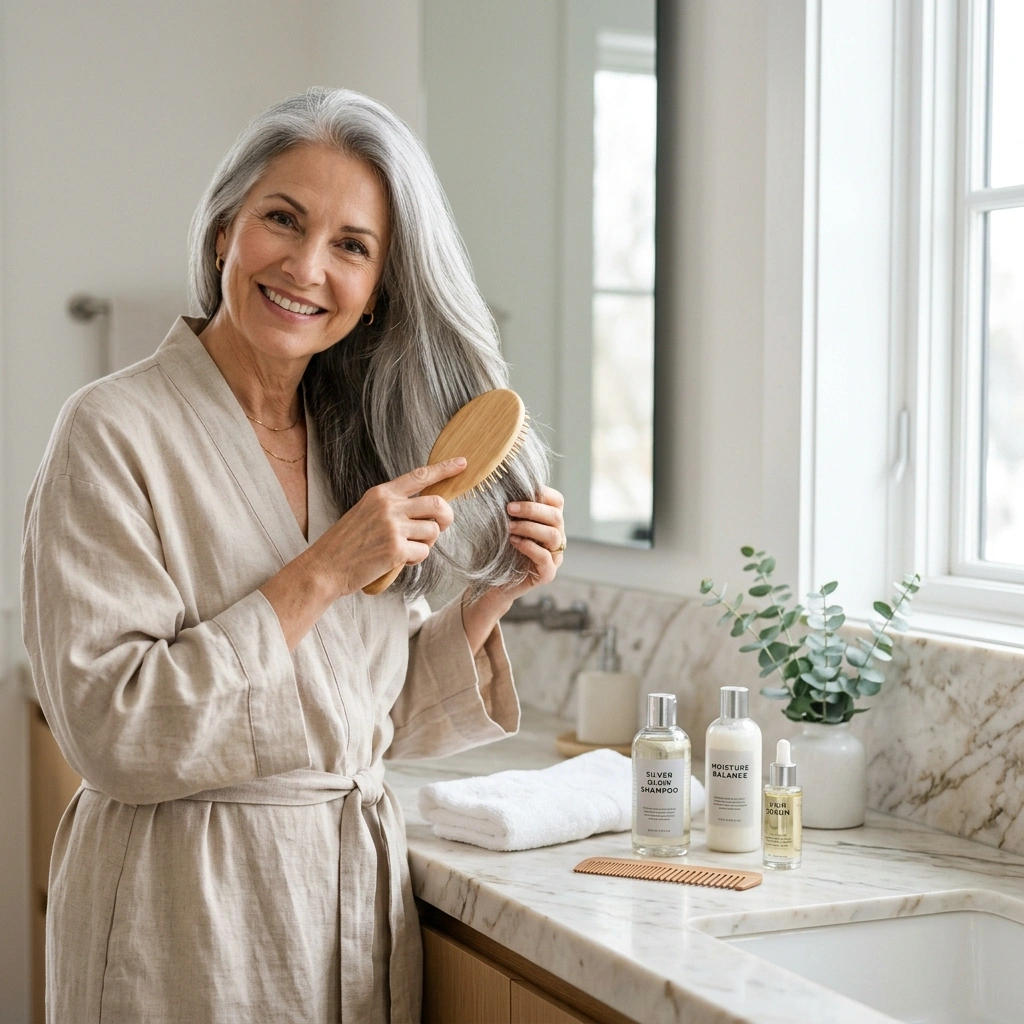
Gray hair can be head-turning, smooth and stunningly dimensional. If its needs are neglected, it can also become dry, rough, dull or slightly yellow.
If you run your fingers through healthy silver hair, it should still feel flexible and smooth to the touch and not stiff, straw-like or coated. The aim of a good grey hair care routine is not to make each strand behave the same way. It is to keep it soft, to prevent damage as much as possible, and to keep the natural silver colour clear.
Often it takes more than just tossing some purple shampoo on your shower shelf.
Gray hair may need moisture, help with buildup, heat protection, sun protection, and gentle handling. Your environment and styling habits, scalp type and hair texture also play a role. A person with fine straight silver hair will require a different balance than someone with coarse tightly curled gray hair.
Here’s how to create a practical routine for gray, white and silver hair without burdening it with lots of unnecessary products.
Medical disclaimer: This article is general information about hair care and is not a substitute for diagnosis and treatment by a dermatologist or other qualified health care professional. If you see sudden graying, excessive hair loss, redness or inflammation of the scalp, bald spots or other changes that concern you, consult a medical professional.
Quick Answer: What Is the Best Routine for Gray Hair?
A good gray hair care regimen should include:
- Shampoo with a mild shampoo according to the needs of your scalp.
- Conditioning after each shampoo.
- For coarse hair, use a more moisturizing treatment.
- Only use purple shampoo when you see yellow tones.
- Product or mineral buildup on curls.
- Protection of the hair against UV rays, chlorine, and excessive heat.
- Be gentle with wet hair to prevent breakage.
- Adjusting product weight to match your hair texture.
Purple shampoo corrects unwanted tone, but it does not moisturize the hair or repair physical damage. Silver hair usually looks its best when toning and conditioning are treated as separate jobs.
Why Does Gray Hair Need a Different Routine?
As we age, our hair turns white or gray because the follicles produce less melanin, the pigment that gives hair its color. Although genetics and certain health or lifestyle factors can influence when that loss of pigment begins, this loss of pigment is usually gradual, a normal part of the aging process, according to the American Academy of Dermatology.
Not all gray hairs will necessarily turn coarse with loss of pigment. Some have soft, fine silver hair. Others say new gray hairs are wiry, uneven, or more resistant to styling.
There are several changes that may take place simultaneously:
- As we age, we may produce less oil on our scalp.
- Hairs can be of different diameter and grow in different patterns.
- Years of sun, heat, color, and mechanical wear can accumulate.
- White hairs tend to show residue/discoloration more easily.
- As you age and with changes in environment, hair can become more fragile.
Changes in pigmentation, sebum production, fiber diameter, density, and texture are described in studies on aging hair, which can lead to hair that appears duller, thinner, drier, or frizzier.
The important difference is: graying is a pigment change; aging and weathering are condition changes. Gray strands aren’t necessarily a sign of damage, but the color and texture variation can make damage much more noticeable.
Dryness, Dullness, or Yellowing? Identify the Real Problem First
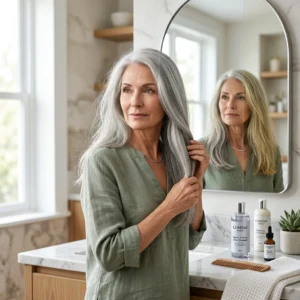
Wrong treatment can worsen gray hair. Applying purple shampoo to lackluster hair caused by mineral deposits can cause dryness and won’t fix the real problem.
Use this guide to figure out what you are seeing and feeling.
| What you notice | Likely explanation | Best first step |
|---|---|---|
| Hair feels rough and tangles easily | Moisture loss, raised cuticle, heat or mechanical damage | Improve conditioning and reduce friction |
| Hair feels soft but looks flat or cloudy | Product buildup or heavy styling residue | Use a clarifying wash |
| Hair has a beige or yellow cast | Environmental exposure, heat, residue or natural oxidation | Remove buildup, then tone if needed |
| Hair develops a violet or lavender tint | Purple shampoo used too often or left on too long | Stop toning temporarily and use regular shampoo |
| Ends feel dry while roots become oily | Shampooing or product placement is unbalanced | Clean the scalp and condition only the lengths |
| Hair snaps during detangling | Fragility, chemical damage or rough handling | Reduce tension, heat and aggressive brushing |
| Gray hair changes suddenly with shedding | Possible health, medication or scalp issue | Consult a healthcare professional |
Diagnose first, don’t go product shopping.
What Makes Gray Hair Look Yellow?
Yellowing is not always a sign of dirty hair. The pale background of white and silver threads makes even small amounts of residue visible.
Some common contributors include:
UV Exposure
Melanin is a natural shield from ultraviolet rays. Gray and white hair may be more susceptible to sun-induced protein damage and color changes because it has less melanin. The American Academy of Dermatology says lighter hair — think blond and gray — is more vulnerable to UV exposure, which can make it dry, brittle, frizzy, dull and discolored.
Heat Styling
Flat irons, curling irons and very hot blow-dryers can gradually damage the outer cuticle. If the surface is rough, the hair will reflect light unevenly, appearing dull or discolored.
Heat also can activate the styling residue in the hair. That’s because you’ll sometimes notice more yellowing in the front sections, where hot tools are often used.
Temperature control is beneficial in addition to the use of a heat-protectant product, as laboratory studies have shown structural and protein changes with repeated heat application.
Product Buildup
Dry shampoo, hairspray, silicone-rich stylers, waxes, oils, and leave-in products build up over time. This layer can sometimes cause silver hair to appear beige, gray-brown, or less shiny.
Cleveland Clinic recommends that people who regularly use multiple styling products may benefit from occasional clarifying to remove buildup.
Hard-Water Minerals
Dissolved minerals are present in hard water. They tend to remain in the hair after multiple washes, particularly in porous or damaged areas.
A clarifying shampoo is used to remove oils and product buildup. A chelating shampoo is designed to help bind and remove mineral deposits. In marketing, the terms are often used interchangeably, so be sure to read the product description carefully.
Chlorinated Pool Water
Chlorine can strip away the hair’s protective lipids, leading to dryness and breakage. Metals in pool water may also deposit on pale hair. The AAD recommends hair protection before swimming, immediate rinsing, and conditioning care.
Airborne Residue
Uncovered hair traps smoke, pollution, cooking fumes and other airborne particles. Laboratory studies have shown that particulate pollution can interact with hair fibers and cause oxidative protein damage.
That doesn’t mean you have to shampoo after every trip out the door. It means that regular, effective cleansing matters—especially when white hair begins to look coated.
The Complete Gray Hair Care Routine
A good routine should have your hair feeling better and looking brighter. Start with the least aggressive solution and escalate to more aggressive treatments if needed.
Step 1: Choose a Washing Schedule Based on Your Scalp
No hard and fast rule that gray hair must be washed twice a week.
Washing frequency should be based on:
- Scalp oil production
- Hair texture
- Exercise and sweating
- Product use
- Hair length
- Climate
- Scalp conditions such as dandruff
- Chemical processing
Sometimes you may need to wash fine hair or an oily scalp more often. If the hair is coarse, curly or very dry, the intervals may have to be longer. Cleveland Clinic notes that how often you should wash your hair isn’t a matter of a set schedule but rather depends on the person’s texture, oil production, age and routine.
A practical starting point
- Fine or oily gray hair: Every one to three days
- Medium-textured hair: Every two to four days
- Coarse, curly or dry gray hair: Once or twice weekly, adjusted for scalp comfort
- Protective styles: Clean the scalp on a schedule appropriate for the style and scalp condition
They are guidelines, not medical prescriptions.
If the scalp is greasy, itchy, uncomfortable, or heavily coated, wash sooner. If your lengths are starting to feel brittle, stretch the time between shampoos.
Apply shampoo where it is needed.
Massage shampoo into scalp, not lengths. When you rinse, the lather will run down the rest of the hair.
This is the AAD-recommended way to treat the scalp, as rubbing shampoo into the lengths all the time can cause damage and dryness.
To study post-wash roughness in more detail, see Why Your Hair Feels Dry Even After Washing.
Step 2: Condition After Every Shampoo
Conditioner is not an optional finishing step for most gray hair. It reduces friction, improves manageability, and helps the cuticle lie more smoothly.
Mainly use on mid-lengths to ends. If your hair is short, coarse, or very dry, you can bring a small amount closer to the roots without coating the scalp.
Look for formulas containing combinations of:
- Fatty alcohols such as cetyl or cetearyl alcohol
- Glycerin
- Panthenol
- Ceramides
- Amino acids
- Behentrimonium chloride
- Lightweight silicones
- Jojoba, argan or other conditioning oils
An ingredient label that says “Alcohol” isn’t necessarily a drying one. Fatty alcohols are a common thickener/softener in conditioners.
How long should conditioner stay on?
Use as directed on product label. It won’t become a deep treatment just because you leave a regular rinse-out conditioner in for 30 minutes.
When your regular product is not providing enough softness, use a proper mask or intensive conditioner.
Step 3: Add Deep Conditioning According to Feel, Not the Calendar
Some people could benefit from a weekly mask, but it is not necessary for everyone as a default.
Consider a more intensive treatment when:
- Ends feel rough right after drying.
- Hair gets more tangled.
- Curls flop.
- The hair has been exposed to the sun, swimming, or chemical treatments.
- You are leaving color that is for good.
- Gray sections feel much rougher than pigmented sections.
Fine hair may only need a light mask every 2-4 weeks. Weekly use may be helpful on coarse, coily, or chemically processed gray hair.
Wash well. If a mask makes hair feel soft but flat, sticky, or greasy quickly, then it is probably too heavy or being used too often.
Step 4: Use a Leave-In Product for Slip and Protection
A leave-in conditioner can be a lifesaver when gray hair snags on your fingers or comb.
Work a small amount through damp hair, concentrating on any rough areas. Use less than you think you need and then add more if needed.
A leave-in product can help:
- Lubricate to detangle
- Make softer
- Control flyaways
- Curl definition of curl curl
- Normal-to-dry ends: normal use protection
- Create a light barrier before outdoor exposure
Fine hair often does best with a spray or light lotion. Coarse and curly hair may need a creamier formula.
Step 5: Detangle With the Hair’s Texture in Mind
Wet hair pulls more easily and can break. But it can be safer to detangle tightly curled hair when it’s damp and coated with conditioner.
The AAD recommends combing straight hair after it is slightly dried, and textured or tightly curled hair can be combed when it is damp.
To reduce breakage:
- Section long or thick hair.
- Hold the top of the hair above the knot so you don’t pull at the roots.
- Start at the ends.
- Work up gradually.
- Don’t force through the knot; use a conditioner or detangler product.
- Listen for repeated snapping sounds, and if you hear them, stop.
The aim is not to brush until the hair is perfectly smooth. Brushing too much causes needless friction.
Step 6: Dry Without Roughing Up the Cuticle
Don’t rub wet grey hair vigorously with a bath towel. Use instead, dab, press or wrap.
It may be easier to absorb the excess water with a microfibre towel or soft cotton shirt, but it is more about technique than the tag on the fabric. But even a soft towel can be damaging if you wring or rub your hair vigorously.
Let the hair air-dry a little before blow-drying, if appropriate.
Step 7: Control Heat Instead of Trusting Heat Protectant Alone
Heat protectant will reduce some of the styling damage, but it won’t make it heat safe at infinite degrees.
Merge these habits:
- Select the lowest temperature that produces the effect.
- Don’t concentrate heat in one place.
- Keep the blow-dryer moving around.
- Don’t re-iron the same section over and over.
- Unless it’s designed for wet hair, don’t use a flat iron on wet hair.
- Allow the hair some days without heat.
- Clean residue from hot-tool plates.
The AAD recommends using the lowest heat setting and reducing the frequency of using hot tools to help prevent breakage and dullness.
If your ends continue to look rough after regular conditioning, turn down the heat for a few weeks before you buy another treatment.
Step 8: Finish With a Small Amount of Serum
A serum can be great for slip and surface shine, especially on coarse ends. It doesn’t replace conditioner or rebuild a split hair fibre.
Rub a drop or two between palms, gently smooth over mid-lengths and ends of hair. Too much can make white hair look greasy, coated, or even darker.
Refer to instructions for use; see Hair Serums: Benefits, Uses, and Mistakes to Avoid.
How to Use Purple Shampoo Without Drying Out Gray Hair
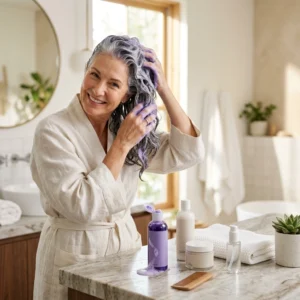
Purple shampoo contains violet pigment that visually neutralizes yellow tones. It is based on colour correction, not on changing the natural pigment in the follicle.
It should be a targeted treatment, not a default on every wash.
Start with this method.
- If necessary, wash away heavy oil or buildup first.
- Work the purple shampoo through your wet hair.
- Look at the yellow areas you can see.
- Follow the manufacturer’s timing instructions.
- Well rinse.
- Use a hydrating conditioner.
- Check the result only after the hair is completely dry.
Wet hair may look darker or cooler than it will after drying.
How often should you use it?
Begin once a week or every other week. Adjust frequency up or down depending on results and strength of pigment in the product.
Use it less when:
- Lavender hair.
- The ends grow rougher and rougher.
- Few yellow areas.
- The hair looks already cool and bright.
- You also use a toning mask or a conditioner.
Use a regular moisturizing shampoo between toning washes.
Purple shampoo cannot fix every type of dullness.
Purple dye is permanent:
- Hard-water minerals
- Heavy silicone or wax buildup
- Chlorine
- Smoke residue
- Heat-damaged ends
- A rough, weathered cuticle
If the hair appears foggy rather than a true yellow, it needs to be clarified or chelated before adding any additional violet pigment.
Clarifying Shampoo vs. Chelating Shampoo
These treatments solve different problems.
| Treatment | Main purpose | Useful when | Use carefully when |
|---|---|---|---|
| Clarifying shampoo | Removes excess oils and styling residue | Hair feels coated, flat, waxy or unusually greasy | Hair is already extremely dry |
| Chelating shampoo | Helps remove mineral and metal deposits | Hard water, swimming or stubborn discoloration is suspected | Hair is porous, bleached or fragile |
| Purple shampoo | Deposits violet pigment to reduce yellow appearance | Hair is clean but visibly warm or yellow | Hair is dry, highly porous or already lavender |
| Deep conditioner | Improves softness and manageability | Hair feels rough, tangled or inflexible | Fine hair becomes easily weighed down |
Don’t use all treatments in the same wash unless the product directions and/or a professional specifically recommend it.
A sensible order is:
- Rinse away residue or minerals.
- Evaluate the dry hair under natural light.
- You only tone if yellow is still there.
- Follow with the proper conditioning.
The Four-Week Gray Hair Reset
The simpler a routine is, the easier it is to find the real problem, especially when layering tonnes of products.
Week 1: Reset
- If there is buildup, use an appropriate clarifying or chelating wash.
- Follow with conditioner or mask.
- If your hair is weak, don’t use purple shampoo in the same wash.
- Photograph hair under diffused daylight.
Week 2: Rebuild softness
- Use a mild shampoo as you normally would.
- Sub-condition.
- Turn the heat off.
- Apply a light leave-in product.
- Notice whether the hair feels smoother before adding shine products.
Week 3: Correct tone
- Use purple shampoo only if yellowing persists.
- Spread evenly.
- Follow with hydration.
- Compare with the first pic in similar lighting.
Week 4: Set the maintenance schedule
Find out the actual treatment needed:
- Regular shampoo to clean the scalp
- Deep conditioner for coarseness
- Clarification of residue treatment
- Mineral chelation therapy
- Purple Shampoo for Unwanted Yellow Stains
This reset helps to avoid the common mistake of using the same bottle for all gray-hair concerns.
Gray Hair Care by Texture

Fine Gray Hair
Fine silver hair can get weighed down with excess oils, creams, and masks.
Prioritize:
- Light conditioner
- Leave-in sprays.
- Small amounts of blood serum.
- Scalp-focused shampooing
- Buildup periodically removed
- Volumising products non-stiff
Apply richer treatments only on the driest ends.
Coarse or Wiry Gray Hair
More slip and flexibility is often required for coarse strands.
Prioritize:
- Thick conditioner
- Disentanglement by parts
- common masks
- Leave-in conditioner
- Turn heat down
- A little oil or serum over the ends
When only the gray strands stand away from the rest of the hair, avoid attacking them with repeated hot-tool passes. Flexible hold and moisture products tend to be kinder.
Curly Gray Hair
The oil from the scalp doesn’t travel down a curly strand as easily, so a curly head of hair can naturally be prone to being dry.
Prioritize:
- Wash as per the needs of the scalp
- Detangle with conditioner
- Leave-in moisturiser
- Curl cream or flexible hold gel
- Dry brushing, minimal
- Protection for the night with silk.
- Lightly misting your hair instead of soaking it down with product.
The AAD notes that curly and coily hair can be particularly vulnerable to dryness and breakage, making gentle handling especially important.
Coily and Tightly Textured Gray Hair
Tight textured silver hair responds well to low tension, delicate handling, and retaining moisture.
Prioritize:
- Sectional cleansing
- Wash thoroughly
- Rich conditioning on length
- Gentle detangle
- Protective styles low tension
- Watching the hairline
- Avoiding repeated tight braids, extensions, or heavy added hair
A protective style should protect—not cause pain, bumps, thinning edges, or scalp soreness.
Oily Scalp With Dry Gray Ends
This is a common combination, and you don’t have to choose between a clean scalp and moisturised ends.
Try this procedure:
- Shampoo the scalp as often as needed.
- Let the lather travel the lengths in the rinse water.
- Use conditioner on the ends, not the roots.
- Only use a light leave-in on the ends.
- Avoid build-up of dry shampoo or styling products.
- Heavy oils should not be used on an oily scalp.
Protecting Gray Hair From Sun and Swimming
Grey hair contains less pigment to buffer from UV exposure. A broad-brimmed hat will give you more dependable physical coverage than a cosmetic spray alone.
Before long outdoor exposure:
- If possible, wear a hat.
- Use a leave-in product formulated for environmental protection.
- Maintain hair covered over long periods of peak sunlight.
- If possible, do not mix heavy sun with chlorine and new chemical processing.
Before you go in the water:
- Wet the hair with clean water.
- Apply a small amount of leave-in conditioner or protective oil.
- Swim often? Wear a swim cap.
- Leave the pool and immediately rinse off.
- Use a swimmer’s or chelating shampoo when residue persists.
- Follow with conditioner.
These steps align with dermatologist guidance from the AAD for reducing sun- and chlorine-related hair damage.
Nighttime Care for Gray Hair

Night care should not be a complicated secondary styling routine, but a reduction of friction.
Bedtime:
- Make sure hair is dry or mostly dry.
- Carefully remove large knots.
- Wear your long hair in a loose braid or low tension style.
- Use ties covered in fabric, not tight elastic.
- Just a little serum on the ends, if the ends feel rough.
- Keep your pillowcases, bonnets, and scarves clean.
A satin or silk surface may reduce friction for some textures, but it cannot correct dehydration, buildup, or heat damage by itself.
Ingredients Worth Looking For
Rather than looking for products that say “for silver hair” only, find out what the formula is supposed to do.
For softness and slip
- Behentrimonium chloride
- Cetrimonium chloride
- Cetyl alcohol
- Cetearyl alcohol
- Dimethicone
- Amodimethicone
For hydration support
- Glycerin
- Panthenol
- Betaine
- Aloe
- Hyaluronic acid
Humectants can help, but it’s more about the formula and not just one ingredient.
For damaged or porous hair
- Hydrolyzed proteins
- Amino acids
- Ceramides
- Bond-supporting ingredients
Protein treatments help the feel of damaged hair for a while, but too much can make some hair stiff. Switch treatments with a moisturising care as needed.
For toning
- Violet pigments
- Blue-violet pigments
Healthy roots will take up pigment slower than the very porous ends. If you have uneven porosity in your hair, be careful when using toning products.
Gray Hair Mistakes That Often Backfire
Purple Shampoo with Each Wash
More pigment does not always translate into brighter hair. Overuse may result in a dull violet cast and may worsen dryness.
Oil and Water, Stirred Up
Oil can reduce friction and create shine, but it does not clean the hair nor replace a properly formulated conditioner.
Stale Products in Hair Loading
Lifeless hair so often means a reach for shine spray, oil, cream, serum. If buildup is the real problem, adding more product makes the hair cloudier.
Hottest water
Hot water may remove oils efficiently, but it can leave already dry hair feeling rough. Lukewarm water is usually more comfortable for the scalp and the length.
Applying Harsh DIY Brighteners
Lemon juice, baking soda, undiluted vinegar, and hydrogen peroxide are often promoted as inexpensive brighteners. These treatments can be irritating or leave hair rougher, especially when the strand is already porous.
A formulated clarifying, chelating, or toning product offers more predictable use instructions.
Grey Strands Pulling
Plucking one gray hair does not cause several more to grow. But repeated plucking can traumatise the follicle and lead to thinning. The new strand will usually grow back grey, because plucking does not restore pigment production.
Gray Hair Myths: What the Evidence Actually Supports
MYTH: GREY HAIR IS THICKER
Grey hair can feel coarse, but everyone doesn’t notice the same change in texture. It is influenced by age, shape and diameter of the follicle, sebum, chemical history and environmental damage.
MYTH: Purple shampoo is awesome for your hair!
Purple shampoo alters the look of yellow tones. It will not thicken the follicle or add pigment or replace conditioner.
Myth: Natural Colour Can Be Replenished by Supplements
Some individuals may have vitamin deficiencies associated with premature grey hair, but supplements are not a proven method to reverse normal age-related grey hair. The AAD advises addressing an identified underlying condition with a healthcare professional rather than assuming a supplement will restore color.
Myth: Stress is the Only Cause of Premature Greying of Hair
Stress may affect pigment-producing cells, but premature graying can also involve genetics, smoking, nutritional deficiencies, and certain autoimmune conditions.
Myth: New products can make your hair return to its original colour permanently
Current consumer hair-care products may color, coat, tone, or improve the appearance of gray hair. They do not reliably restart permanent melanin production in age-related graying.
The AAD states that no effective medical treatment currently restores pigment in ordinary gray hair.
What Does the Latest Research Say About Reversing Gray Hair?
Hair pigmentation is a hot topic of research, but it is important to distinguish between lab research and what is available to the public as a treatment.
Melanocyte stem cells in hair follicles in mice are mobile and switch between locations and cellular states, according to a study published in Nature in 2023. As the animals aged, some cells became lodged in a region where they could not properly mature and support pigmentation. The finding added a new dimension to scientists’ understanding of the reasons behind why hair may lose its colour, but did not advance a proven treatment for reversing grey hair in humans. Read the paper in Nature.
Reviews of human hair graying describe a complex process involving genetics, oxidative stress, melanocyte biology, cellular aging, and the follicle environment. They also emphasize that reliable evidence-based reversal treatments remain limited. Read a review indexed by PubMed and a recent comprehensive review from PubMed Central.
For now, the realistic goals of a gray hair care routine are to:
- Improve softness
- Reduce breakage
- Control discoloration
- Protect against weathering
- Maintain scalp comfort
- Enhance the natural silver appearance
When Should You See a Dermatologist?
“It’s normal to go grey gradually through the years. If other symptoms develop with greying or change in texture, see a medical provider for evaluation.
If you notice: See a dermatologist or other health care provider
- Grey hair, especially sudden or rapidly increasing grey hair at an unusually young age
- heavy shedding
- Thinning or receding hairline
- Smooth bald spots
- Broken hairs at the scalp
- Itching, burning or soreness that won’t go away
- Redness, scaling, sores or drainage
- Eyebrow or eyelash hair loss
- Fatigue, weakness, numbness or other possible signs of deficiency
- Hair changes and medications
- A major texture change that is not amenable to more mild treatment.
Genetics still plays a large role, but premature greying is sometimes associated with nutritional deficiencies or autoimmune disorders. A health care professional can determine whether medical history, examination, or lab testing is appropriate.
If changes in hair-care habits don’t improve breakage, thinning or other worrisome issues, the AAD also recommends visiting a dermatologist.
Simple Weekly Gray Hair Care Schedule
| Day or frequency | Routine |
|---|---|
| Regular wash day | Gentle scalp cleansing, conditioner, leave-in and low heat styling |
| Once weekly or as needed | Moisturising mask for coarse, curly or damaged hair |
| Every one to two weeks | Use purple shampoo only when you see yellow tones |
| Once or twice monthly | Clarifying Shampoo For When Styling Buildup Occurs |
| As needed | Chelating treatment post hard-water or pool exposure |
| Daily | Low heat, gentle touch, UV conscious |
| Every 6–12 weeks | Trim to style length and condition of split ends. |
If you find your hair is overconditioned, dry, coated, or overtoned, adjust this schedule accordingly. A routine should be a response to the hair, not a forcing of the hair into a calendar.
Frequently Asked Questions
How can I make gray hair soft and shiny?
Wash. Use conditioner. If you need it, use a leave-in conditioner. Avoid high heat. Occasionally remove buildup. Apply a small amount of serum to the ends of your hair only. Shine improves if the surface is smooth and clean – not just greasy.
Why is my gray hair suddenly turning yellow?
Consider recent sun exposure, swimming, hard water, smoking or pollution exposure, heat styling, medication changes, and new styling products. If you suspect buildup, first clarify or chelate. If the hair is clean but appears yellow, then use purple shampoo.
How about natural grey hair? Can I use purple shampoo?
Yes. Purple shampoo can reduce the appearance of unwanted yellow tones in naturally gray, white, or silver hair. Begin slowly, then follow the product directions for the condition.
How often should you wash grey hair?
Wash according to scalp oiliness, texture, activity level, and product use. An oily scalp may need washing every day or two, while dry, coarse, or tightly curled hair may need less frequent washing.
Is sulphate-free shampoo always better for grey hair?
No. A shampoo’s overall formulation and cleansing strength matter more than whether it carries a sulfate-free shampoo. Some sulfate-free cleansers are gentle; others can still feel drying. Choose according to the reaction of your scalp and your hair.
Does gray hair need protein?
Damaged or highly porous gray hair may temporarily feel stronger after a protein treatment. If overused, these treatments can stiffen healthy or protein-sensitive hair. Use them based on condition, not color alone.
Can coconut oil prevent greying hair from turning yellow?
Coconut oil does not neutralize yellow tones. This may help the feel of some hair types or reduce friction, but it also can weigh fine hair down. Yellowing is more of a toner, buildup remover, and environmental protection.
Can Grey Hair Be Reversed?
The grey hair that turns grey with age usually doesn’t grow its pigment back for good. Rare repigmentation has been reported under specific circumstances, but there is no established consumer treatment that reliably reverses ordinary graying.
Which One? Purple Shampoo or Blue Shampoo?
Generally, purple is used to neutralise yellows. Blue is better for orange tones, and can make light silver hair look dull if overused. For most yellowing of white or grey hair, purple is the better choice.
Why does my gray hair feel wiry?
Texture can be influenced by changes in strand diameter, scalp oil production, follicle behaviour, accumulated damage, and humidity. Step one, before you assume the texture can’t be improved, increase the conditioning and reduce the high heat.
Final Gray Hair Care Checklist
If your routine is getting complicated, check this list:
- Do not scrub the hair too hard, but wash the scalp.
- Condition after each shampoo.
- Deep-condition according to texture and dryness.
- Don’t overload on shine products until you’ve gotten rid of the buildup.
- For the yellow tones you can see, you use the purple shampoo.
- If minerals are the likely culprit, chelate.
- Apply leave-in products sparingly.
- Work from the ends upward to detangle.
- Use as low an effective styling temperature as possible.
- Protect silver hair from prolonged sun and pool exposure.
- Don’t go for harsh DIY lightening treatments.
- Seek medical advice for sudden or concerning changes.
Conclusion
You don’t have to cover up or “fix” grey hair. It needs a process that really understands what it means to have pale, ageing or weathered fibres.
Silver hair feels coarse? Increase slip, reduce damage. If it clouds up, clean the buildup off. Tone gently when it takes on a true yellow cast. Remove (from heat and aggressive styling) when brittle.
Usually the best grey hair care routine is not the one that uses the most products. It’s the one that clearly defines the purpose for every single product.
Begin by examining your hair in natural light and select the problem that matters the most to you: dryness, dullness, or yellowing. Make one change at a time and then watch the results over a few washes and adjust from there.
Ready to give your silver hair the TLC it deserves? Review your current wash-day products today, remove any step that has no clear purpose, and build a simpler routine focused on softness, brightness, and long-term protection.