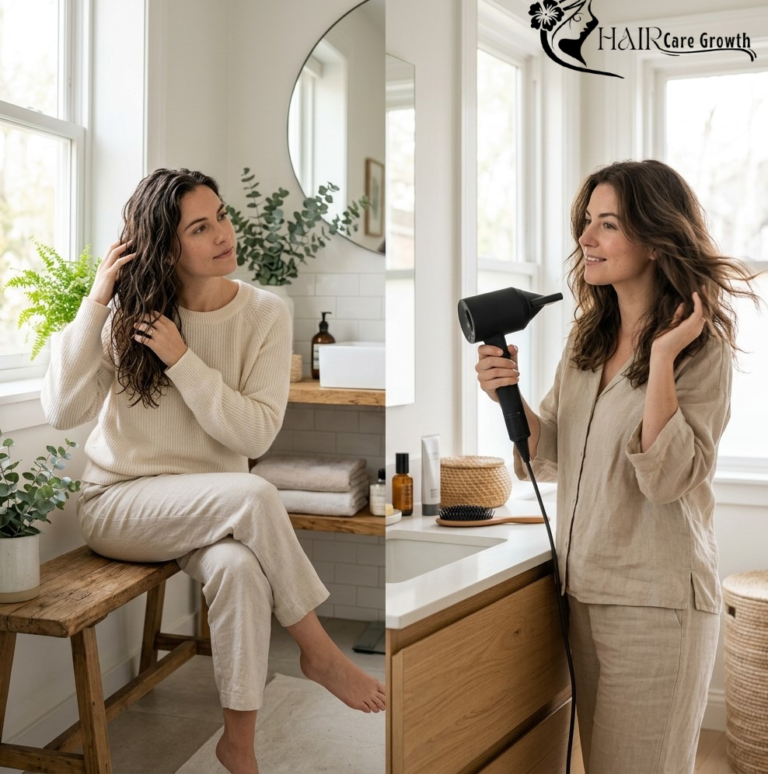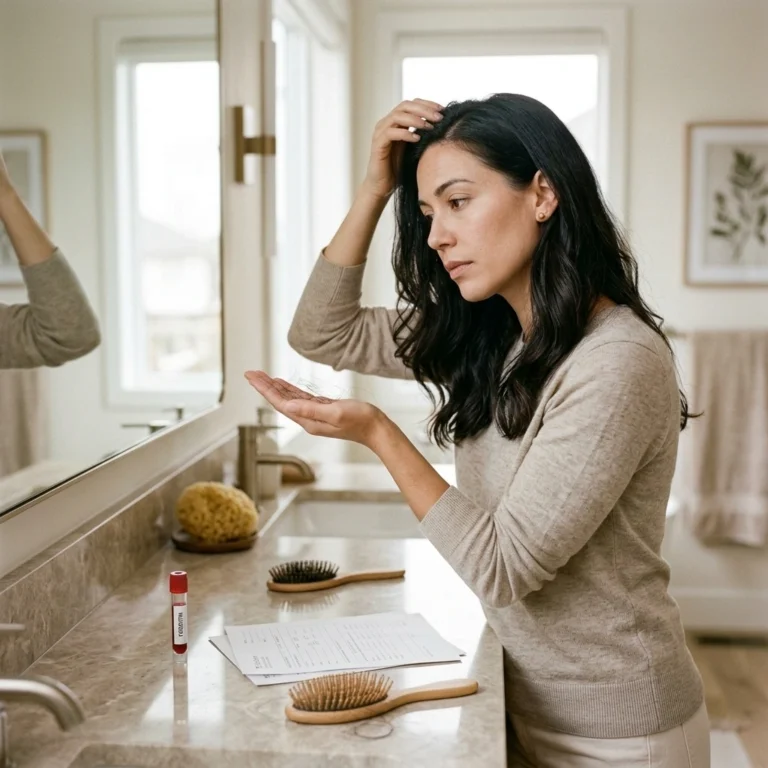
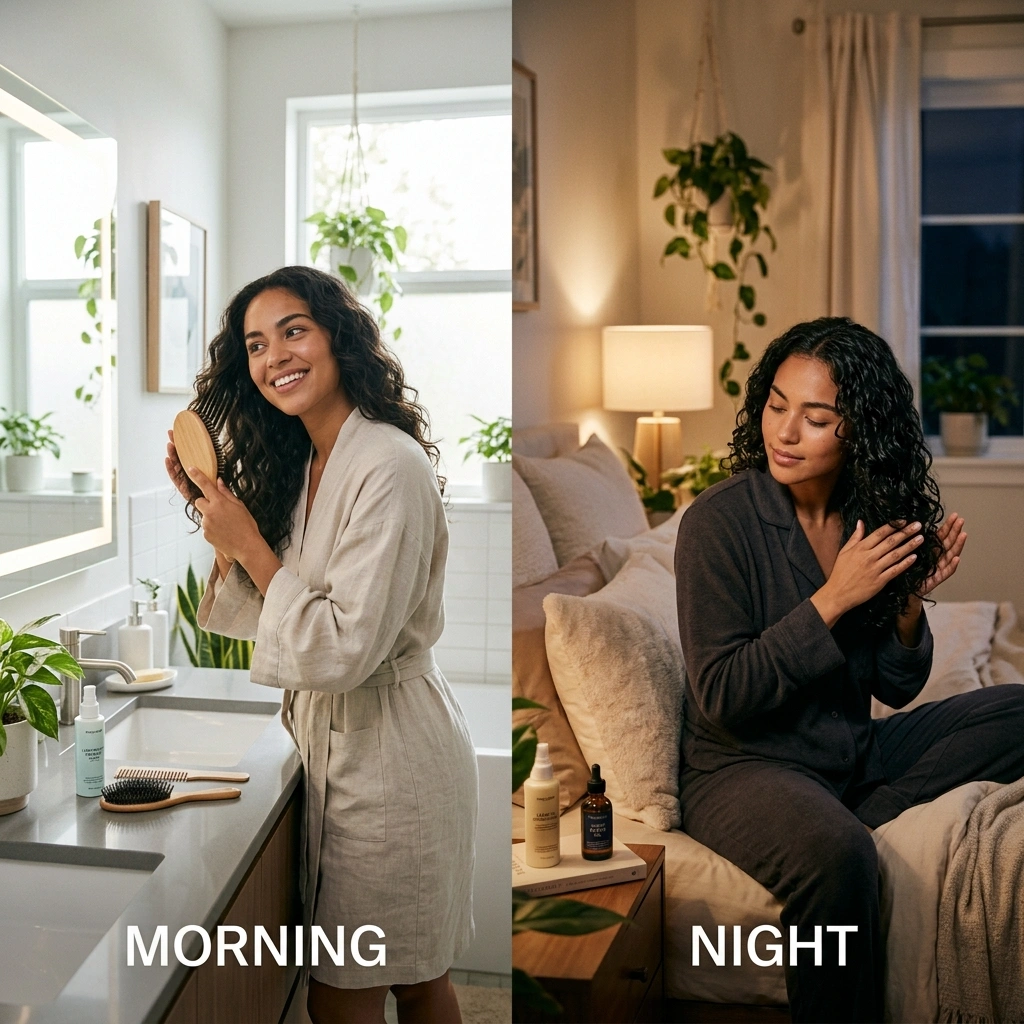
Picture this: You’re at the bathroom mirror, hairbrush in hand, half-asleep, wondering if you should wash now or just live with it tonight. I lived that moment for years!!! I was a strict morning-wash person for a long while. A friend swore by nighttime care as her secret to softer, stronger hair. So I got interested, did some research, and tried both routines on my own head for months.
What I discovered surprised me. What time of day you care for your hair matters far less than how you treat it, gently and consistently. But each routine offers real advantages, and a few minor errors can quietly sabotage your progress without you even noticing.
This is such a relevant topic because so many of us are wasting energy on the “perfect” schedule when our hair just wants consistent, kind treatment.
What you’ll learn in this guide:
- The real effect of your body clock and your scalp on your hair
- The real benefits of a morning routine vs. a night routine
- Simple best practices: the mistakes not to make
So, let’s get started!
Does the Time of Day Really Affect Your Hair?
The short answer: a little, but not in the way you think.
Your hair grows in cycles, and your scalp produces oil (called sebum) all day long. Your skin and scalp are influenced by hormones and your circadian rhythm (the body’s own internal 24-hour clock). “When you sleep, repair and cell turnover are more active overnight.
But there’s a catch. There’s no solid research that supports the idea that washing or treating your hair at a certain time will speed up hair growth significantly. What the experts do agree on is that gentle, consistent care protects your strands and keeps your scalp healthy, says the American Academy of Dermatology (AAD).
So forget the clock and develop habits that work for your life and protect your hair.
A Quick Peek at Scalp Biology
Your scalp is skin, and it behaves like skin. It gets oily, it can dry out, and it needs a clean, balanced surface to grow healthy hair.
- Sebum tends to build up more at the end of the day
- Old product and sweat can clog your follicles
- Rubbing your pillow can stress delicate strands overnight
Once you’ve got a handle on this, it’s much easier to tell when your hair is most in need of TLC.
The Case for a Morning Hair Care Routine

If you love starting fresh and styling with full control, mornings are wonderful. A night of tossing and turning often leaves hair flat, creased, or frizzy, so a morning reset makes real sense for plenty of people.
The benefits of a morning routine:
- You wash off the oil and sweat of the night
- Better clean hair styles
- You walk out feeling polished and put together
But here’s the catch. If you wash and then pick up the hot tools immediately, you’re introducing heat at a time when your hair is at its most delicate. Over time, the heat on wet or just-washed hair causes breakage.
Morning Best Practices
Want mornings to work for you? Give these a try:
- Wash when your scalp feels oily, not just because you always do
- Use a leave-in conditioner for moisture and slip.
- Always use a heat protectant before using any hot tool
- When you have the time, let your hair air-dry a bit before blow-drying
These small moves contribute to real protection against everyday damage.
The Case for a Night Hair Care Routine
To be honest with you, I was slowly won over to the nighttime routine, mostly for one reason. It gives your hair long, uninterrupted hours to soak up treatments. You’re not running out the door, so you can slow down and be more gentle and intentional.
Benefits of a nightly routine
- Allowing more time for masks and treatments to soak in
- No rushing to heat style before work
- A way to protect your hair from friction with the pillow
The evening is the best time for a deep conditioning or nourishing hair mask. You put it on, then relax and let it work its magic as you unwind. You get a break, and so does your hair.
Best Practices at Night
Here’s how I get my evenings ready for thicker strands:
- Gently comb through with a wide-tooth comb before bed
- Deep conditioning treatment, once or twice a week
- Braid or loosely tie hair to keep it from becoming tangled
- Switch to a silk/satin pillowcase to decrease friction
That silk pillowcase switch? “It’s honestly, a game changer for me.” Less friction equals less breakage and way fewer tangles in the morning.
Morning or Night? Which Time Is Right For You?
So after all the testing, I finally came up with this: choose a timing that works for you to be consistent and gentle. Above all else, it encourages a healthy scalp and regular hair growth over the long term.
This is a helpful guide to help you decide:
- Oily scalp or sweat every day? You may do well in the morn.
- Dry, colour-treated or curly? Night treatments are really nice.
- In a hurry in the morning? Schedule your treatments in the evening.
- Like a fresh style look? Morning washing is usually preferred.
You can mix it up too. Wash in the morning, do your nourishing treatments at night. There is no law that you can only choose one.
Common Mistakes to Avoid
I’ve done all of these myself so learn from my mistakes!
- Over washed. Removing natural oils, however, can cause dry hair and a cranky scalp. How often you wash will depend on your hair type and how oily it gets, says the AAD.
- No heat protectant. This is one of the easiest ways to do needless damage.
- Wet and brushing hard. Wet hair is more likely to stretch and break.
- Night Tights Styles. Pulling your hair back tight can strain your follicles. Tension has been linked to a form of hair loss called traction alopecia (AAD Hair Loss).
- Go to bed with wet hair. Wet hair is weaker and more prone to breakage on your pillow.
Stay away from these and you are one step ahead of most people.
Expert Tips for Healthier Hair
Here are some other tips I’ve learned from reading and a lot of real-world trial and error:
- Match products to your hair type. Fine hair can benefit from lighter formulas. Thinner or straight hair will usually soak up lighter moisture.
- Leave the ends out of the shampoo. Focus on the scalp, the rinse will look after the lengths.
- Use intention to deeply conditioned. Most people don’t need more than a couple of times a week. More doesn’t always mean better.
- Protect from heat each time. Also, lower your tool temperature when possible.
- Be kind to yourself. Hair takes time to grow (often months) and to be seen and to be fixed. Quick fixes don’t compare to consistent habits.
Just a friendly reminder: If you experience any sudden shedding, thinning or scalp irritation that won’t go away, please see a board-certified dermatologist. There are many causes of hair loss and a professional can help you find yours.
Frequently Asked Questions
1. Do I wash my hair in the morning or at night?
Neither is superior in all situations. Depends on your hair type, oil levels and daily routine. Pick a time you can stick to regularly, and do it gently.
2. Is it bad to wash my hair at night
Only if you get into bed with it soaking wet. Let wet hair dry or use a microfiber towel before bed, because wet hair is fragile.
3. How often do I need to deep condition?
Most people are comfortable with once or twice a week. Dry, curly or color-treated hair requires a little extra moisture.
4. Is there really a way to improve hair growth with my timing?
Not really. Hair growth is mostly a function of genetics, hormones and general health. A healthy scalp is the basis of growth and a gentle routine helps.
5. Heat styling – morning or night? When to do it?
Always use a heat protectant first when ever you style . Don’t style your hair when it’s clean and wet. This is going to add more heat damage.
6. Do silk pillowcases actually work?
Many report less friction and tangling which can lead to less breakage overnight. Nice little upgrade, low risk, comfort.
7. When to visit a dermatologist on my hair?
If you have sudden shedding or bald patches, pain or itching of the scalp that won’t go away, make an appointment. It is usually easier to treat the sooner you start treatment.
The Bottom Line
So, what is most important? It’s not really the clock. It’s your consistency and how delicately you treat your hair. A morning and night routine can keep your scalp healthy and strands strong—just avoid the common mistakes and always protect from heat.
What you do next is straightforward. Choose a time that works best with your schedule, pick products made for your hair type, and stick with it for a few weeks. Take it for a spin and you’ll finally stop second-guessing that sleepy mirror moment.