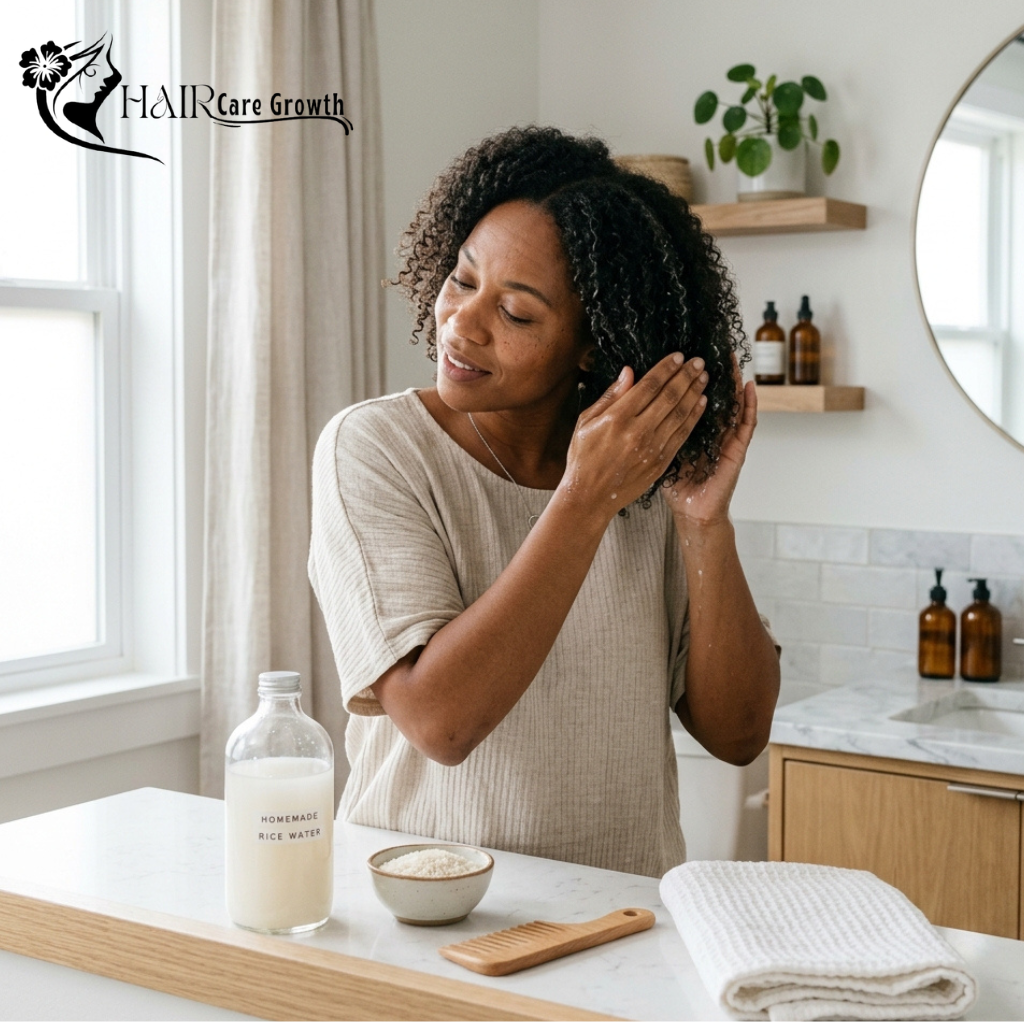
Rice water is now a staple in the internet’s DIY hair treatments. It’s cheap, easy to make, and is often said to do everything from making your hair shinier to making it grow dramatically.
The reality is less dramatic – but still interesting.
Rice water may make some hair feel smoother, easier to comb, and less likely to break due to friction. What it hasn’t been proven to do is make hair follicles grow hair significantly faster.
Short answer: Rice water is the starchy water left behind after soaking or cooking rice. It may lightly coat the hair shaft (which may improve smoothness and reduce friction). But there is little scientific evidence at this time that directly suggests that homemade rice water is promoting new hair growth.
If you want to give it a shot, consider rice water an occasional conditioning rinse, not a hair-loss treatment or replacement for a good hair-care routine.
What Is Rice Water?
Rice water is simply the milky liquid left behind from rice sitting or cooking in water.
Most DIY versions are made by:
- Soaking rice in water.
- Cooking rice in excess water; collecting the water
- Rice water that has been left for a long time, also called fermented rice water
The cloudy appearance is primarily due to the starch released by the rice.
Rice water can also contain trace amounts of naturally occurring rice compounds like inositol, along with various vitamins, minerals, and amino acids. But while there are nutrients in rice water, this doesn’t mean that the hair follicle can absorb enough of the nutrients to make a difference in hair growth.
That difference matters because a lot of these viral claims go from “rice has good nutrients in it” to “rice water makes hair grow”. These are not the same conclusion.
What are the benefits of rice water for hair?
The most realistic benefits are for the hair shaft, which is the part of the hair you can see and touch.
Rice Water Can Help Make Your Hair Feel Smoother
This is one of the more believable benefits.
Cleveland Clinic dermatologists say the starch from rice water may coat the outside of the hair strand and have a kind of conditioning effect. That coating can reduce friction between strands rubbing against one another.
Less friction makes hair:
- Feel smoother
- Make detangling easier
- Less frizzy
- Make it easier to comb or style
These are cosmetic upgrades, but they can be useful nonetheless – especially if your hair is prone to snags.
It Might Add Shine
Shiny hair has a smoother surface that reflects light more evenly.
Some people might see a temporary increase in shine after rinsing if rice water makes the hair shaft less rough.
That doesn’t mean that the internal structure of the hair is permanently repaired. It’s more of a conditioning effect, so while the coating may make the strand look and feel better, it’s not really healthier.
It may help reduce breakage.
Breakage and hair loss are often mistaken.
Hair loss is the loss or shedding of strands from the follicle. Breakage occurs when a section of the current hair strand breaks off.
Rice water may not change what is going on inside your follicle, but decreasing friction and tangling can help delicate strands survive brushing and styling with less breakage.
It’s important because avoiding unnecessary breakage can help you retain length.
To reduce damage and breakage, the American Academy of Dermatology advises using conditioner frequently and gently. See our guide on preventing hair damage for more useful advice.
Does Rice Water Help Hair Grow Faster?
This is where we have to be realistic about expectations.
Currently, there is no strong clinical evidence that common homemade rice water causes the hair on the human scalp to grow significantly faster.
Cleveland Clinic dermatologists say there is no scientific evidence that rice water can promote hair growth. Genetics, age, health, nutrition, hormones, and medical conditions can all play a much larger role in the hair growth cycle.
Still, rice water could help hair look healthier or help you hold onto more length by reducing breakage. This is not the same as stimulating the growth of new follicles.
What Does Science Actually Say?
Some confusion arises in studies using extracts from rice.
A 2022 systematic review examined studies on rice bran extracts and hair growth. The results were considered promising, particularly for some biological pathways involved in the hair cycle. But the research used processed rice ingredients, not the jar of starchy water you get from soaking rice in your kitchen.
For example, one randomised trial looked at a particular supercritical carbon dioxide rice bran extract in patients with androgenetic alopecia. That product was formulated and standardised at a controlled concentration. It was not just rice water.
So citing those studies as proof that a DIY rice-water rinse treats hair loss would be inaccurate.
The evidence in plain English: Compounds from rice are scientifically interesting, but more research needs to be done on homemade rice water specifically to make strong claims about hair growth.
How to prepare rice water for hair

There are a few ways of preparation, but the soaking method is the most practical place to start.
Cleveland Clinic dermatologists recommend the shorter soaking method, noting that prolonged soaking or fermentation may allow bacteria to enter the mixture.
No-Fuss Rice Water Recipe
You’ll need:
- ½ cup uncooked rice
- 2-3 cups fresh water
- A clean jar or bowl
- A filter
Directions:
- Rinse the rice briefly to wash off any surface debris.
- Put into a clean bowl.
- Add 2 to 3 cups of water.
- Let the mixture sit for about 30 minutes.
- Stir or swirl the rice occasionally.
- Strain cloudy liquid into a clean container.
- Use it as a hair rinse.
A small batch is easier to make and use immediately than having a large amount of homemade rice water.
How About Fermented Rice Water?
Fermented rice water is simply rice water that has been left at room temperature for a long time.
There’s no good evidence that fermented DIY rice water gives you better hair results than fresh soaked rice water, although the internet often claims fermenting rice water is more potent.
Longer soaking can also raise concerns about microbial contamination. For most beginners, fresh rice water is the easier option.
How to Apply Rice Water on Hair
Rice water works best as a rinse and not something you leave on indefinitely.
Step 1: Wash your hair
Wash your scalp as usual to remove oil, sweat, and product buildup.
Don’t rub the shampoo hard down the length of your hair. The American Academy of Dermatology recommends focusing shampoo on the scalp and letting the rinse water clean the lengths.
Step 2: Use the Rice Water
Spray or pour rice water through damp hair.
If you want smoother, more manageable hair, focus mainly on your mid-lengths and ends.
You may use it on a healthy scalp, although scalp application is not necessary for conditioning of the hair shaft.
Step 3: Leave On for a While
5 to 20 minutes is a reasonable range.
The Cleveland Clinic suggests allowing the rice water to sit for about 20 minutes before rinsing it off. If you’re a beginner, especially with dry or fine hair, start with a shorter time.
Leaving it on for hours doesn’t mean you’ll get better results.
Step 4: Rinse well
Residual starch can cause some hair to feel:
- Stiff
- Coated
- Heavy
- Dull
- Difficult to style
Rinse until hair feels clean, not slippery with residue.
Step 5: Condition if your hair needs it
You don’t have to substitute your conditioner with rice water.
If your hair is naturally dry, curly, coily, bleached, or chemically processed, using an appropriate conditioner afterwards helps keep it manageable and soft.
How Frequently Should You Use Rice Water
More is not always better.
Once a week is a good practical place to start.
Be attuned to how your hair reacts, not forcing yourself to a strict schedule. Some may want to use it here and there every week or two.
Reduce the frequency or stop using rice water if your hair begins to feel:
- Rough
- Dry
- Stiff
- Heavy
- Coated
- Tangled
For most people, there is no need to have a daily rice-water treatment.
Is Rice Water Beneficial for All Hair Types?
There is no one type of hair that should use rice water or should avoid rice water.
What’s more important is that each person responds individually.
Straight or fine hair
Fine hair can be weighed down by starchy residue more quickly.
Try this:
- A more dilute mixture
- Short contact time
- Less often used
- Thorough rinse
Curly or Kinky Hair
Curly and coily hair often requires a lot of conditioning as the strands may be naturally prone to dryness and tangling.
Some may find that rice water improves slip, but if your curls feel stiff or overly dry, stop or reduce usage.
Follow with conditioner if your hair feels dry.
Dry, Bleached or Chemically Treated Hair
Rice water can temporarily make damaged hair feel smoother, but it will not permanently reverse bleach or chemical damage.
Start with a short treatment time and work on regular conditioning.
If your hair is already brittle, adding more treatments just because they are “natural” isn’t always helpful.
For more help, see Hair Care After Bleaching: Repair Tips That Help on Hair Care Growth.
Can Rice Water Make Hair Feel Dry or Coated?

It can.
Rice water is very starchy. If you leave too much on the hair, it will feel coated rather than conditioned.
Signs of rice water not working well for your hair include:
- Increased stiffness
- Roughness
- Dullness
- More tangling
- Roots or lengths feeling heavy.
- More difficult to style
If this happens, skip the rice water and return to your usual shampoo-conditioner routine.
If you are consistently using oils, styling creams, silicones, or other products on top of rice water, you may also have a buildup of the overall product. A clarifying wash every now and again can be helpful, but clarifying too much can be too drying for hair that is already fragile.
Simple Rice Water Mistakes To Avoid
Treating Rice Water as if it were a Proven Hair-Loss Treatment
Rice water might improve the appearance and feel of existing strands. It is not a substitute for medical evaluation for unexplained thinning or shedding.
The overnight option
There is no good evidence that overnight exposure improves the results. Longer contact just might leave more residue.
Using it daily
Frequent use may be unnecessary and can leave some hair increasingly stiff or coated.
Rice Water as a Protein Treatment
Commercial hydrolyzed-protein treatments are not the same as rice water.
Homemade rice water is really a starchy rinse. Saying that every bad reaction is “protein overload” is a oversimplification of what could be dryness, residue, or overuse.
Assuming Fermented Rice Water Is Better
Fermentation sounds more intense, but stronger is not always better. There’s no evidence that fermented DIY rice water is better for hair.
Ignoring How Your Hair Responds
A treatment doesn’t have to work for everyone to be worth something — but it also doesn’t have to be forced into your routine just because it’s popular.
If your hair always looks or feels worse after you use it, stop.
Who Should Be Cautious With Rice Water?
Don’t try rice water on a scalp that is currently irritated or inflamed.
Cleveland Clinic specifically warns against doing so if there is scalp inflammation, as further exposure could lead to increased irritation.
Stop using the rinse if you experience:
- Burning
- Itching that won’t go away
- Redness
- Rashes
- Persistent scalp pain
If you experience ongoing shedding, bald patches, scalp pain, or progressive thinning, seek medical attention rather than trying DIY treatments repeatedly.
The American Academy of Dermatology advises speaking with a board-certified dermatologist to identify the root cause of hair loss.
What Can You Reasonably Expect to Achieve?
If your hair responds well to rice water, the most obvious effects will probably be cosmetic.
What you might notice after one or a few uses:
- Softer feeling strands
- More shine
- Easier to detangle
- Less snagging on styling
Less breakage over a longer period of time can help you maintain length.
What you shouldn’t expect: dramatic new growth, immediate thickening, or reversal of a medical hair-loss condition.
Healthy-looking hair is often more about consistent habits than anything else: gentle washing, regular conditioning, less heat and chemical damage, careful detangling, good nutrition, and proper medical care when something is wrong.
FAQs: Frequently Asked Questions
Does rice water actually help hair grow?
There’s no good evidence that homemade rice water promotes follicle growth. It can help hair hold length by reducing breakage and improving the way it looks.
How often can I use rice water?
Start once a week or so. If your hair gets dry, stiff, or coated, decrease the frequency of use.
How long should I leave rice water on my hair?
You can consider 5 to 20 minutes reasonable. There is no evidence that longer exposure will lead to better results.
Should I shampoo before or after using rice water?
First, shampoo, rinse, then do the rice-water rinse and rinse out well. Rinse, and use conditioner if needed.
Can I leave rice water on my hair overnight?
Usually it is not required. Overnight use may lead to increased residue, stiffness, or irritation without any proven extra benefit.
Does fermented rice water work better?
There’s no proof of that. Short-soak rice water is easier and does not have some of the contamination issues associated with long fermentation.
Can rice water cause hair loss?
Rice water is not known to be a common cause of hair loss. Stop using it if it irritates your scalp or if it makes your hair so brittle it causes more breakage.
Can color-treated hair be treated with rice water?
Feel free to try it, although colour-treated or bleached hair may already be dry and brittle. Start with short exposure and follow up with conditioner if necessary.
The Bottom Line
To summarise: Rice water is a simple, optional rinse for your hair, but not a miracle hair growth treatment.
Its starch can temporarily coat the hair shaft, making some strands feel smoother, shinier, and less prone to friction. Those benefits can make hair easier to manipulate and may help prevent breakage that could be avoided.
The widely held belief that rice water can greatly accelerate hair growth is much less certain. There’s some interesting research on rice-derived extracts, but that’s not proof homemade rice water will treat hair loss.
If you want to experiment, keep it simple: Make a fresh short-soak batch, use it for several minutes after shampooing, rinse thoroughly, and begin no more than once a week. Let your hair’s reaction tell you if it’s worth a place in your routine.
So, ready to build a routine around what your hair actually needs? More evidence-based guides are available in Hair Care Growth’s Hair Oils & Products section, where you can select treatments for their realistic benefits, not their viral promises.
Medical Disclaimer: This article is intended for educational purposes only and is not intended to diagnose or treat hair loss, scalp disease, or any other medical condition. If you notice persistent shedding, inflammation of the scalp, bald patches, or any other concerning symptoms, make an appointment with a qualified healthcare professional or board-certified dermatologist.
Written by Mian Hussain.