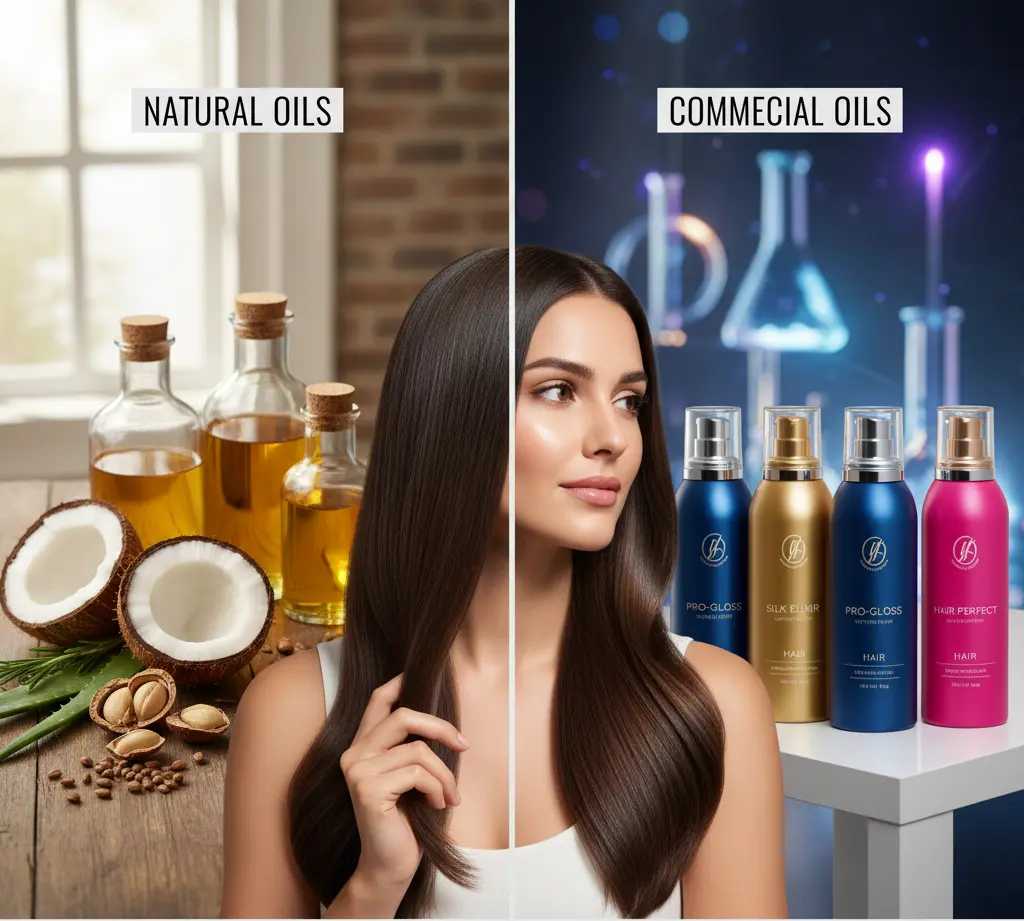
We’ve all stood in that aisle at the shop, observing rows and rows of bottles. On one side, you have the smooth packaging of business hair oils, promising instant shine and miracle maintenance. On the alternative hand, you see simple bottles of natural coconut, argan, or jojoba oil, claiming to be nature’s solution for your hair woes.
It can be overwhelming to determine what’s really high-quality for your hair. Do you believe the science of a lab-formulated product, or do you pass returned to basics with components that have been used for hundreds of years?
The fact is, there isn’t always a one-size-suits-all answer. Both natural oils and industrial blends have their location in a hair care ordinary, however they paintings in very distinctive ways. This guide breaks down the pros and cons of every so that you can make a preference that really enables your hair develop and thrive.
Understanding Natural Hair Oils
Natural oils are precisely what they sound like—oils extracted immediately from plants, seeds, or nuts. They have not been altered with artificial additives, preservatives, or perfumes. When you purchase a bottle of natural candy almond oil, it is generally the handiest aspect on the label.
These oils are structurally similar to the sebum (oil) your scalp produces naturally. Because of this, they can be excellent for deep nourishment.
The Benefits of Going Natural
There is a motive humans have used olive oil and coconut oil on their hair for lots of years. Natural oils provide several wonderful benefits:
- Purity: You realize precisely what you’re setting in your scalp. There aren’t any hidden silicones or parabens that could motive buildup through the years.
- Deep Penetration: Certain oils, like coconut oil and olive oil, have a molecular shape small enough certainly to penetrate the hair shaft. This manner they moisturize from the inner out instead of just sitting on pinnacle.
- Scalp Health: Many natural oils have antifungal or antibacterial homes. Tea tree oil, for instance, is famous for supporting with dandruff.
- Versatility: You can use them for extra than simply hair. A bottle of jojoba oil works simply as well on your cuticles or dry elbows as it does for your cut up ends.
Common Natural Oils and Their Uses
Not all herbal oils do the same factor. Here is a short breakdown of a few favorites:
- Coconut Oil: Great for preventing protein loss. It’s heavy, so it’s high-quality used as a pre-shampoo treatment.
- Argan Oil: Often referred to as “liquid gold,” that is lighter and high-quality for taming frizz and including shine with out looking greasy.
- Jojoba Oil: This is technically a wax ester, now not an oil, and it mimics human sebum nearly flawlessly. It’s wonderful for balancing oily scalps.
- Castor Oil: A very thick, sticky oil often used to inspire thickness and growth, specially around the hairline.
The Downsides of Natural Oils
While they may be incredible, natural oils are not perfect.
- They Can Be Heavy: If you’ve got satisfactory or thin hair, pure oils can weigh it down right away, making your hair appearance flat and greasy.
- Hard to Wash Out: Have you ever attempted to scrub castor oil out of your hair? It can take three rounds of shampoo, which may additionally dry your hair out more than the oil helped.
- Short Shelf Life: Without preservatives, natural oils can pass rancid quite fast, particularly if stored in a heat bathroom.
What Are Commercial Hair Oils?

Commercial hair oils are formulated products. They would possibly include a few natural oils, but they are generally mixed with silicones, artificial fragrances, preservatives, and other chemical sellers.
Now, “chemical” is not a horrific phrase here. These formulations are designed in labs to carry out specifically for hair styling and manageability.
Why People Love Commercial Blends
If you want your hair to appearance desirable right now, business oils are typically the winner.
- Instant Slip and Shine: Ingredients like dimethicone (a silicone) coat the hair shaft. This smoothes down the cuticle right away, making hair feel silky and look brilliant.
- Heat Protection: Many business oils are formulated to guard your hair from the warmth of blow dryers and flat irons. Pure herbal oils can once in a while “prepare dinner” the hair if used with high warmness.
- Lightweight Formulas: Chemists can design those oils to evaporate or take in quickly, which means you get the shine without the grease. This is why “dry oils” exist.
- Fragrance: Let’s be sincere—all of us like our hair to odor like a salon. Commercial oils generally smell high-quality.
The Hidden Cons of Commercial Oils
While they make hair look incredible superficially, they may not be enhancing its real fitness.
- Buildup: Silicones are extremely good for shine, but many aren’t water-soluble. Over time, they are able to building up at the hair shaft, blockading moisture from getting into. This can subsequently lead to dry, brittle hair.
- Masking Damage: Commercial oils often act like a band-aid. They glue cut up ends together briefly, however they don’t restore the structure of the hair.
- Irritation: The fragrances and preservatives utilized in those products can worsen sensitive scalps.
Comparing the Two: A Side-by means of-Side Look
Let’s look at how they stack up in specific categories so that you can see the differences sincerely.
1. Absorption vs. Coating
This is the biggest medical distinction.
Natural oils are in general composed of fatty acids. Oils like coconut, sunflower, and babassu have the capability to penetrate the hair cortex. This makes them actual moisturizers. They improve the flexibility of the hair fiber.
Commercial oils are normally sealants. They sit down on pinnacle of the cuticle. This is extremely good for locking in moisture this is already there, or for blocking off out humidity to prevent frizz. However, they do not generally add moisture to the internal structure of the hair.
2. Cost Effectiveness
Natural oils are usually more fee-powerful. A massive jar of unrefined coconut oil fees a fraction of a tiny bottle of excessive-cease salon hair serum. Plus, you want little or no pure oil to get the task completed.
Commercial oils range wildly in charge, from drugstore brands to luxurious labels. Often, you are deciding to buy the emblem name, the packaging, and the advertising in place of the ingredients.
three. Application and Usage
Natural oils are messy. They are satisfactory used as in a single day treatments or pre-poo (pre-shampoo) mask. You observe them, allow them to take a seat for an hour or extra, and then wash them out.
Commercial oils are designed for styling. You observe a pump or two to damp hair earlier than blow-drying, or to dry hair to clean flyaways. They are handy and easy to use on the pass.
Which One Should You Choose?
The answer relies upon entirely on your hair desires and your hair type.
Choose Natural Oils If:
- You need lengthy-time period fitness: You are centered on improving the elasticity and strength of your hair over the years.
- You have a sensitive scalp: You want to keep away from synthetic fragrances and harsh chemical substances.
- You have curly or coily hair: Textured hair has a tendency to be drier and blessings substantially from the deep penetration of heavy herbal oils like shea butter or castor oil.
- You enjoy DIY treatments: You like mixing up your own hair mask on Sunday nights.
Choose Commercial Oils If:
- You fashion your hair regularly: You want the heat safety that silicones provide.
- You have great hair: You want something lightweight that disappears into the hair and presents volume instead of weight.
- You need immediate outcomes: You need your hair to look polished and shiny for an occasion or a assembly right now.
- You dislike the odor of uncooked oils: You prefer a product that leaves a lingering, perfumed heady scent.
The Hybrid Approach: The Best of Both Worlds
You don’t simply have to select a aspect. In fact, the healthiest hair care workouts regularly use each natural and business products strategically.
Here is a easy habitual that leverages the strengths of each:
- Weekly Deep Treatment: Once per week, saturate your dry hair with a penetrating herbal oil like coconut or olive oil. Massage it into your scalp and pull it thru to the ends. Leave it on for as a minimum 30 minutes before you bathe. This handles the deep nourishment.
- Wash Day: Shampoo and circumstance as everyday.
- Styling: When your hair is damp, follow a small quantity of a awesome commercial serum or oil. This will seal inside the water out of your shower, guard your hair from your blow dryer, and come up with that glossy end.
By doing this, you feed your hair the vitamins it needs internally whilst protective the external layer from every day put on and tear.
A Note on Reading Labels
If you decide to move the commercial path, or even in case you are buying “herbal” oils, you need to study the ingredients list.
Marketing can be problematic. You would possibly see a bottle categorised “Argan Oil” on the the front, however when you switch it over, argan oil is the tenth aspect, and the first three are cyclomethicone, dimethicone, and alcohol.
- Look for the Latin name: On a natural oil bottle, look for the scientific call (e.G., Cocos nucifera for coconut oil).
- Check the order: Ingredients are listed by quantity. If the “key” herbal oil is listed close to the quit, there may be barely any in there.
- Watch for “Fragrance” or “Parfum”: If you have got a touchy scalp, this popular term can hide loads of capacity allergens.
For more records on cosmetic aspect safety and labeling, you could visit the FDA’s Cosmetics Safety page.
Conclusion
The war among herbal oils and business hair oils isn’t always truely a battle at all—it’s about know-how equipment. Natural oils are your vitamins; they may be the vegetables and nutrients on your hair. Commercial oils are your make-up; they’re the polish and protection that make the whole lot look ideal.
If you’re suffering with breakage and dryness, lean heavily into herbal oils. If your hair is wholesome however looks a piece stupid or frizzy, a commercial serum might be all you want.
Listen to your hair. If it feels greasy and limp, you are using some thing too heavy. If it feels brittle and straw-like, you may have silicone buildup or a lack of moisture. Adjust your routine, attempt the hybrid approach, and do not be afraid to experiment till you locate the proper balance to your specific texture.
Ready to begin your adventure to healthier hair? Start simple. Pick up one excellent natural oil this week and strive a pre-shampoo treatment. Your hair may thank you for it.
Frequently Asked Questions
1. Can herbal oils make my hair fall out?
Generally, no. However, if you are allergic to a particular nut or seed, it is able to cause a response. Also, extremely heavy oils like castor oil can purpose traction alopecia in case you rubdown too vigorously or if the oil is simply too sticky and pulls on fragile hairs.
2. Are silicones in industrial oils awful for hair?
Not inherently. Silicones are safe and powerful for smoothing hair. The problem arises whilst you do not wash them out well. If you use silicone-based totally oils, make sure to apply a clarifying shampoo now and again to save you buildup.
3. Which oil is first-class for hair growth?
While no oil can miraculously make hair grow faster than your genetics allow, oils like Rosemary oil and Pumpkin seed oil have shown promise in research for helping scalp circulate and hair density. A healthful scalp surroundings is prime to boom.
four. Can I depart coconut oil in my hair in a single day?
Yes, you can. However, in case you are susceptible to “bacne” (lower back acne) or clogged pores, be careful, as the oil can transfer for your pillowcase and then for your pores and skin. Wrap your hair in a bonnet or towel to keep the whole thing contained.
five. Why does my hair sense dry after using oil?
Oil is a sealant, not a moisturizer (water is moisture). If you observe oil to bone-dry hair, you might be sealing dryness in and moisture out. Try making use of oil to barely damp hair to lock inside the hydration.
Disclaimer: The data supplied in this text is for academic and informational purposes best and is not meant as medical or expert recommendation. Always consult a certified expert for customized guidance.