Gentle scalp massage is relaxing. But do a few minutes of pressure on your head really help your hair grow?
Here’s the evidence-based answer: Scalp massage may temporarily increase blood flow in the skin and mechanically stimulate tissue around the hair follicles. Another small clinical study found that daily massage for 24 weeks thickened hair. Researchers have not shown that increasing blood flow to the scalp will grow new hair or reverse hair loss.
That distinction is important. Massage can be a nice, inexpensive addition to a healthy scalp-care regimen, but should not be touted as a cure for pattern baldness, alopecia areata, nutritional hair loss, or an inflamed scalp condition.
In this guide, you’ll learn how scalp circulation works, what researchers have actually measured, and how to massage your scalp without scratching the skin or breaking your hair.
Quick answer: Scalp massage is the application of gentle pressure to the skin and underlying tissue. This can result in a short-term increase in local blood flow and may generate mechanical signals around hair follicles. There is limited evidence that massage may help improve the thickness of your hair, but not enough to prove that it grows lost hair back reliably.
Why Hair Follicles Need a Blood Supply
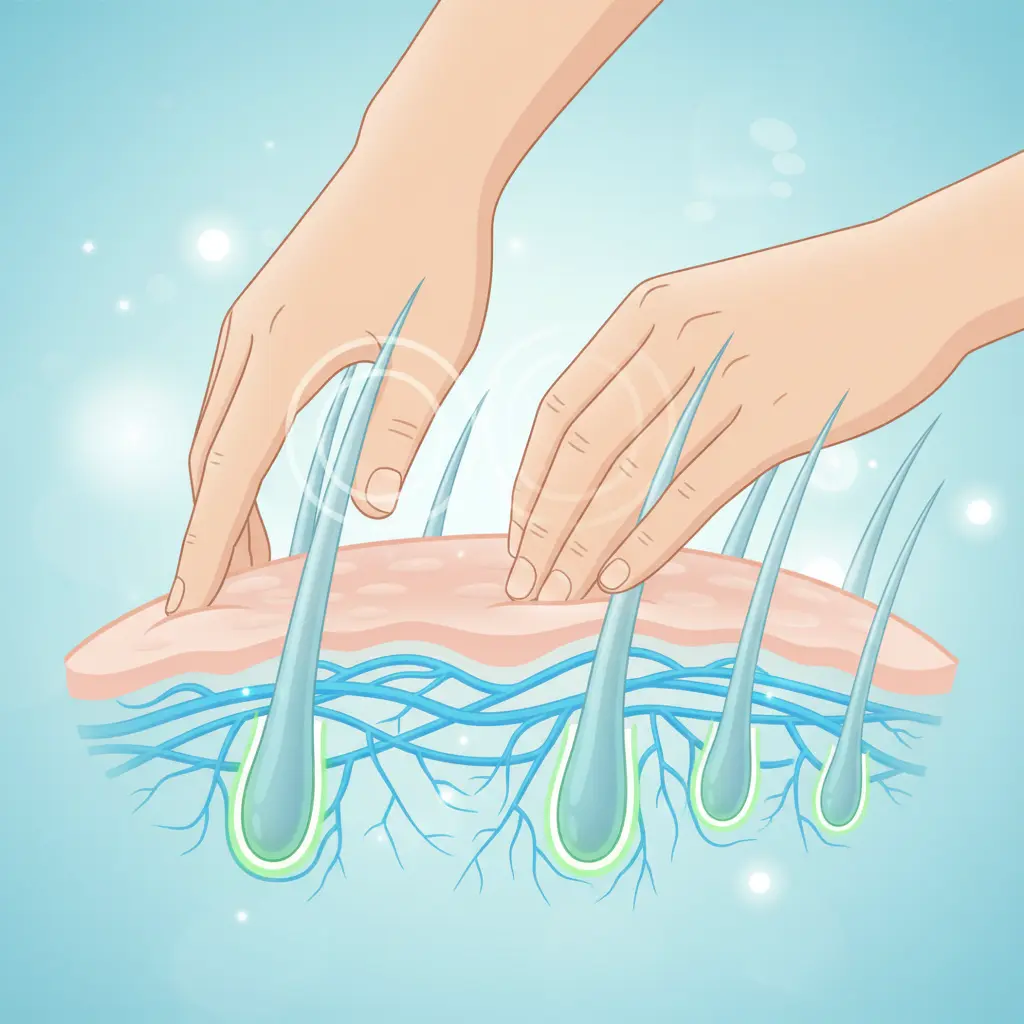
A hair follicle is a tiny pocket in the skin and is shaped like a tube. The base is the dermal papilla, which contains cells that regulate hair growth. The blood vessels surrounding the growing follicle provide oxygen and food.
According to the Cleveland Clinic’s summary of hair-follicle anatomy, growth begins near the dermal papilla, the part of the follicle that receives its blood supply and nutrients.
Thinning hair is not necessarily caused by bad circulation. Hair loss can have many different reasons, including:
- Hormone sensitivity
- Autoimmune disorder
- Major physical stress or illness
- Nutritional deficits
- Certain drugs
- Tight or painful hairstyles
- Inflammation or infection of the scalp
- Hormonal changes and aging
Blood flow is necessary for normal follicle function, but simply sending more blood to the skin does not automatically create more follicles or correct the biological cause of hair loss.
Blood flow is only one part of the growth cycle.
Scalp hair has a repeating cycle:
- Anagen growth phase
- Catagen: A short transitional stage
- Telogen – the resting phase
- Exogen: the phase of hair shedding and loss.
Several causes of hair loss interfere with this cycle. For example, pattern hair loss is a progressive miniaturization of the follicle. Alopecia areata is an immune attack on the follicles. Massage does not correct either process alone.
Does Scalp Massage Increase Blood Circulation?
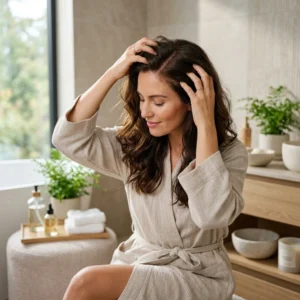
It can cause a temporary change in local circulation by affecting the skin, soft tissue, nerves and small blood vessels.
In a 2014 lab study, different scalp massage motions were explored, and changes in blood flow to the scalp were quantified. Some massage techniques were found to have short-term effects on blood flow, but the study was designed to look at blood-flow responses immediately after, not about regrowing hair. This was also from a hair-care product research laboratory, and this should be taken into consideration when interpreting the results. The full study can be found at the Society of Cosmetic Chemists of Japan.
This allows for a modest conclusion: massage might increase short-term scalp circulation. But it doesn’t show that the change in circulation is sufficient or sustained enough to treat hair loss.
What happens while you massage the scalp?
Rubbing your fingers in small circles can do a number of things:
- The skin and soft tissue slip under your fingers.
- Pressure compresses small vessels for a short time.
- Blood flow changes when you press and let go.
- Touch and movement stimulate nerve endings.
- Mechanical force is applied to the tissue surrounding the follicles.
The scalp may feel warmer after a scalp massage. More blood through the skin may be associated with warmth, but it does not prove that more blood is reaching each follicle or that hair growth is increased.
What Research Says About Scalp Massage and Hair Growth
The evidence is interesting, but is far from what is often implied by social media posts.
24-week hair thickness study
One often-referenced study, from 2016, studied nine healthy Japanese men with no apparent hair loss who massaged a device into part of their scalp for four minutes a day. The average diameter of hair in the massaged area increased from approximately 0.085 millimeters to 0.092 millimeters at 24 weeks.
But:
- The study involved only nine men.
- No participant had a hair loss diagnosis.
- It did not test all fingertip techniques; it tested one mechanical device.
- No significant improvement in hair count and growth rate.
- Investigator measures of scalp blood flow were not made.
- Some authors were affiliated with the company that makes the massage device.
In the laboratory part of the study, stretching cultured dermal papilla cells changed the expression of a number of genes related to the hair cycle. This provides a possible mechanism, but results in cell culture do not demonstrate that the same process will regrow hair in a person.
The complete peer-reviewed study is available in ePlasty through PubMed Central.
The 2019 self-reported survey
A follow-up survey of those who had downloaded online instructions for a standardised massage routine. Of the 1,899 people contacted, 340 responded to the survey, and 327 said they had tried the massages.
A few respondents said their hair loss had stabilised or improved. But the study had serious flaws:
- Results are based on participants’ own ratings.
- No random control group.
- Respondents were self-selecting.
- Participants used different treatments and routines.
- Answers may have been subject to recall and expectation biases.
The results are useful in generating research questions, but can not demonstrate that massage contributed to regrowth. Full paper on PubMed Central in Dermatology and Therapy.
Evidence summary
| Question | What the evidence shows | Confidence |
|---|---|---|
| Can massage temporarily affect scalp blood flow? | Small studies indicate that some massage movements can cause immediate circulation changes. | Low to moderate |
| Can massage increase hair thickness? | One nine-person study found a small increase after four minutes daily for 24 weeks. | Low |
| Can massage increase hair count? | The same study did not find a significant increase in hair number. | Low |
| Can massage reverse pattern hair loss? | No well-controlled clinical trial has established this. | Very low |
| Is better circulation proven to be the reason for thicker hair? | No. The main hair-thickness study did not measure blood flow. | Not established |
The practical conclusion is simple; scalp massage is reasonable as supportive care, but the evidence is too limited to promise hair regrowth.
How to Massage Your Scalp Safely
You don’t need an expensive tool or complicated routine. Clean fingers are good enough.
Step 1: Start with clean, shiny fingertips
Inspect your nails for sharp edges and wash your hands. Remove rings that can catch single strands.
If you have a tendency to tangle your hair, before you start, gently separate it into a few sections. This is great for long, curly, coily, braided, or extension-wearing hair.
Step 2: Put the pads of your fingers onto the scalp
Use the soft pads of your fingers and not your nails. Let your fingertips lie over one part of the scalp.
Apply enough pressure to move the skin slightly, but not enough to cause pain. A scalp massage should never feel like scratching, scraping, or forceful rubbing.
Step 3: Use small, controlled circles
Make slow circular movements without sliding aggressively across the hair. Work through the scalp section by section:
- Start at the hairline at the front.
- Slide over temples.
- Get to the top.
- Fill in the back and sides of the head.
Just the skin; don’t rub the shafts of hair together. But if there is too much friction, then you will get tangles and breakage, and no added circulation benefit.
Step 4: Do this for about four to five minutes.
The only controlled study in humans used 4 minutes a day. That’s not to say four minutes is the ideal clinical dose, but it does provide a research-based starting point.
Good evidence shows that a hard 20-minute massage is no better than a soft five-minute massage. If it irritates the scalp, more force is not more effective.
Step 5: Stop if the scalp becomes uncomfortable
If you notice, stop the massage:
- Pain or tenderness increasing
- Burning or itching lasting
- Redness
- Open skin
- Hair breakage or snagging
- Inflammation upscaling
If you feel sore after a massage, your scalp should feel good, not sore.
Fingertips vs. a Scalp Massager
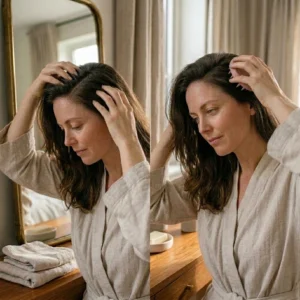
Both methods can move the scalp tissue, but neither has been proved universally superior.
| Method | Advantages | Possible drawbacks | Best suited for |
|---|---|---|---|
| Fingertips | Free, easy to control, good pressure feedback | Nails may scratch if used incorrectly | Most people and sensitive scalps |
| Soft silicone massager | Convenient during shampooing and easy to hold | Can tangle hair or encourage too much pressure | Short hair or people who dislike using their fingers |
| Electric massager | Produces consistent movement | More expensive and may be too strong | People who can tolerate the device comfortably |
| Hard wire “head scratcher” | Produces a tingling sensation | May scrape sensitive or inflamed skin | Relaxation rather than controlled scalp massage |
If you want to use it for blood circulation, select a scalp massager that has soft, flexible tips. Use often and allow it to dry thoroughly between uses.
Do not share a massager with someone who has an active scalp infection.
Should You Massage a Wet or Dry Scalp?
Both are possible, but the technique should be different according to the condition of your hair.
Dry massage
A dry scalp massage is easy to do and doesn’t require any product. It lets you feel the exact amount of pressure you are applying too.
Don’t rake your fingers through the hair; roll the scalp under the fingers. Sectioning first can help reduce tangling for fine, fragile, chemically treated, or tightly curled hair.
Massage while shampooing
A gentle massage while you shampoo helps to spread the cleaner over the scalp and loosen any oil or debris on the surface. Rinse well with gentle motions.
Wet hair is more stretchable. Try to avoid piling long hair on top of the head or scrubbing strands against each other. According to the American Academy of Dermatology, people with hair loss should adhere to gentle hair care guidelines for washing and conditioning that do not traumatize fragile hair.
Oil-assisted massage
Oil-free. It can add slip and reduce friction, but it doesn’t have to increase circulation to the scalp.
On purpose, this article does not provide an extensive oil treatment guide, because the main subject is mechanical scalp massage. Readers looking for ingredient-specific information can be directed to the site’s separate articles on rosemary oil, tea tree oil, coconut oil, or other hair oils.
Do not use essential oils undiluted. They may lead to irritant or allergic contact dermatitis, and an increased level of tingling doesn’t indicate an oil is increasing blood flow to hair follicles.
How Often Should You Massage Your Scalp?
A good initial routine is four to five minutes on a daily or several times weekly basis depending on how your scalp feels.
This schedule is largely based on the 4-minute daily routine used in the small 24-week study. It is not a medically proven dose; it’s a practical experiment.
If irritation, tenderness, tangling, or breakage occurs, decrease frequency or discontinue use. If you have an oily scalp, you may also prefer to massage just before washing instead of after styling.
A realistic progress timeline
| Time | What you may reasonably notice |
|---|---|
| Immediately | Relaxation, warmth, or less feeling of scalp tension |
| First few weeks | A more consistent scalp-care habit; no expected visible regrowth |
| 8–12 weeks | Usually too early to draw firm conclusions about hair density |
| Around 24 weeks | A reasonable point to compare photographs, based on the duration of the small hair-thickness study |
| Any time | Stop and seek advice if shedding, pain, scaling, or bald areas worsen |
Shoot a before photo. Once a month, repeat the same lighting, distance from the camera, hair style, and part. But changes in lighting or position of the hair can easily create the illusion of improvement.
Who May Benefit From Scalp Massage?
Scalp massage might be right for you if:
- Scalp without any break is healthy
- Searching for a relaxing hair-care addition
- Can do without pulling or tangling of the hair
- Knows there’s little sign of regrowth
- Is already treating the real cause of hair loss diagnosed
- Want a way to stimulate your scalp without products
If the touch is gentle and everyone is okay with it, it could also be a nice way for family to relax together.
For children, keep the session short, use only fingertips, and do not use essential oils unless approved by a qualified health care professional for the specific product and concentration. If a child is shedding or has a bald patch without explanation, it should be investigated, and massage avoided.
Who Should Avoid Scalp Massage?
No massaging over:
- Cuts, sores, burns or skin recently operated
- Active scalp infection
- Painful pimples, boils or draining spots
- A bad flare of psoriasis, eczema or seborrheic dermatitis.
- Rash, unexplained or painful
- Easily bleeding areas
- Recent hair transplant unless given the all clear by treating clinician
If you have traction damage, fragile hair or scarring alopecia, it’s best to consult a dermatologist to see if manipulation is right for you. But if your scalp hurts to the touch, more pressure probably won’t help.
Common Myths About Scalp Circulation
Myth 1: Tingling scalp = increased blood flow
Tingling may result from pressure, changes in temperature, nerve stimulation, menthol, peppermint, irritation, or an allergic reaction. It is not a good index of the blood supply of the follicles.
Myth 2: Inverting your head will make your hair grow faster
Changing position may alter the pressure and give a sensation of fullness in the face or scalp, but there is no good clinical evidence that inversion will regrow scalp hair. It can also cause dizziness and can be unsafe for some people.
General exercises that are good for your heart are good for you overall, but there’s no evidence that any particular “scalp circulation exercise” can treat hair loss.
Myth 3: Brushing your hair stimulates the circulation in your scalp
If you brush too hard, there will be friction and tension. It can snap strands, scratch the scalp, and exacerbate fragile hair. A sore or burning scalp is a sign of irritation, not treatment.
Myth 4: Poor circulation is the cause of most hair loss
Hair loss has many causes and is not usually diagnosed as simply a problem of poor circulation. Genetic pattern loss, autoimmune disease, nutritional deficiency, medication effects, illness, and damaging styling require different approaches.
Myth 5: Massage can wake up every inactive follicle
A follicle in a temporary resting state is not the same as a miniaturized, scarred, or permanently damaged follicle. Scarring hair loss is when the follicles are destroyed and cannot be regrown by massage.
Scalp Massage vs. Proven Hair-Loss Treatment
Massage and medical treatment do not serve the same purpose.
| Approach | Main purpose | Quality of evidence | Important limitation |
|---|---|---|---|
| Gentle scalp massage | Relaxation and supportive scalp care | Limited | Not proved to reverse hair loss |
| Topical minoxidil | Treat certain forms of pattern hair loss | Substantially stronger | Requires correct, ongoing use and may cause side effects |
| Prescription medication | Treat selected diagnosed conditions | Depends on the medication and diagnosis | Requires clinician guidance |
| Anti-inflammatory or antifungal treatment | Treat a specific scalp disorder | Condition-specific | Massage does not replace it |
| Correcting a confirmed deficiency | Address deficiency-related shedding | Appropriate when a deficiency exists | Supplements do not help every cause |
| Hair transplant | Redistribute suitable follicles surgically | Established for selected patients | Invasive and not appropriate for everyone |
Identifying the cause is the first step to effective treatment, the American Academy of Dermatology explains. If you do massage without knowing why hair is thinning in the first place, it may delay useful treatment.
Follow directions if you’re already using minoxidil or another topical medicine. Do not mix it into massage oil or alter the method of application unless you check with the prescriber or pharmacist.
Mistakes That Can Turn Massage Into Hair Damage
Used nails
Nails can cause minor scratches and further aggravate it. Only finger pads.
Push it until it hurts you.
The pain does not equate to the follicles receiving more nutrients. Use pressure that feels comfortable and that the skin moves slightly.
Rubbing the hair rather than moving the scalp
Rubbing quickly tangles strands and creates friction. Press down on one section with fingers and gently slide tissue under.
Massage of inflamed scalp
Massage does not cure dandruff, fungal infection, psoriasis, folliculitis, allergic dermatitis. An active condition can be aggravated by friction.
Oil overuse.
A heavily coated scalp isn’t getting a stronger treatment. Some people find it difficult to remove excess product, and it can exacerbate buildup or irritation.
Looking forward to quick regrowth
Changes in the hair cycle require time, and visible improvement is not guaranteed. Looking every day can make the normal ups and downs look like something else.
How to Support Healthy Hair Beyond Massage
If you want to improve hair health, focus on the factors that have a better correlation with growth and breakage:
- Eat a varied diet and plenty of protein.
- If you think you have an iron deficiency, thyroid deficiency, vitamin deficiency, or other deficiency, ask a clinician about testing.
- Don’t wear tight styles that pull repeatedly in the same spots.
- Limit bleaching, chemical processing and high heat.
- Shampoo according to the oiliness of the scalp and product usage.
- Use for persistent itching, scaling or inflammation.
- Don’t use high-dose hair supplements for no reason; some nutrients are bad in excess.
- Ask for diagnosis of progressive or persistent thinning.
The attempt to maximise circulation alone is less directly concerned with scalp disease, strand damage or nutritional problems.
When to See a Dermatologist
See a doctor if you or your child has:
- Patchy or sudden loss of hair.
- Rapidly increasing loss
- Frontal or vertex hair loss
- Scalp marked by tenderness, burning, or pain
- Pus, bleeding, crusts, or open sores
- Thick or persistent scaling
- Smooth, shiny areas where follicle openings seem absent
- Eyebrow or eyelash loss
- Hair loss accompanied by fatigue, weight change, menstrual changes, or other symptoms
Mayo Clinic advises seeking medical attention for sudden, patchy, or unusually heavy hair loss, because these patterns can indicate an underlying condition that needs treatment.
Early evaluation is particularly important when scarring hair loss is possible, since permanent follicle damage can occur.
Frequently Asked Questions
Does a Scalp Massage Help You Grow Hair?
At this time, there is no evidence that scalp massage can consistently grow new hair. One very small study found increased hair thickness after 24 weeks of four minutes’ daily massage, but no significant increase in hair count. Massage should be considered as a supportive scalp care.
How does scalp massage help in increasing blood circulation?
“So in the short term we can manipulate the blood flow in the skin by pressure and release. There are a few small studies that measure immediate changes in circulation after certain scalp massage movements, but researchers have not proven that this leads to any clinically meaningful hair growth.”
What is the safe way to increase blood circulation in my scalp?
With your fingertips, gently circle around for four to five minutes. Regular physical exercise is generally good for your heart too. No scrubbing, no squeezing, no inversion exercises, and no irritating essential oils.
How do I increase blood flow to hair follicles?
Vessels close to the hair follicles already supply blood. Scalp massage may temporarily increase circulation in the scalp skin. None of these techniques have been shown to increase blood flow to individual follicles selectively or reverse follicle miniaturisation.
Can I massage my scalp every day?
A short daily massage is usually a practical way of keeping the scalp healthy, so long as it doesn’t cause pain, redness, tangling or breakage. It’s not medically necessary to do it every day.
Do I need oil for circulation on the scalp?
Oil adds slip but is not necessary for mechanical scalp stimulation. There is no massage oil proven to increase scalp blood flow permanently or to guarantee regrowth.
Is a scalp massager better than hands?
Not always. A soft silicone device could be useful, but fingers give better feedback on pressure. Gently move the scalp using whatever method you prefer. Be careful not to scratch or get your hair tangled.
Scalp massage and hair loss: is there a link?
In a gentle massage, healthy hair firmly attached should not be pulled out. Rough rubbing, fingernail scratching, or repeatedly snagging fragile strands can result in irritation and breakage. Massage can also loosen up hairs already in the shedding phase.
Results? When do I get to see ’em?
There is no time limit guaranteed. The small clinical study did show an increase in hair thickness at 24 weeks, so a few months seems a more realistic time frame for evaluation than a few days. And if the routine is annoying, stop earlier.
The Bottom Line
Scalp massage may temporarily increase local circulation and may also provide mechanical movement to tissue surrounding hair follicles. Research suggests that massaging for four minutes every day might make your hair thicker over several months, but the evidence isn’t strong enough to say that massage can regrow hair.
The simple way is:
- Use the fingertips, not your nails.
- Gently massage for about four to five minutes.
- Do not use on irritated, infected, or damaged skin.
- Don’t mistake tingling or redness for better results.
- Take photos each month for progress.
- Diagnose sudden, ongoing or patchy hair loss.
A scalp massage should be a treat – not a chore. Try a light session today, and if your scalp and hair are happy, build it into your routine. If it continues to thin out, get a dermatology appointment instead of a harder massage.
Medical disclaimer
This post should not be used as a replacement for expert medical advice, diagnosis, or treatment; rather, it should be used primarily for informational reasons. There is no evidence that a scalp massage will treat hair-loss disorders. If you have ongoing shedding, bald patches, scalp pain, inflammation or anything else that concerns you, see a qualified healthcare professional.
How this article was researched
To put this guide together, we compared existing human scalp massage studies with authoritative information about follicle anatomy, hair loss diagnosis and warning signs. Claims were restricted to what each source actually measured. The article specifically does not accept increased blood flow as a proven explanation for the hair-thickness finding, because the relevant 24-week study did not measure circulation.