You have heard the warning a hundred times. “Don’t sleep with wet hair, you’ll catch a cold.” Maybe it was your mom. She said it. Maybe a friend blamed it for her thinning hair.
There have been many times that I washed my hair late at night and went straight to bed. I understand the concern. You’re tired, your hair is dripping, and drying it is one too many jobs.
Here’s the straight stuff. Sleeping with wet hair can cause real problems, but not the ones most people are afraid of. Let’s separate the myths from the facts, and see what you can actually do about it.
Why Wet Hair Is So Fragile
Wet hair is different from dry hair. Most people miss this part.
Water in the hair makes it swell and become elastic. Wet hair, for example, can stretch up to 30% of its length before breaking, the Cleveland Clinic says. Push past that point, and the damage remains.
Wet hair is weak hair. When wet, the cuticle or protective outer shell of each strand lifts open, exposing the soft inside, making it vulnerable to injury.
Now think of your head moving back on a pillow all night long. Hours are spent pulling, twisting, and rubbing those swollen strands. That’s where the trouble starts. That friction.
The bottom line is: wet hair is delicate hair. It’s more about how you treat it overnight than the water itself.”
Can Wet Hair Actually Make You Sick?
Let’s kill this myth. Wet hair doesn’t cause a cold.
Colds are caused by viruses, not by damp strands. That is what the Cleveland Clinic says. There is nothing you can get without a germ being involved.
The old warning contains a tiny nugget of truth. Cold weather forces people into closer quarters and closer proximity to one another, which can speed the spread of germs. But that’s for busy rooms, not your wet hairline.
So if you only worry about sickness, chill out. The real dangers are elsewhere, on your scalp and strands.
The Scalp Risk Most People Never Think About
That’s the part that surprised me when I first researched it. Going to bed with a wet head can become a problem.
Fungi and bacteria love warm, moist conditions. That’s exactly the kind of cozy environment you’re creating when your wet head is pressed against a pillow for hours. Heat and trapped moisture are a recipe for growth.
A damp scalp can lead to worsening of problems like dandruff and itchiness over time. For example, it could be a scalp yeast infection. This is caused by an overgrowth of a yeast called Candida. This can result in flaky, itchy, irritated patches.
But don’t get excited. One wet night will not give you an infection. If it becomes a nightly thing, especially if your scalp is already oily or sensitive, the risk increases.
Who Should Take Extra Care
Some people are more prone to scalp than others. If you: Concentrate more
- Have a history of scalp irritation or dandruff.
- Sweat a lot or live in a hot and humid place
- Have a compromised immune system
- Already have psoriasis, eczema, or other conditions
If that sounds like you, it’s worth building a small habit of drying your hair before bed.
Breakage and Friction: The Quiet Damage
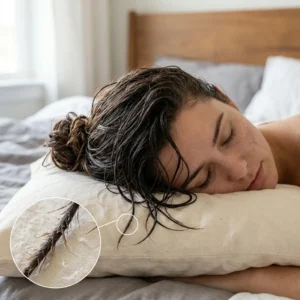
Even if you have a healthy scalp, your strands can pay the price.
Think of how wet hair is stretched, and the cuticle is raised. When your head is rolling on a cotton pillow case, friction tugs on those weak strands. Night after night, the damage adds up.
You may observe over time:
- More wet hair damage and split ends
- Frizz that won’t settle down
- Coarse, dull hair
- Thinner or slower-growing hair
And it gets worse if you tie soaking wet hair into a tight bun or a braid. That builds more friction. The American Academy of Dermatology lists tight, pulling hairstyles as one of the most common habits that hurt hair.
Quick takeaway: It’s not always the water. It’s the pulling and the tension and the rubbing when your hair is weakest.
Common Mistakes to Avoid
Don’t make these mistakes if you do go to bed before your hair is dry.
- Rubbing your hair with a rough towel. This roughs up the cuticle and feeds frizz.
- running a brush through wet hair. Stiff bristles break wet strands easily.
- Tight buns or ponytails with wet hair. Hair breaks under tension and weakness.
- No conditioner. Conditioner smooths and protects the cuticle.
- sleeps on the same damp pillow each night. Trapped moisture causes scalp problems.
If you skip these five, you’ve pretty much eliminated most of the risk.
Expert Tips to Protect Your Hair Overnight
The best cure is to sleep with dry hair when you can. But life is busy, and sometimes you can’t wait. These are habits that matter.
Switch to a Silk or Satin Pillowcase
This is my favorite tip, because it costs you next to nothing. Silk pillowcases have much less friction than cotton ones. It glides through your hair without snagging, so you wake up with less breakage and frizz.
It also helps your hair keep its own moisture. That smooths, strengthens strands, morning after morning.
Use a Microfiber Towel or Soft T-Shirt
Skip the thick bath towel and the scouring. Gently squeeze out and wring out the water with a microfiber towel or an old cotton T-shirt.
It absorbs moisture without raising the cuticle. Less rubbing equals smoother, shinier hair.
Detangle With a Wide-Tooth Comb
Never brush your hair when it is wet. Take a wide-tooth comb and work from the ends.
Slowly work up to the roots. It detangles with little pulling & snapping.
Blow-Dry on Low Heat
You don’t need to have bone-dry hair to protect it.” Does a lot already, about 80% dry on the low cool setting.
Continue to move the dryer around and keep it a few inches away. AAD recommends that you use the lowest heat setting possible and avoid hot tools.
Add a Leave-In or Light Oil
A little bit of leave-in conditioner or a lightweight oil will create a protective layer. It cuts down on friction and locks in moisture.
Apply to mid-lengths and ends only, not to the scalp. A little bit goes a long way here.
Loosen Up Your Nighttime Style
If you have to wear your hair up, wear it down. A soft scrunchie or loose braid will pull on your strands far less than a tight elastic band.
A Simple Overnight Routine to Follow
Want it all in one place? On nights you can’t dry your hair all the way, do this quick routine.
- Gently squeeze out water using a microfiber towel.
- First, run a wide-tooth comb through it.
- Rub the ends with a bit of leave-in or oil.
- Tumble dry low until almost dry.
- Soft hair, down or low braid. Sleep on a silk pillow case.
All of these steps will help you protect your scalp and strands with minimal extra effort.
Frequently Asked Questions
1. Sleeping with wet hair is it bad?
Yes. A damp night here and there won’t spoil your hair. But when you’re doing it every night and not taking precautions like a silk pillowcase, things can go awry.
2. Does hair fall out when wet?
Wet hair does not lead to permanent baldness. Repeated breakage due to friction and tight styles can make hair look thinner over time.
3. Is it true that sleeping with wet hair causes dandruff?
It can exacerbate scalp issues. Dandruff and fungus love the warm, moist environment of the scalp.
4. What’s the quickest way to get hair dry before bed?
Use a microfiber towel to blot away excess water, and then blow-dry on low heat until mostly dry. It doesn’t have to be bone dry, just not wet.
5. Are silk pillowcases worth the investment?
Yes. For the health of hair. They help reduce friction and can help prevent breaking and frizzing of the hair, so it is a small upgrade that really pays off.
6. It is a common belief that sleeping with wet hair causes a cold.
No. Wet hair does not cause colds and flu. Viruses do. One of the most common myths, and it’s just not true.
7. Do I sleep with my hair wet up or down?
If you tie it, tie it loosely, with a soft band. Down works, preferably on a silk pillowcase to reduce friction against your strands.
The Bottom Line on Wet Hair and Sleep
So, does sleeping with wet hair damage it? Sometimes, yes, but not likely in the way you thought.
It’ll not make you cold. The real dangers are weaker strands that are prone to breaking and a scalp that is damp, which can lead to irritation over time.
The good news is, you have the controls. Dry your hair as much as you can, switch to a silk pillowcase, treat wet strands gently, and avoid tight styles. These small habits are much better than any worry in protecting your hair.
Tonight, select one tip and put it to use. Your hair will appreciate you in the morning.
Medical disclaimer: This article is for general informational purposes only and is not a substitute for professional medical advice. If you have persistent scalp irritation, hair loss, or any symptoms that worry you, please see a board-certified dermatologist or your healthcare provider.