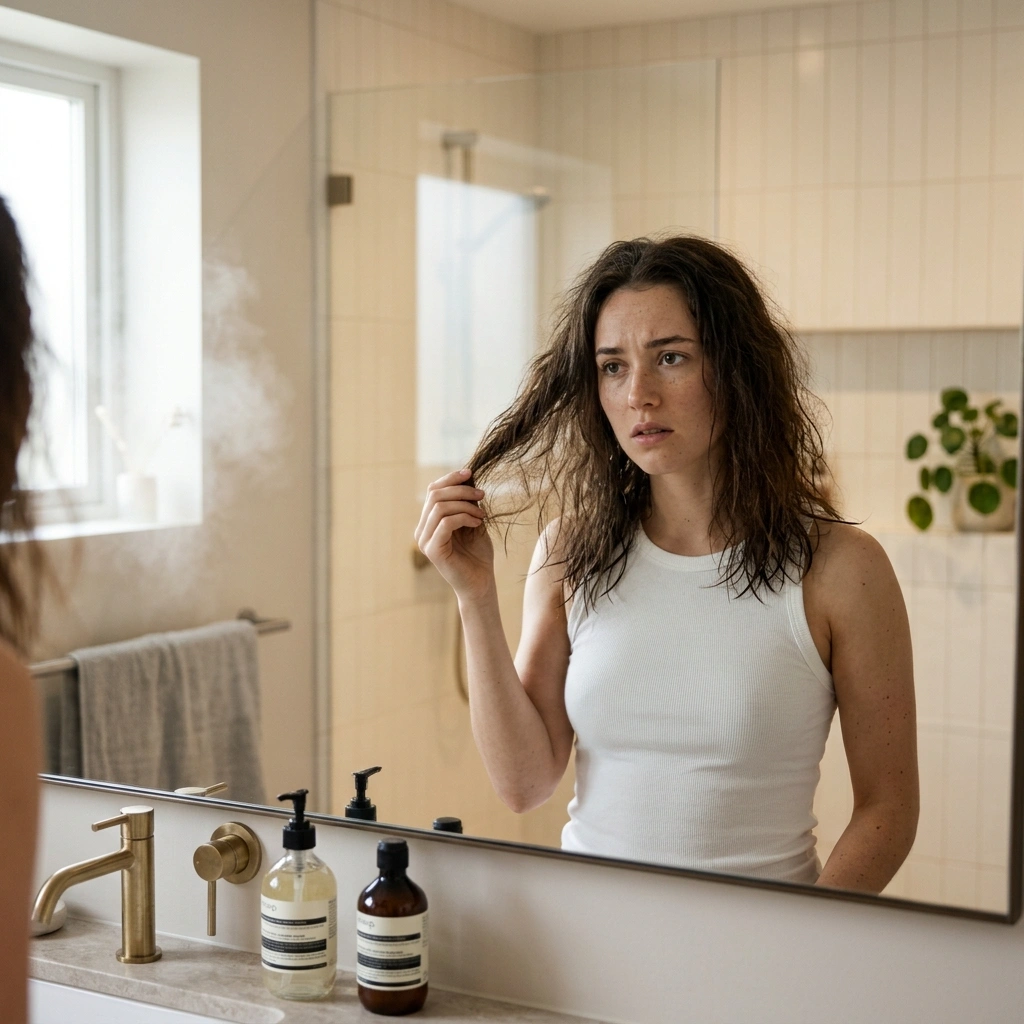
For years, I thought dry hair meant I wasn’t washing enough. So I washed some more. Of course, my hair got worse. (Which, it turns out, was the exact opposite of what I should’ve done.)
If you get out of the shower with hair that looks more like straw than silk, you’re not imagining it, or alone. Shampoo is meant to clean and refresh hair, not dry it out. If your results start to go sideways, it’s usually telling you something specific about your routine, your water, or your products.
Here is the good news. One of the most fixable hair problems out there is dryness after washing. You just have to know what’s really making it happen. Let’s jump into it.
What “Dry Hair” Really Means
Dry hair means that the hair strands lose moisture faster than they can hold onto it. Your hair has an outer layer called the cuticle that acts like roof shingles lying flat to seal in hydration. If those shingles are lifted or damaged, water and natural oils escape. The result feels rough, brittle, and frizzy.
According to the American Academy of Dermatology, healthy hair starts at the scalp with natural oils that travel down the strand. Anything that strips or blocks those oils throws the entire balance off.
So when your hair feels dry immediately after a wash, something in that wash is interfering with moisture. Let’s find the culprit.
Common Causes of Dry Hair After Washing
1. Hard Water Is Quietly Sabotaging You
That was my big “Aha!” moment. I got a new apartment, and my hair turned to straw, and I blamed my shampoo. Nah. The water, it was.
Hard water is rich in minerals like calcium and magnesium. These minerals form on your strands and prevent moisture from entering. You rinse, you condition, and nothing penetrates.
Indications that hard water might be the culprit:
- Hair feels stiff or slimy after washing
- Shampoo doesn’t foam well
- Soap film on your shower walls
A basic shower filter or a weekly clarifying treatment can help clear out the buildup. (If you want to check your own supply, the USGS hardness guide tells you what’s really in your water.)
2. Sulfates Are Doing Too Good a Job
That satisfying foam is created by sulfates, the cleansing agents. The issue? They can be aggressive. They do remove dirt and oil, sure, but they also remove the natural oils your hair needs to stay hydrated.
Seeing sodium lauryl sulfate or sodium laureth sulfate high on the list of ingredients on your shampoo and your hair feeling tight after washing is a good clue.
Switching to a gentle, sulfate-free hydrating shampoo may make a noticeable difference in a week or two.
3. You’re Washing Too Often
I see. Clean hair feels so nice. However, frequent washing removes the protective oils more quickly than your scalp can create them.
Most hair types require washing two or three times a week. Fine hair may need it more often, while thick or curly hair can usually go longer between washes. This is backed up by washing advice from the American Academy of Dermatology.
4. Damaged Cuticles From Heat and Chemicals
Blow dryers, flat irons, bleach, and color treatments all lift up and crack the cuticle over time. Once that protective layer is broken, moisture escapes, no matter how much you condition.
One of the most common reasons hair stays dry while following a routine is heat styling. Research published on PubMed has shown that repeated exposure to heat weakens the hair shaft and increases the loss of moisture.
5. The Wrong Products for Your Hair Porosity
Porosity in hair is how well your hair absorbs and retains moisture. It’s the piece most people skip, and it explains a lot.
- Low porosity: Cuticles are lying flat, so products are sitting on top rather than soaking in
- High porosity: Cuticles remain open, so moisture penetrates and immediately escapes
- Applying a heavy cream to low-porosity hair results in greasy, yet still dry hair. A lightweight product does nothing for high porosity hair. Matching products to your porosity is a game-changer.
How to Fix Dry Hair After Washing
The fixes are simple in a refreshing way once you find the cause.
Use a moisturizing shampoo. Things to look for: glycerin, panthenol, aloe, or hyaluronic acid. They draw and hold water in the strand.
Condition: Each time. Concentrate on the mid-lengths through the tips, where the hair is oldest and driest. If your roots are oily, skip the scalp.
Follow with weekly deep treatment. Give your hair a moisture reset once a week with a hydrating mask. Leave on for the recommended time.
Rinse in colder water. Although hot water is beautiful, it dries your hair and elevates the cuticle. A cool final rinse helps to seal everything back down.
Keep away from heat. Always use a heat protectant before styling and try to air-dry when you can. Check out the American Academy of Dermatology’s tips on how to avoid heat damage here.
OIL Seal. A few drops of argan or jojoba oil on the damp ends after washing will seal in moisture.
Best Practices for Long-Term Hair Moisture
Quick fixes are great. Habits = long-lasting results. That is what keeps hair hydrated over time.
- Never scalding hot, but lukewarm water
- Use a microfiber towel or an old cotton T-shirt instead of rough toweling.
- A wide-tooth comb can be used to carefully untangle wet hair.
- Regularly trim the split ends every 8 – 12 weeks
- Drink plenty of water and eat a balanced diet, as the health of the scalp is from the inside
- Don’t neglect your scalp, since your hair depends on the oils that the scalp produces. Gentle exfoliation and a balanced shampoo keep things working the way they should.
Common Mistakes to Avoid
I’ve done almost all of these, so learn from my mistakes and don’t do them.
- No conditioner today. Saves time. The majority of the moisturizing work is done in that step.
- Adding more product when hair feels dry. Buildup doesn’t add moisture; it prevents moisture.
- Wet hair brushing. Wet hair stretches easily and breaks.
- Ignoring water quality. You can buy the best shampoo on earth. Hard water will still win.
- Year-round rut. In winter, hair is drier and needs richer products.
Expert Tips for Healthier, Hydrated Hair

A few small adjustments can make a significant difference:
- Monthly explanation. A clarifying shampoo gets rid of mineral and product buildup so the moisture can actually get into the strand.
- Check for porosity. Put a clean strand in a glass of water. If it sinks fast, then you probably have high porosity. Low porosity if it floats.
- Apply to damp hair. Layer. Hydrating products work best when applied to wet hair, not dry.
- Sleep on silk or satin. Cotton pillowcases absorb moisture from your hair during the night.
- If you experience itching, flaking, or hair loss with the dryness, see a dermatologist. These can be a sign of a scalp condition that needs medical attention, not just a new shampoo. You can search for one in the American Academy of Dermatology directory.
Frequently Asked Questions
Dry Hair Even When I Condition Every Time. Why?
Conditioner is not a cure-all. If you have hard water, damaged cuticles, or you’re using products that don’t match your porosity, hydration won’t stick. Watch the complete sequence, not just one part.
Does hard water dry out hair after shampooing?
Yes. Hard water leaves mineral deposits on your strands, blocking moisture. Usually, a shower filter or some normal clarifying treatment.
How often should I wash my hair if it’s dry?f
For most people, two to three times a week is the trick. Natural oils are eliminated by daily washing, which exacerbates dryness.
Sulfate-free shampoo: Is it better for dry hair?
For a lot of people, yes. Sulfate-free hydrating shampoos cleanse more gently and retain more of your natural oils.
Can water add moisture to hair?
Hydration is good for the overall health of your scalp, but you can’t drink your way to soft hair on its own. For the strand itself, topical treatments and good products are more important.
What’s the quickest way to put moisture back into hair?
Use a deep conditioning mask and a few drops of natural oil on wet ends for immediate, noticeable benefits.
When should I see a doctor about a dry scalp?
If you have persistent itching, redness, flaking, or shedding with dryness, talk to a board-certified dermatologist. It may be a treatable condition of the scalp. The American Academy of Dermatology is a good place to begin.
The Bottom Line
The mystery of dry hair after washing is no mystery, and it is seldom permanent. Once you know whether it’s your water, your shampoo, your habits, or your hair’s porosity, the fix is usually straightforward. Hydrate with a shampoo, condition with intention, protect from heat, and treat your scalp.
Your hair wants to retain moisture. Sometimes getting out of your own way is all you need to do.