
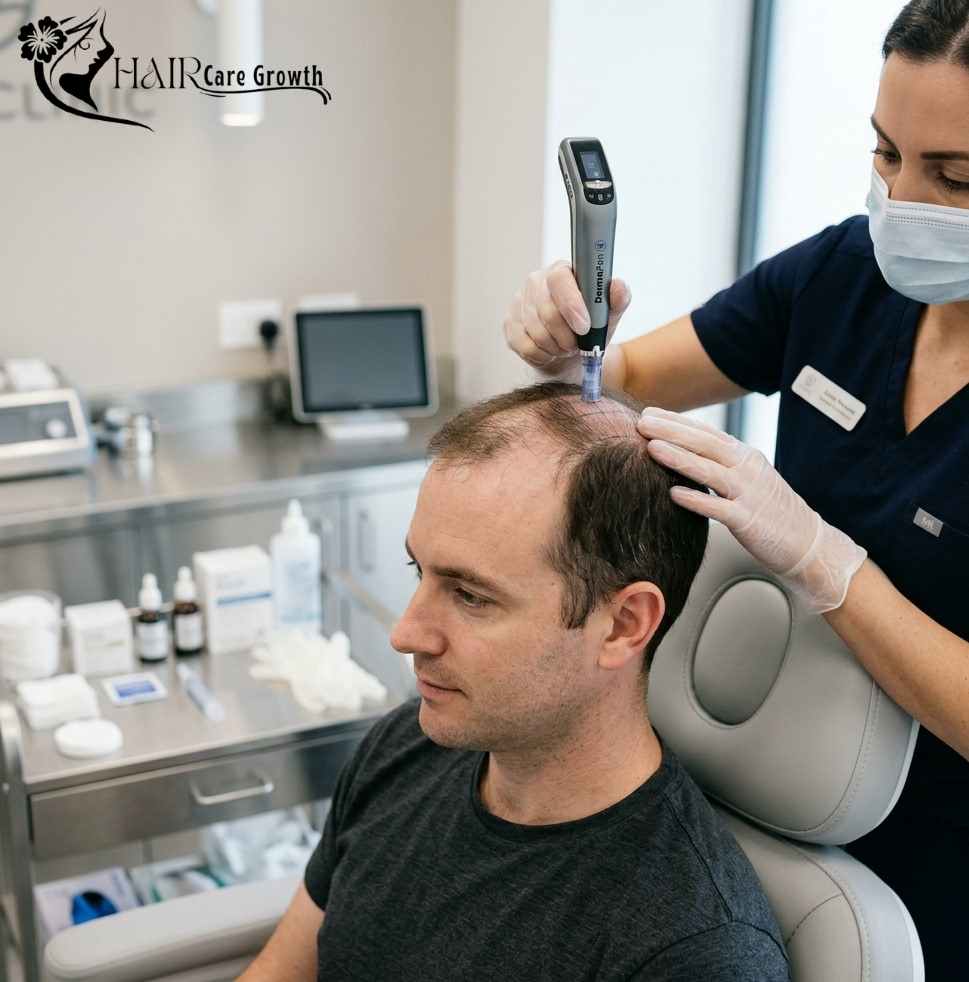
Microneedling has transcended skincare and is now a part of the larger conversation around thinning hair. Dermarollers, dermastamps, and motorised microneedling pens are now common terms when talking about hair regrowth tools. But one important question remains: does making tiny holes in the scalp really help hair to grow?
The short answer is, microneedling for hair loss can be helpful for some people, particularly those with androgenetic alopecia, also called pattern hair loss. The most promising evidence is for scalp microneedling combined with an established treatment such as topical minoxidil. This is not a proven cure for all types of hair loss, and outcomes can differ greatly from person to person.
The root cause of hair loss is equally important. A person with pattern baldness has a very different treatment plan than a person losing hair due to iron deficiency, an autoimmune condition, medication, or scalp inflammation.
This guide discusses what scalp microneedling does, what research suggests, potential benefits and risks, what the treatment involves, and what realistic results are.
What Are Microneedling Treatments for Hair Loss?
What Is Microneedling for Hair Loss? Microneedling for hair loss involves the movement of a device with very fine needles over the skin to create controlled micro-punctures.
On the scalp, the aim is not just to ‘make holes for hair to grow‘. It is far more complex: the mechanism.
The wound healing response of the skin is triggered by microneedling. The process triggers cellular signaling and growth factors that researchers believe could impact the environment around hair follicles. Microneedling may also temporarily change the skin barrier, which is one of the reasons why it has been studied in conjunction with topical treatments.
The exact mechanism behind any hair-growth benefit is still being investigated. Microneedling for Hair-loss disorders have shown promising evidence, according to a systematic review, but study treatment methods vary considerably.
Understanding Microneedling, Dermarolling, and Dermastamping
These terms are often used interchangeably, although the devices work differently.
A dermaroller is a rotating cylinder with a set of needles attached. A dermastamp pushes needles vertically into a target area. Motorised microneedling pens repeatedly insert and retract needles into and out of the skin and may enable a trained provider to adjust treatment settings with more precision.
There is no one device or needle depth that works best for hair loss.
Does microneedling work for hair loss?
There is legitimate research to support microneedling, but the evidence needs to be interpreted with caution.
Currently, the best supported application is androgenetic alopecia, or male or female pattern hair loss.
In 2025, a systematic review and meta-analysis examined 12 randomised controlled trials involving 631 participants who had androgenetic alopecia. Microneedling + minoxidil had greater improvements in hair count and hair diameter compared with minoxidil alone. Adverse effects were slightly more common with the combination approach but were generally reported to be mild or self-limiting.
Previous reviews have reached similar conclusions. However, different devices, treatment schedules, needle depth, and outcome measures were used in the studies. This variation makes it hard to find one perfect protocol.
At a Glance
|
Question |
What the Evidence Currently Suggests |
|---|---|
|
Can microneedling help pattern hair loss? |
Evidence suggests possible benefits, especially with minoxidil. |
|
Is microneedling plus minoxidil better than minoxidil alone? |
Current evidence suggests the combination may improve hair count more than minoxidil alone in suitable patients. |
|
Can microneedling work alone? |
Some evidence exists, but research is less extensive. |
|
Is there an ideal needle depth? |
No universal depth has been established. |
|
Does it work for all hair loss types? |
No. Different causes require different approaches. |
|
Are the long-term results known? |
Not yet |
Similarly, the American Academy of Dermatology reports that studies have shown increased hair growth with microneedling plus minoxidil than with minoxidil alone.
One caveat on regulation: The FDA has not cleared microneedling devices for the specific purpose of hair loss. “FDA-cleared microneedling devices are cleared by the FDA only for certain uses, including some facial wrinkles and scars, but not for hair regrowth.”
Who Can Benefit From Scalp Micro-Needling?
Microneedling is most effective when combined with the right diagnosis.
Pattern Hair Loss (Androgenetic Alopecia)
Androgenetic alopecia is distinguished by progressive miniaturisation of susceptible follicles producing finer and finer hairs. It can occur in both men and women.
This is one of the types of hair loss for which microneedling has the most research support, especially as an adjunct rather than an alternative to proven therapies.
Alopecia Areata
Smaller studies have looked at microneedling for alopecia areata, an autoimmune type of patchy hair loss. The evidence is far less strong than for pattern hair loss and alopecia areata should be diagnosed and managed by a dermatologist.
How about telogen effluvium?
Microneedling shouldn’t be implemented automatically if a person notices too much shedding.
Telogen effluvium can occur after illness, nutritional deficiencies, hormonal changes, some medications, severe physical stress, and a number of other causes. It is more important to treat the root cause rather than to stimulate the scalp.
For instance, if shedding is due to iron deficiency, addressing and investigating that deficiency is more important than adding microneedling.
Microneedling: Possible Benefits for Hair Loss
Microneedling has some potential advantages for an appropriate candidate.
It can make hair more dense. Clinical trials show that people with pattern hair loss can see increases in measurable hair counts, especially when the treatment is used in combination with minoxidil.
It can help hair grow more thick. The 2025 meta-analysis also found hair diameter improvement with combination treatment. Even if there’s no dramatic regrowth, thicker individual hairs can make a thinning patch look fuller.
It is less intrusive. Microneedling does not involve the surgical excision and repositioning of the follicles, as is done with hair transplantation.
It can be an adjunct to an existing treatment plan. It is perhaps the most important role. There is stronger evidence for microneedling as an adjunct to other hair regrowth treatments than as a stand-alone treatment.
One major limitation of these benefits is that microneedling does not eliminate the underlying genetic predisposition that causes pattern hair loss.
What to Expect From Professional Scalp Microneedling
The first step in responsible treatment should be diagnosis, not device.
A dermatologist or other appropriately qualified healthcare professional may first evaluate the pattern of thinning, scalp condition, medical history, medications and other possible causes of hair loss. Blood testing may be appropriate depending on the symptoms and suspected cause.
During a professional treatment the scalp is cleaned and the area is prepared. Depending on the device and the intensity of treatment, a topical anaesthetic may be used.
The provider systematically moves a microneedling device over targeted areas of the scalp. You may experience temporary redness, tenderness and pinpoint bleeding.
Treatment protocols vary. There is another reason why there is no evidence-based universal schedule for everyone to follow, and that is because research has tried anything from fairly regular treatments to monthly procedures.
Recovery and Aftercare
Scalp microneedling is less invasive than surgery, therefore it has a shorter downtime, but the skin still needs some time to recover.
In the short time after treatment you may have:
- redness or warmth
- tender scalp
- mild swelling
- itching or tightness
- temporary scaling
- pinpoint bleeding or small scabs.
Redness, bleeding, bruising, itching, peeling, and tightness are some of the effects associated with microneedling, according to the FDA. Infection and pigment changes are less common but can occur.
Follow your practitioner’s aftercare instructions. Just because you usually tolerate a product does not mean it is safe to use straight after treatment.
Best Time to Apply Minoxidil After Microneedling
There are no hard and fast timing rules.
Microneedling causes temporary damage to the skin barrier, which may change how a topical product interacts with the scalp. Your clinician will let you know when to start using minoxidil again based on what treatment you had and your individual situation.
The FDA also points out that it has not approved microneedling devices for the delivery of drugs, cosmetics, platelet-rich plasma (PRP) or other products into the skin.
Microneedling Risks and Side Effects
Microneedling is minimally invasive, but minimally invasive is not the same as risk-free.
Possible complications are irritation, prolonged redness, bleeding, infection, pigment changes, allergic or contact reactions, and rarely, scarring.
The risk of infection might be raised by poor hygiene. Reuse of needle cartridges for single use by a single patient or between patients or treatment sessions, in a manner inconsistent with device instructions, is not recommended.
Patients with active skin disease or infection, impaired healing, certain bleeding disorders, those on anticoagulants, immunocompromised patients and those with a history of abnormal scarring require additional care. The Cleveland Clinic and the FDA advise speaking with a healthcare provider about relevant medical conditions and medications before microneedling.
If the redness, swelling, drainage, or pain gets worse instead of better after you get treatment, call a healthcare professional.
Plus, don’t mix up traditional microneedling with radiofrequency (RF) microneedling. RF devices deliver heat into the skin and have different risks. In October 2025, the FDA released a safety communication in response to reports of major issues with specific RF microneedling uses.
Professional Microneedling vs Home Dermarolling
Cheap dermarollers are easy to find online which might make you believe that scalp microneedling is an ordinary grooming routine. Deeper needling is not quite so simple.
You are in professional hands and will be given an extensive scalp analysis, a controlled technique, set standards of hygiene, appropriate equipment and a practitioner who can recognise complications.
At-home use adds more variables: too much pressure, multiple passes over irritated skin, contaminated equipment, wrong needle choice, and treatment of a scalp condition that has never been diagnosed.
The FDA states it has not approved microneedling medical devices for over-the-counter sale. Some superficial consumer rollers are different products and may not qualify as a medical microneedling device under the regulatory definition.
If you are looking for real hair loss treatment and not some superficial cosmetic skin care, then it’s better to get a diagnosis first.
How Long Does Microneedling Take to Work?
Progress should be measured in months, not in days.
Hair follicles grow slowly, so a scalp that looks the same a few weeks into treatment doesn’t necessarily mean it hasn’t responded.
Many hair loss studies look at results after a few months. If you’re using a topical hair-loss treatment such as minoxidil, it may be six months or longer before you see any results.
When measuring progress, take the same photographs, with the same hairstyle, lighting, distance, angle and parting. You can make a change seem much bigger or much smaller than it really is when you look at random selfies from different rooms.
Microneedling results should be considered as one part of the overall treatment plan. The pattern of hair loss is progressive and improvement does not mean that the underlying condition has resolved.
Microneedling and Other Hair Loss Treatments
Microneedling is not an alternative to treatments such as minoxidil. Often the more useful question is whether it has a role alongside them.
Topical minoxidil is a known treatment for pattern hair loss. Other drugs approved by the FDA for male pattern hair loss include finasteride. Other drugs may be prescribed by dermatologists depending on the patient’s sex, medical history, potential for pregnancy, diagnosis and risks.
Hair transplantation is quite another matter : it is the surgical transfer of follicles . Other options that may be considered in selected cases are PRP and low level light or laser devices.
So the most appropriate treatment is less about which option sounds newest and more about why you are losing your hair in the first place. For more help, check out our related coverage of hair-loss treatments and scalp-care basics.
Microneedling Mythbusting
More needles, deeper treatment, more hair growth.
Not proven. Research has not found one universal depth that gives the best results and more aggressive treatment may increase injury.
If microneedling works, you don’t need any other treatments.
Not necessarily. The current research is most promising for combination therapy.
A dermaroller can treat any type of hair loss.
Wrong. Nutritional deficiencies, inflammatory scalp disease, autoimmune hair loss, scarring alopecia, medication-related shedding and pattern hair loss all require different approaches.
Frequently Asked Questions
Can microneedling regrow my hair?
Microneedling may help improve hair growth and density in some people, especially those with androgenetic alopecia. It cannot guarantee regrowth, and areas where follicles have been permanently destroyed are unlikely to respond in the same way as areas with living, miniaturised follicles.
Can microneedling be used for male/female pattern hair loss?
Research supports a possible role in both, especially when combined with topical minoxidil. The treatment is still to be individualised.
Will microneedling worsen hair loss?
Done with bad technique, it can cause unnecessary inflammation, irritation, or infection. Microneedling may also be contraindicated in underlying scalp disorders. If you experience a sudden surge of hair loss after a procedure, don’t just assume it’s a normal “shedding phase”—talk to your doctor.
How often to microneedle scalp?
There is no universally accepted schedule. Clinical studies have used different frequencies, devices, and depths. It should be based on the procedure you had done and provide adequate time to heal instead of some generic social-media schedule.
Microneedling vs Minoxidil: Which One Is Better?
The evidence does not support this as a simple either/or decision. Overall, research on androgenetic alopecia has indicated that microneedling in conjunction with minoxidil is superior to minoxidil alone, thus making microneedling a more attractive adjuvant therapy.
FDA Approval for Hair Loss Microneedling
There is no FDA clearance for any microneedling device for hair loss treatment. Some devices are FDA cleared for other dermatologic indications, such as certain scars and wrinkles.
Bottom Line
Microneedling is an emerging treatment approach that has shown promising results in some studies, particularly when combined with minoxidil, and it deserves a more complex reputation than either “miracle treatment” or “internet gimmick.”
Some research suggests it may help increase density and thickness of hair in some people with androgenetic alopecia. There have been particularly encouraging findings for microneedling with minoxidil. What research has not established is a universal device, depth, schedule, or guarantee of regrowth.
The most important first step is before a needle touches your scalp: determine what is causing your hair loss.
If your hair is thinning gradually, you are developing bald spots, your scalp is inflamed or sore, or you are losing hair in much larger amounts than normal, consider making an appointment with a board-certified dermatologist. It is very important to get the correct diagnosis so that you are not wasting your time and money on a treatment that does not actually solve the problem.
Want to find out what’s behind your hair changes? For more evidence-based hair-loss and scalp-care guides, check out Hair Care Growth, and build your routine on the cause, not the hype.
Medical Disclaimer: This information is intended only for general educational purposes and should not be used in place of a qualified healthcare professional’s diagnosis or treatment. If you have hair loss that is persistent, sudden, patchy, painful, or that you cannot explain, see a dermatologist or other appropriate health care provider.
References
- American Academy of Dermatology – Diagnosis and treatment of hair loss
- FDA – Microneedling Device Safety Information
- Ahmed KMA et al. 2025 Systematic Review
- English RS Jr et al. Microneedling in hair loss disorders: a systematic review.
- Cleveland Clinic – Microneedling Overview