My Two Bottles, One Real Lesson
I once had two very different products standing side by side on my shelf. One was a tiny amber bottle of cold-pressed castor oil. The other was a shiny, salon-branded hair serum promising silkiness, growth, and shine. Both claimed they were the solution.
After a few weeks of use, I had a definite opinion. But it was not a case of one being better than the other. It was about the type of hair and the condition of the scalp, and what I was actually trying to solve.
That’s the heart of this guide. We’re not here to pick a winner, but to help you find what works for you. Because when it comes to hair oils, the right choice is personal.
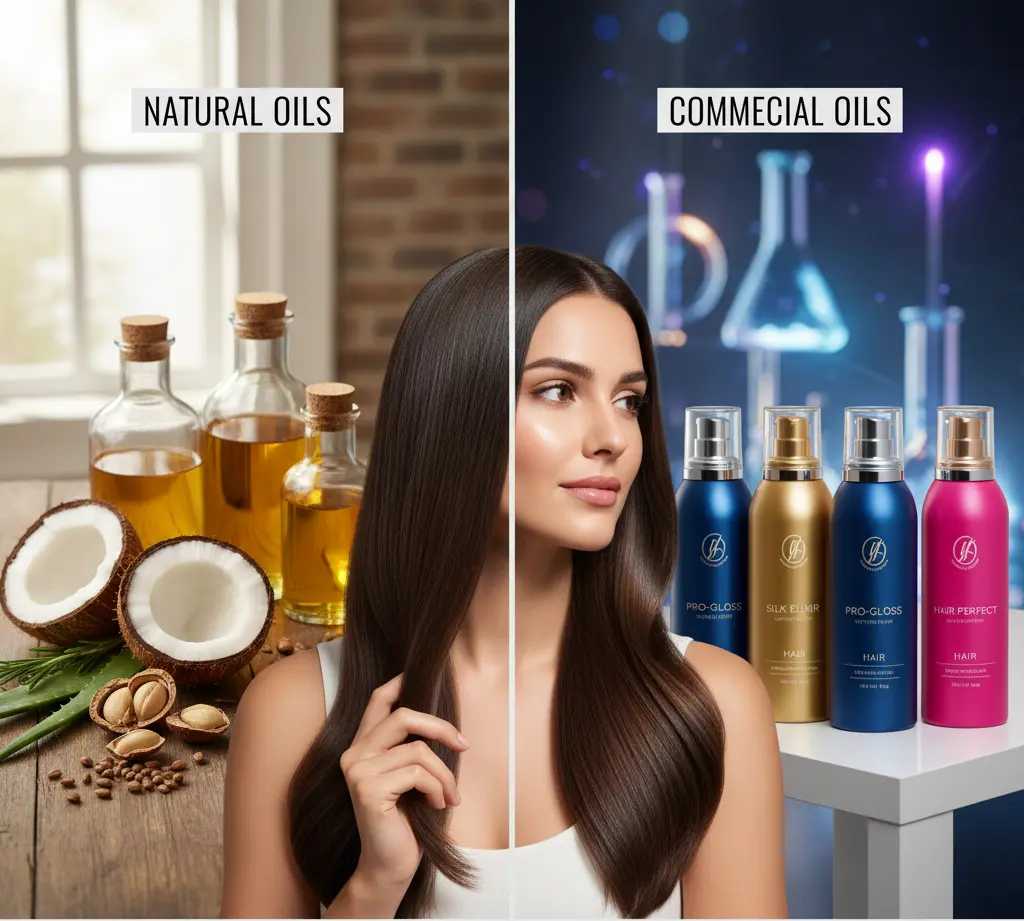
What Separates Natural Oils from Commercial Formulas
To compare the two, it’s good to know what each of them is.
Natural Hair Oils
Natural oils are fats that are extracted from seeds, kernels, fruits, and nuts. Coconut oil is made from the flesh of the coconut. It comes from the kernels of a tree that only grows in Morocco. It is obtained from the seeds of Ricinus communis. In their pure, unrefined form, these oils contain naturally occurring fatty acids, antioxidants, and vitamins that interact directly with your hair and scalp.
Some natural oils actually penetrate the hair, explains research published in the International Journal of Trichology. For example, coconut oil has a low molecular weight, which helps it to penetrate the hair shaft and reduce protein loss. Castor oil contains ricinoleic acid, which is moisturizing and can be anti-inflammatory to the scalp. Sesame oil has shown antioxidant activity and can penetrate the hair follicle due to its high penetration capacity. This is not just marketing speak. They are packed with real chemistry.
Commercial Hair Oils
Commercial hair oils are prepared blends. They typically combine carrier oils with silicones, synthetic fragrance, preservatives, and occasionally active ingredients such as keratin, biotin, or botanical extracts. They are built for consistency, convenience, and instant results.
The reason why commercial hair oil feels silky on your hair the moment you open it is due to the silicone and not the oil. Silicones coat the hair shaft, smooth the surface of the cuticle, and instantly give that polished look. That’s genuinely useful in certain situations. It’s just a different mechanism than what a pure oil would do.”
Breaking Down the Popular Natural Oils
Not all natural oils are appropriate for every hair type. Here’s what the most-used ones are famous for:
- Coconut oil – penetrates the shaft, reduces protein loss, and is best for dry or coarse hair. It might be too heavy for fine or low porosity hair.
- Argan oil – light, moisturizing, great for frizzy, color-treated, or chemically processed hair.
- Castor oil – Thick and viscous, good for scalp massage and spot use on thinning areas. Needs to be mixed or thinned to make it easier to apply.
- Almond oil – Softens, is light enough for everyday use, and has shown some protection against UV-related damage.
- Sesame oil – anti-inflammatory, penetrates deeply, may help with scalp circulation and overall hair growth routines.
- Olive oil is a good emollient and has some antifungal properties, but coconut oil is usually better at sealing in moisture.
Shelf life is the downside of natural oils. Without preservatives, they can go rancid. Quality also varies a lot. Refined coconut oil behaves quite differently from cold-pressed, virgin coconut oil. Always check the processing when purchasing.
What’s Actually Inside Commercial Hair Oils

Turn a commercial hair oil upside down, and you will usually find:
- Dimethicone or cyclopentasiloxane for slip and shine (silicones)
- Mineral oil as a low-cost barrier ingredient
- Great-smelling synthetic fragrance, but can cause sensitivity in some people’s scalp
- Longer shelf-life preservatives
- Natural oil extracts, often in very small amounts, are heavily featured in marketing
That last point is something to think on. Sometimes, the product that says it contains argan oil on the front will have the oil listed as the 14th ingredient. The top of the ingredient list has a lot of meaningful concentration. If buried near the bottom, it’s probably a negligible amount.
Not that this makes commercial oils evil. It simply means you need to know what you are buying and what it is meant to do.
Natural vs Commercial: A Head-to-Head Look
|
Factor |
Natural Oils |
Commercial Hair Oils |
|---|---|---|
|
Penetration |
Some oils penetrate the shaft |
Mostly coat the surface |
|
Ingredients |
Minimal, plant-based |
Multiple, including synthetics |
|
Shelf life |
Shorter, no preservatives |
Longer, stabilized formula |
|
Scalp sensitivity |
Generally gentler |
Fragrance and additives can irritate |
|
Buildup risk |
Lower with proper rinsing |
Higher, especially with silicones |
|
Instant results |
Gradual |
Usually immediate |
|
Cost |
Varies; pure oils can be expensive |
Wide range of price points |
Which One Is Right for You
If you go for natural oils:
- Have a sensitive or easily reactive scalp
- Prefer to know precisely what you are putting on your hair and skin
- Need deep, long-lasting moisture if dry, coarse, or high-porosity hair
- Working on a healthy hair growth routine with scalp massage
- Want to stay away from fragrance and silicones
Lean toward commercial hair oils if you:
- Use heat styling tools often and require thermal protection
- Need instant frizz control or shine before an event?
- Have coarse, low-porosity hair that gets weighed down by heavy oils
- Want a product that’s travel-friendly and uniform without the guesswork
- Looking for something easy to apply and fast-absorbing.
Most people do best with both of them. A natural oil for pre-wash scalp treatment or deep conditioning mask, and a light commercial oil to use as a finishing product after styling.
Common Mistakes to Avoid
Using the wrong oil for your porosity
The porosity of your hair determines how well your strands absorb moisture. Low porosity hair has tightly bound cuticles and doesn’t easily absorb thick oils. Low-porosity hair can get stiff and clogged up when you use coconut oil. Lighter oils like argan or almond oil are much better for low porosity hair.
Applying oil directly to the scalp when you have oiliness or dandruff
If your scalp is already producing too much sebum, adding oil on top can trap dead skin cells and increase the buildup. Heavy oil applications to the lengths and ends, not the roots.
Expecting oils to regrow hair
This is one of the biggest myths surrounding hair oiling. Oils can help add shine, softness, reduce breakage, and create a healthy scalp environment. They don’t promise to regrow hair. If you’re dealing with major shedding, patchiness, or visible thinning, those are signs to see a dermatologist, not try another oil. The American Academy of Dermatology recommends that if you have ongoing scalp inflammation, itching, or flaking that does not improve with regular care, you should see a professional.
Assuming fragrance means effectiveness
And just because something smells good doesn’t mean it’s working harder. One of the most frequent triggers of scalp irritation and contact dermatitis is strong synthetic fragrance. If you experience an itchy or tight scalp after using a product, fragrance is often to blame.
Skipping patch tests
Whether it’s a pure natural oil or a new commercial formula, patch test before you go all over your scalp. Put a small dab on your inner wrist or behind your ear and wait 24 hours. “It’s easier to handle reactions when they’re caught early.
Expert Tips for Better Results
Oil weight should match hair type.
Fine hair needs feather-light oils. Thick, coarse, or natural hair can handle heavier oils like castor or coconut. If in doubt, go on the lighter side.
Heat to increase natural oil absorption
Low porosity hair absorbs oil better when the cuticle is open. Apply a natural oil and sit underneath a warm towel or hooded dryer for 20 to 30 minutes and rinse.
regularly clear up
Both heavy natural oils and silicone-based commercial products can build up over time. Use a clarifying shampoo once or twice a month to help keep the scalp clean and free of product buildup that can block moisture.
Identify your specific scalp problem.
Good for dryness are nourishing natural oils. Dandruff may require an antifungal shampoo before oils are used. Scalp conditions like seborrheic dermatitis usually require specific medical treatment, not just oil application.
Use oil as a system, not a one-time thing.
Oils work best when used as part of a complete hair care regimen that includes a good moisturizing shampoo, conditioner, and protective styling practices.
Frequently Asked Questions
1. Can natural and commercial hair oils be mixed?
Yes, and a lot of them do. Use a commercial oil as a styling finisher, and a natural oil for scalp treatments or pre-wash conditioning. Avoid layering too many heavy products so you don’t end up with buildup.
2. Which oil is best for the growth of hair?
No single oil has been clinically proven to consistently grow new hair. There are many oils that are said to promote scalp circulation and reduce breakage, including castor oil and sesame oil, but no two heads of hair are the same, and results are not guaranteed. If you keep losing hair, you should see a dermatologist.
3. Is coconut oil good for all hair types?
No. Coconut oil is great for dry, damaged, or high porosity hair. It may be too heavy for fine or low-porosity hair, leaving it greasy or stiff. Know your porosity before you commit.
4. How often should I put oil on my scalp?
A good start is once or twice weekly. If you have an oily scalp, apply oil only on the lengths and ends. If your hair is super dry or damaged, you might want to do it more often.
5. Is commercial hair oil ever better than natural?
Yes, for some uses. If you flat-iron or blow-dry regularly, a commercial oil with heat protection is more effective for that purpose than a natural oil. The thermal barrier is not the same as natural oils.
6. Oils instead of conditioner?
Not so much. Conditioners have proteins, humectants, and conditioning agents that oils do not have. Oils work best with a conditioner, not on their own.
7. What happens if an oil irritates my scalp?
“Stop using it immediately. Wash with a gentle sulfate-free shampoo and observe the reaction. If there is significant irritation, swelling, or itching that lasts more than a day or two, see a dermatologist before doing anything else.
8. Are natural oils good for colour-treated hair?
Natural oils that are light, such as argan oil, are typically safe for hair that has been colored and can assist in maintaining shine and minimizing frizz. Avoid heavy oils that require vigorous shampooing to remove, as excessive harsh washing can cause color to fade faster.
The Honest Answer
Natural oils are no better than commercial hair oils and vice versa. They have different uses, and the best one for you totally depends on your hair type, your scalp condition, porosity, and what you are trying to improve.
Natural oils contain fewer ingredients, the interaction with the hair structure is deeper, and real dermatological studies back up their use. Commercial oils are instant, have a longer shelf life, and provide better thermal protection for heat styling.
For most people, a combination of both is the most effective approach. Before washing, apply a natural oil to feed your scalp and strands. Finishing and protection: After styling, use a light commercial oil.
Begin with a problem you want to solve. Pick an oil that works on it. Be consistent and clarify when needed. Manage your expectations. Oils are good for hair. They don’t do miracles. But used right, they really do make a visible difference.