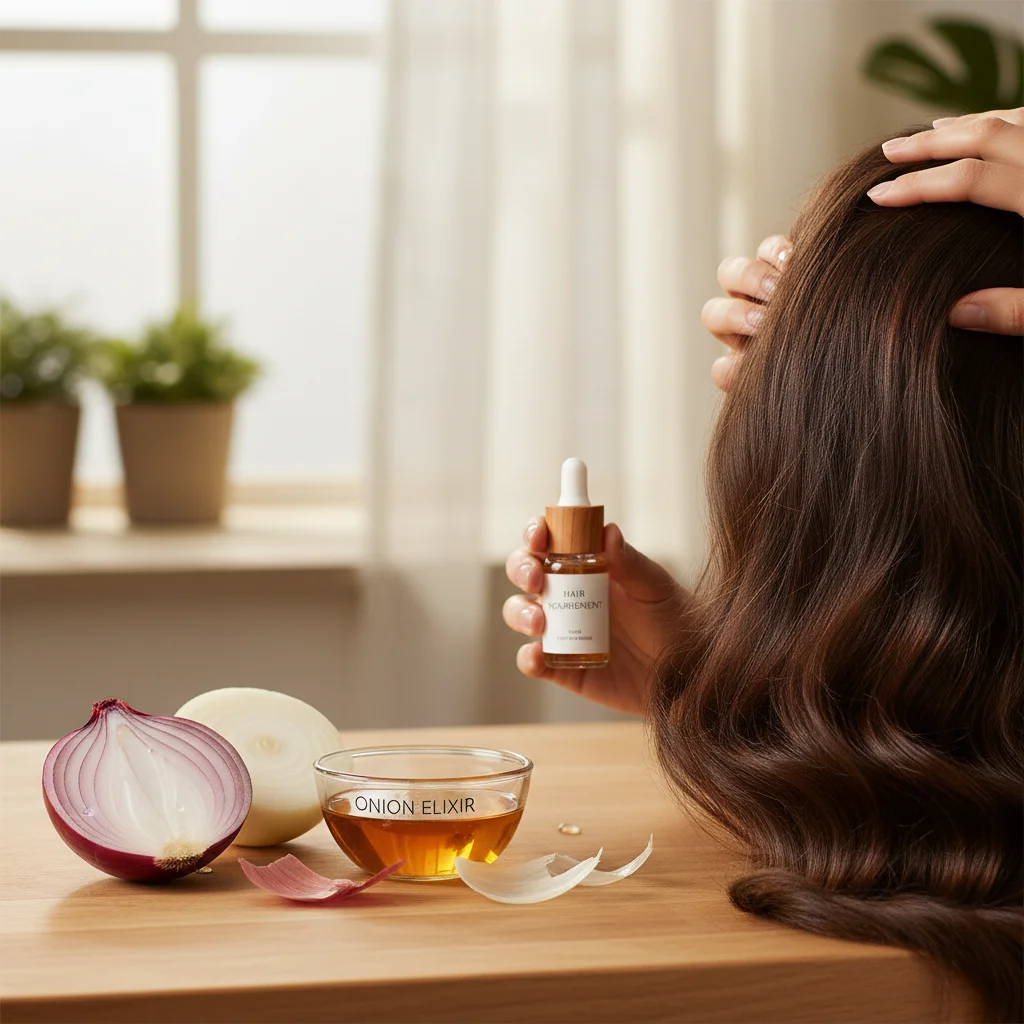
In any natural hair care community online, you will eventually come across someone extolling the virtues of onion juice. They will tell you it stopped their shedding, thickened their hair, or grew hair where they had given up.
Is there any reality behind it? Well, this is the honest question this article is here to answer.
After five-plus years of reading hair loss research and separating what stands up from what doesn’t, I can tell you this: onion is one of those remedies where the truth is a bit more nuanced than the hype suggests. There is real biological science behind why this could be a good thing for your scalp. And there’s a lot of overpromising that’s way beyond what the limited research actually supports.
Here is what this guide covers:
- Why onion can be beneficial for hair health
- What science really found (And what it didn’t)
- Safe, effective methods of applying onion juice at home
- Who it may help – and who should definitely steer clear
- Realistic expectations: When to see a doctor
Let’s work through this carefully.
What Makes Onion Popular in Natural Hair Care?
Long history in home beauty routines
Home beauty and health practices have used preparations based on onions for centuries. Long before serums and growth sprays lined the shelves of drugstores, many homes kept onions as a go-to for scalp care.
Why is this tradition kept up? Some of it is cultural. People have a lot of trust in natural remedies passed down in families. Some of it is practical – onions are cheap, readily available, and there’s no prescription barrier. And part of it is the same reason anyone turns to their kitchen when they’re frustrated: they want to do something, and this feels like a place to start.
Social media has amplified the modern wave of interest. DIY hair mask videos get millions of views and before-and-after photos go viral. That’s where onion juice fits in so well. It sounds dramatic, costs almost nothing, and has enough of a backstory to feel credible.
Why people drink onion juice
When people make the decision to try onion juice on their hair, they’re typically looking for at least one of the following to occur:
- Less hair loss in the shower or on the brush
- A calmer, healthier scalp
- Thicker, fuller-looking hair over time
- Stronger, less brittle strands
- Shinier, Softer Feel
These are all valid goals. But the question is: Are the promises being fulfilled by onion juice?
Is Onion Good for Hair? Understanding the Science

What’s actually inside an onion
But before we get into the findings of the study, it’s good to understand what happens chemically when you put onion juice on your scalp.
Organosulfur compounds. Onions are among the best sources of the sulfur-containing compounds thiosulfinates and quercetin glycosides in the diet. Sulphur is a major structural component of keratin, the protein that comprises your hair. Without enough sulphur, keratin bonds weaken. This link to sulphur is part of the argument for onion juice. But note that topically applied sulphur compounds are not the same as those ingested or synthesised internally, and it’s not fully clear how much actually makes it through the skin to the follicles.
Quercetin and other flavonoid compounds. “Onions are one of the most studied foods for quercetin content. A review published in Nutrients (Mlcek et al., 2016) states that quercetin is a plant antioxidant that has been studied for its anti-inflammatory and antimicrobial properties in laboratory settings. Oxidative stress has been implicated in some types of hair follicle damage, and antioxidant properties are biologically relevant; however, much remains to be understood regarding the topical delivery of quercetin to hair follicles.
Vitamin C. Onions provide small amounts of vitamin C, which helps in collagen synthesis and acts as an antioxidant in skin tissue. The NIH Office of Dietary Supplements attests to vitamin C’s function in collagen synthesis, which is pertinent to the scalp’s skin integrity. Small doses are applied topically, but the whole nutritional context is crucial.
Antimicrobial agents. Onion extracts have been shown to exhibit antibacterial activity against certain bacteria and fungi in earlier research. If there is too much microbial activity on your scalp (causing dandruff or irritation, for instance), then better hygiene may be part of the solution. Here, the natural compounds in onion may play a small supportive role.
The Key Study on Onion Juice and Hair Regrowth
In the case of onion juice for hair, one study is almost always cited. A 2002 study by Sharquie and Al-Obaidi in the Journal of Dermatology examined the effects of onion juice on patients suffering from alopecia areata, a particular autoimmune disease in which the immune system targets hair follicles, resulting in patchy hair loss. This is different from normal diffuse shedding or androgenetic (pattern) hair loss;
The trial showed that 86.9% of subjects who applied crude onion juice to their scalp twice daily for six weeks had some hair regrowth compared to 13% of the tap water control group.
That is a significant difference. But before drawing sweeping conclusions, let’s look at the context:
- Small sample size: Only 38 individuals completed the study. You can’t extrapolate results from studies this small to a larger population.
- Specific condition: Alopecia areata. Many irritant and contact treatments work for this condition — sometimes immune-mediated regrowth can be induced by controlled irritation in this condition. It is not the same mechanism as, for example, pattern baldness.
- No comparison to standard treatments: The study did not compare onion juice with minoxidil, corticosteroids or other proven alopecia areata treatments.
- No replication at scale: In the two-plus decades since then, no large randomised controlled trial has replicated these findings.
So what does this mean in practice? Onion juice has not been proven to work for common thinning hair, pattern baldness, or hair loss due to nutritional deficiencies or hormonal changes in the body. There is a lack of evidence base. That doesn’t mean it’s worthless – it means expectations need to be adjusted to the actual evidence.
Does Onion Juice Regrow Hair? A Realistic Summary
|
Question |
What the Evidence Shows |
|---|---|
|
Can onion juice help with alopecia areata? |
One small study suggests it may, but evidence is limited |
|
Does onion juice regrow hair in pattern baldness? |
No evidence supports this |
|
Can onion juice support general scalp health? |
Plausible, based on its antimicrobial and antioxidant properties |
|
Is onion juice as effective as proven treatments? |
No head-to-head comparison data exists |
|
Should you rely on it as your only hair loss treatment? |
No — medical causes require medical evaluation |
Potential Benefits of Onion for Hair
These are benefits that are plausible and have a reasonable basis in what science tells us:
1. May Improve Scalp Health
This is probably the best and most defensible argument for onion juice. Good hair begins with a clean, balanced scalp. The American Academy of Dermatology states that conditions affecting the scalp, such as seborrhoeic dermatitis and dandruff, might affect the environment in which hair grows. Onion might not grow your hair directly, but if the antimicrobial and antioxidant compounds in onion can help reduce scalp irritation or microbial imbalance for some people, then it is a meaningful benefit.
2. Could help create better conditions for hair growth
Scalp massage is an underused tool for hair care. A small study in 2016 in ePlasty (Koyama et al.) showed that standardised scalp massage improved hair thickness in nine healthy men over 24 weeks, due to mechanical stimulation of dermal papilla cells. Onion juice also involves scalp massage — and maybe that massage is doing a lot of the work all on its own, with or without the onion.
3. May Decrease Hair Breakage in Certain Situations
Biologically, sulphur is present in the structure of keratin. A healthy scalp environment and well-treated hair break less. The larger regimen — gentle handling, no harsh chemicals, regular scalp care — may not actually get meaningful sulphur into the cortex of the hair shaft, but can improve the behaviour of hair over time with topical onion juice.
4. Can provide temporary shine and softness
The texture has been reported by some to be improved by regular onion-based masks, particularly when combined with moisturising ingredients like coconut oil or honey. This is probably more of a cosmetic change than a structural one, but better texture and look are real quality-of-life benefits.
How to Use Onion Juice for Hair
Step-by-Step: Basic Onion Juice Treatment
This is an easy approach. You don’t need anything fancy!
- Pick your onion. You can use yellow or red onions. According to USDA nutritional data, red onions have a slightly greater quercetin content.
- Peel and clean the onion well.
- Finely chop or grate the onion until it becomes a pulp.
- Use cheesecloth or a colander with fine mesh to filter the juice. Extract as much liquid as you can.
- Using a cotton ball, dropper, or your fingertips, apply directly to your scalp. Focus on the scalp, not the lengths.
- Massage gently for 2-3 minutes to aid absorption and blood flow.
- Let stand for 15 to 30 minutes. Do not exceed one hour, particularly on first use.
- Wash with a mild sulfate-free shampoo after thoroughly rinsing with cool or lukewarm water.
Either add a few drops of peppermint or lavender essential oil to the juice before applying, or rinse with diluted apple cider vinegar after shampooing to lessen odour.
Three Onion Juice Hair Mask Recipes
Coconut Oil and Onion Juice:
Best for: Dry, damaged, or color-treated hair.
According to research published in peer-reviewed publications, coconut oil lowers hair protein loss more effectively than mineral oil or sunflower oil because it can permeate the hair shaft (Rele & Mohile, Journal of Cosmetic Science, 2003). To create a mask that is easier to apply, gentler on the scalp, and better for dry hair, mix equal parts coconut oil and onion juice.
Apply, leave on for 20-25 minutes, rinse thoroughly.
Aloe Vera Gel + Onion Juice
Best for: Sensitive, irritated, or flaky scalps.
Aloe vera gel has been shown to have soothing and moisturising properties in the skin literature. The anti-inflammatory compounds of aloe vera and its role in supporting the skin barrier are discussed in a 2009 review in the Indian Journal of Dermatology (Surjushe et al). Add two parts fresh aloe gel to one part onion juice for a milder, cooling application that tempers the astringency of the onion.
Leave on for 20 minutes and rinse well.
Onion Juice + Honey
Best for: dull hair or those who want super soft hair.
As a natural humectant, honey pulls moisture into your skin and hair from the surrounding air. It has a mild antimicrobial effect too. MCombine two tablespoons of onion juice with one teaspoon of raw honey. This mask does a good job of adding shine and manageability without feeling too heavy.
Apply for 20 minutes, wash, and gently shampoo.
How Often Should You Use Onion Juice on Hair?
Frequency is key. More is not better, and this is one area where people often go wrong.
Week 1-2: Every week. Check your scalp reaction after each use for 48 hours.
Week 3 and beyond: You may try twice weekly if you’d like, if you’re not irritated. For most people, even once or twice a week is fine.
Use daily: Not advisable. Daily application increases the risk of contact dermatitis and scalp dryness without proportionate benefit.
If your scalp is sore, dry, tight, or itchy after use, reduce frequency or stop altogether. The best advice to get is what your scalp tells you. If you want to know what your scalp thinks, ask it.
Side Effects and Safety Considerations
Onion juice is a potent acidic substance.
Even people who can tolerate it initially can react to it over time. Common side effects are:
- Scalp irritation and stinging, especially with initial use
- Contact dermatitis (redness, rash, swelling)
- Dryness or increased scaling of the scalp
- Persistent or hard-to-remove odour
- Eye irritation if juice contacts them
Who Should Not Go for Onion Juice Treatment
If you are any of the following, do not use onion juice treatments:
- Are allergic to onions, garlic, leeks, or other Allium vegetables
- Have an active scalp injury, open wound, or sunburn.
- Have eczema, psoriasis, or seborrhoeic dermatitis in an active flare — onion can exacerbate inflammation in already irritated tissue.
- Are using medicated scalp treatments without consulting your doctor (interactions have not been formally studied)
- Have had contact dermatitis or allergic reactions to plant extracts in the past
How to do a patch test the right way
This is a must, especially the first time you use it.
- Put a tiny bit of diluted onion juice behind the ear or within the forearm.
- Cover loosely, leave for 24 hours, and do not wash.
- Watch for redness, itching, raised skin, or swelling.
- If you notice any reaction, do not use onion juice on your scalp.
- If there is no reaction after 24 hours, apply to a small section of the scalp and leave for 24 hours before applying more generally.
When to See a Dermatologist
In a self-care regimen, natural remedies like onion juice can be used, but this doesn’t replace medical evaluation. See a board-certified dermatologist if:
- You’re losing hair in patches or strange patterns.
- Your shedding is rapid, heavy, or increasing.
- You have scalp pain, burning, lots of flaking, or visible scaling.
- You have other systemic symptoms along with hair loss, such as fatigue, weight changes, etc.
- You’ve been using home remedies regularly without improvement for three to six months.
Numerous conditions, such as androgenetic alopecia, telogen effluvium, thyroid issues, low iron, hormone issues, and autoimmune diseases, can result in hair loss. The American Academy of Dermatology has a nice overview of the most common causes. Only the right diagnosis will lead to the right treatment.
Onion Juice vs. Other Natural Hair Remedies

If you’re exploring natural options, it helps to understand how each one differs in terms of evidence, usage, and who it suits best.
|
Natural Remedy |
Strongest Claim |
Evidence Level |
Best For |
Cautions |
|---|---|---|---|---|
|
Onion juice |
Scalp antimicrobial support; one small study in alopecia areata |
Low to moderate |
Mild scalp issues; alopecia areata (with caution) |
Strong smell; irritation risk |
|
Rosemary oil |
Hair growth comparable to minoxidil 2% in one RCT |
Moderate (Panahi et al., 2015) |
Pattern hair loss; general thinning |
Dilute before use; patch test required |
|
Coconut oil |
Reduces hair protein loss; protects against breakage |
Moderate (lab + clinical) (Rele & Mohile, 2003) |
Dry, brittle, or damaged hair |
Not ideal for fine hair prone to buildup |
|
Aloe vera |
Soothing, moisturizing scalp care |
Low to moderate |
Scalp sensitivity, dryness, dandruff |
Generally well tolerated |
|
Fenugreek |
Traditional remedy for strengthening |
Very low |
Traditional care preference |
Limited clinical evidence; allergy possible |
Rosemary oil deserves special mention as there is more evidence to support it than there is for onion. According to a 2015 randomised controlled experiment published in SKINmed, rosemary oil increased hair count at six months just as well as minoxidil 2%, but it caused less scalp irritation. This isn’t to say that rosemary oil is a proven hair loss treatment, but the trial was better designed than the onion juice study.
Common Myths About Onion for Hair
Myth 1: Onion Juice for Faster Hair Growth
Fact: The speed of human scalp hair growth is approximately 1/2 inch (1.25 cm) per month and is predominantly determined by genetic factors, hormonal milieu, and nutritional status, not by any topical remedy. As the AAD’s overview of hair growth explains, no topical product has been proven to permanently increase hair growth rate. Onion juice cannot change your biology.
Myth 2 – More Onion Juice Application Means Better Results
Reality: The longer it’s in contact, the higher the chance of irritation and the less impact. The 2002 Sharquie trial used 30-minute applications twice a day — not overnight treatments. Leaving onion juice on overnight can cause significant scalp dryness, contact dermatitis, and discomfort, especially in people with sensitive skin.
Myth 3: Onion juice is as effective as prescription medications
Reality: There are FDA-approved treatments for hair loss that have been studied in large controlled trials, including topical minoxidil and oral finasteride, and have known efficacy and safety profiles. One small study in one specific condition for onion juice. They are not the same, and onion juice should not be used as a substitute for medically indicated therapy.
Myth 4: Red Onion is Far Superior to Yellow Onion For Hair
Reality: Some analyses do show red onions having slightly higher quercetin, but the practical difference for a topical scalp application is not going to be significant. Both of these types give similar sulfur-containing compounds. Whatever you got, choose accordingly.
Myth 5: Onion Juice Is Effective for ALL Kinds of Hair Loss
Reality: Hair loss isn’t one thing; it’s many things. Androgenetic alopecia (pattern baldness), telogen effluvium (shedding due to stress or nutrition), alopecia areata (autoimmune), and traction alopecia (mechanical damage) are all different in aetiology and require different approaches. Onion juice has evidence only in alopecia areata, and only a single small study.
Tips for Better Results From Natural Hair Remedies

Onion juice, rosemary oil, scalp massage – none of them work on their own. The habits that most reliably support hair health are less dramatic but more consistent:
Nutrition: Protein is the building block of hair. The AAD recommends ruling out nutritional deficiencies before moving to therapies. Research links iron deficiency, vitamin D deficiency, and low ferritin levels with hair shedding. Eat enough protein, leafy greens, eggs, legumes, and fatty fish.
Hydration: Sufficient hydration of scalp tissue is needed for normal function. Chronic dehydration disrupts skin barrier function.
Heat styling: Cleveland Clinic dermatologists recommend against frequent high-heat styling that damages the hair cuticle, resulting in more breakage as time passes.
Gentle products: Sulfate-free shampoos and conditioners help to preserve the scalp’s natural moisture barrier, especially if you have dry or color-treated hair.
Scalp massage: As mentioned in the above Koyama et al. study, regular massage may stimulate hair thickness by mechanical irritation. The research employed a protocol of 4 minutes a day.
Stress management: Telogen effluvium is a type of temporary but significant hair shedding that can be triggered by acute and chronic stress. Severe emotional stress is known to cause hair loss, the Mayo Clinic says.
Evidence Summary: Onion for Hair at a Glance
|
Claim |
Evidence Status |
|---|---|
|
Onion contains sulfur relevant to keratin structure |
Supported (basic biology) |
|
Onion contains antioxidants with anti-inflammatory properties |
Supported (laboratory and nutrition studies) |
|
Onion juice may help regrowth in alopecia areata |
Suggested by one small 2002 trial — limited and not replicated |
|
Onion juice treats pattern baldness |
No supporting evidence |
|
Onion juice supports scalp health |
Plausible, not formally proven |
|
Onion juice is as effective as minoxidil |
Not established |
|
Onion juice causes no side effects |
False — irritation, contact dermatitis, and odor are common |
Frequently Asked Questions
Does onion juice promote hair growth?
In a small trial, twice-daily application helped some people with alopecia areata to regrow hair. There is no good evidence it works for everyday hair thinning or pattern baldness. This can be beneficial for scalp health conditions that impact the hair environment, but it is not a growth treatment on its own.
How long does onion juice stay good?
Results were seen after six weeks of consistent twice-daily use in the 2002 study. But that was in a special case (alopecia areata). Most people will have to use natural remedies for general scalp support consistently for three to six months before they notice any visible change—if any. This is an issue of patience and realistic expectations.
Yes, you can put onion juice on hair overnight.
Do not use it overnight, especially if you are new to it. When left on the scalp for too long, the concentrated acidic components in onion juice can cause extreme dryness and irritation. Fifteen to thirty minutes is more than enough, and that is what the research used.
Does onion juice help prevent hair fall?
If your shedding is related to scalp problems where the antimicrobial or antioxidant properties of onion may help, then it may help. However, hair loss due to hormonal changes, nutritional deficiencies, thyroid disorders, or genetics requires proper diagnosis and targeted treatment. There is no evidence that onion juice reduces androgenetic hair loss.
Can onion juice hurt your hair or scalp?
Onion juice is highly unlikely to cause any structural damage to the hair strands but can definitely irritate the scalp if used in excess or if you are sensitive to it. It’s a known skin reaction called onion dermatitis. Patch testing and moderate frequency greatly reduce this risk.
Onion juice is safe for kids’ hair.
Children’s scalps are more delicate than those of adults. There are no clinical studies of onion juice use in paediatric populations. If you are thinking of using a natural scalp remedy on a child, always check with your paediatrician or paediatric dermatologist first. Strongly concentrated DIY treatments are generally not advisable for young children.
Expert Tips for a Gentle, Family-Friendly Hair Care Routine
If your family is into natural hair care, here’s how to keep it safe for everyone:
- Always dilute strong ingredients – onion juice, tea tree oil, and essential oils should never be applied undiluted to children’s scalps
- Choose the mildest option available for children and keep contact time to a maximum of ten to fifteen minutes
- Don’t layer harsh ingredients – mixing onion juice with lemon, garlic, or vinegar creates a more aggressive, higher acid mix with more potential to irritate.
- Basic care is the focus: age-appropriate gentle shampoo, adequate moisture, protective styling, and balanced nutrition do so much more for children’s hair in the long run than any remedy
- Never skip the patch test – for any family member, at any age
Final Verdict: Is Onion Good for Hair?
Here is the real summary.
Onion juice is a cheap, easily available natural remedy with a reasonable biological rationale and one small study in support of its use for one type of hair loss. There could be some minor real benefits to some people in terms of overall scalp health and as part of a bigger hair care regimen.
It is not a tried-and-true method for hair growth. doesn’t treat pattern baldness. Especially if used too often, it may irritate the scalp. It should never take the place of a medical evaluation if your hair loss is severe or getting worse.
The most evidence-based way to maintain hair health is proper nutrition, stress control, gentle, consistent scalp care, and working with a dermatologist to identify and treat the actual cause of your hair loss when needed. That can have a small supporting role in that. No more, no less.
Want more? Check out our evidence-checked guides on scalp care, proven hair growth ingredients, and natural remedy comparisons at Hair Care Growth. We are writing for real people who want accurate information, not disguised product pitches posing as advice.
Have you ever tried onion juice for your hair? What did you see then? Leave your experience in the comments — honest experiences from real people are more useful to this community than any single study.
Medical Disclaimer: This article should not be interpreted as medical advice; rather, it is intended for general informational purposes only. There are many different causes of scalp diseases and hair loss, some of which require a professional diagnosis and treatment plan. It’s important to consult a board-certified dermatologist or other trained healthcare professional before starting any new hair treatment, especially if you have a history of scalp problems, allergies, or notable hair loss.